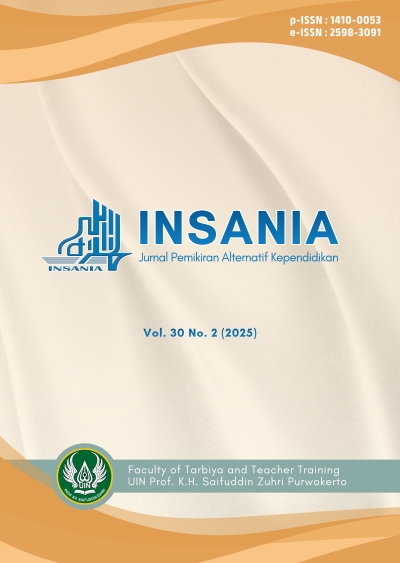
AI-Based Learning Management Strategy to Enhance Numeracy Literacy Skills in Alignment with SDG 4
DOI:
https://doi.org/10.24090/insania.v30i2.14162Keywords:
Artificial Intelligence, era Society 5.0, numeracy literacy, AI-based learning, learning management strategiesAbstract
This study aims to explore and analyze the effectiveness of Artificial Intelligence (AI)-based learning management strategies in improving numeracy literacy skills of Elementary School Teacher Education (PGSD) students in the era of society 5.0. Using a mixed-method approach, data were collected through in-depth interviews, classroom observations, and quantitative tests. Interviews involved lecturers, students, and educational technology experts to explore implementation strategies and challenges of AI integration, while observations were conducted to observe the learning process. Quantitatively, the study used a quasi-experimental design by comparing the pre-test and post-test results between the experimental group (using AI) and the control group (conventional learning), each consisting of 32 students. Qualitative results show that AI-based learning management strategies are carried out systematically through needs mapping, selecting appropriate applications (such as GeoGebra AI and ChatGPT), and automatic monitoring of learning outcomes. AI encourages students to be more independent and interactive, although they still face technical constraints such as limited devices and internet networks. Quantitative results show a significant increase in the numeracy literacy skills of students in the experimental group compared to the control group, with the results of the independent sample t-test showing a significance value of 0.000 <0.05 and an average score difference of 10.11 points. These findings demonstrate that AI-based learning strategies are effective in strengthening students’ numeracy literacy and align with the principles of Sustainable Development Goal 4 (Quality Education). Therefore, AI integration in higher education is highly relevant for advancing sustainable educational practices and preparing future educators to meet the demands of Society 5.0.Downloads
References
Afrina, C., Zulaikha, S. R., & Jumila. (2024). The Low Level of Digital Literacy in Indonesia: An Analysis of Online Media Content. Record and Library Journal, 10(2), 374–387. https://doi.org/10.20473/rlj.V10-I2.2024.374-387
Calp, M. H., & Bütüner, R. (2022). Society 5.0: Effective technology for a smart society. In Aboul Ella Hassanien, Jyotir Moy Chatterjee, Vishal Jain (Eds), Artificial Intelligence and Industry 4.0 (pp. 175-194), Academic Press. https://doi.org/10.1016/B978-0-323-88468-6.00006-1
Deda, Y. N., Disnawati, H., & Daniel, O. (2023). How Important of Students’ Literacy and Numeracy Skills in Facing 21st-Century Challenges: A Systematic Literature Review. Indonesian Journal of Educational Research and Review, 6(3), 563–572. https://doi.org/10.23887/ijerr.v6i3.62206
Edison, G. (2023). Transforming Medical Decision-Making: A Comprehensive Review of AI’s Impact on Diagnostics And Treatment. BULLET : Jurnal Multidisiplin Ilmu, 2(4), 1121–1133. https://journal.mediapublikasi.id/index.php/bullet/article/view/3490
Gligorea, I., Cioca, M., Oancea, R., Gorski, A. T., Gorski, H., & Tudorache, P. (2023). Adaptive Learning Using Artificial Intelligence in e-Learning: A Literature Review. Education Sciences, 13(12), 1-27. https://doi.org/10.3390/educsci13121216
Helmiatin, Hidayat, A., & Kahar, M. R. (2024). Investigating the adoption of AI in higher education: a study of public universities in Indonesia. Cogent Education, 11(1), 1-15. https://doi.org/10.1080/2331186X.2024.2380175
Lisnasari, S. F. (2025). Scientific-Based Numeracy Literacy Teaching Materials in Learning Management : Student Motivation and Higher Thinking Skills. Jurnal Eduscience (JES), 12(3), 738–752. https://doi.org/10.36987/jes.v12i3.7122
López-Regalado, O., Núñez-Rojas, N., Rafael López-Gil, O., & Sánchez-Rodríguez, J. (2024). Articial intelligence in university education: Systematic review. Research Square, 5(84), 1-30. https://doi.org/10.21203/rs.3.rs-3830323/v1
Malik, S. A. (2017). Revisiting and re-representing scaffolding: The two gradient model. Cogent Education, 4(1), 1-13. https://doi.org/10.1080/2331186X.2017.1331533
Ng, D. T. K., Leung, J. K. L., Su, J., Ng, R. C. W., & Chu, S. K. W. (2023). Teachers’ AI digital competencies and twenty-first century skills in the post-pandemic world. Educational Technology Research and Development, 71(1), 137–161. https://doi.org/10.1007/s11423-023-10203-6
Ningtyas, P. D. A., & Haris, I. (2024). The Impact of Utilizing Artificial Intelligence In Independent Curriculum-Based Learning. International Journal of Multidiscplinary Sciences, 2(4), 426–439. https://doi.org/10.37329/ijms.v2i4.3732
OECD. (2023). Pisa 2022 Results. In Factsheets: Vol. I. https://www.oecd-ilibrary.org/education/pisa-2022-results-volume-i_53f23881-en%0Ahttps://www.oecd.org/publication/pisa-2022-results/country-notes/germany-1a2cf137/
Pepin, B., Buchholtz, N., & Salinas, U. (2025). A Scoping Survey of ChatGPT in Mathematics Education. Digital Experiences in Mathematics Education, 11, 9-41. https://doi.org/10.1007/s40751-025-00172-1
Rusmin, L., Misrahayu, Y., Pongpalilu, F., Radiansyah, & Dwiyanto. (2024). Critical Thinking and Problem- Solving Skills in the 21st Century. Journal of Social Science, 1(5), 144–162. https://doi.org/10.59613/svhy3576
Shetye, S. (2024). An Evaluation of Khanmigo, a Generative AI Tool, as a Computer-Assisted Language Learning App. Studies in Applied Linguistics and TESOL, 24(1), 38–53. https://doi.org/10.52214/salt.v24i1.12869
Southworth, J. (2022). Bridging critical thinking and transformative learning: The role of perspective-taking. Theory and Research in Education, 20(1), 44–63. https://doi.org/10.1177/14778785221090853
Sugiyono. (2018). Metode Penelitian Kuantitatif, Kualitatif, dan R&D. Alfabeta.
Wardat, Y., Tashtoush, M. A., AlAli, R., & Jarrah, A. M. (2023). ChatGPT: A revolutionary tool for teaching and learning mathematics. Eurasia Journal of Mathematics, Science and Technology Education, 19(7), 1-18. https://doi.org/10.29333/ejmste/13272
Yunianto, W., Lavicza, Z., Kastner-Hauler, O., & Houghton, T. (2024). Investigating the use of ChatGPT to solve a GeoGebra based Mathematics+computational thinking task in a geometry topic. Journal on Mathematics Education, 15(3), 1027–1052. https://doi.org/10.22342/jme.v15i3.pp1027-1052
Downloads
Published
How to Cite
Issue
Section
License
Copyright (c) 2025 Srie Faizah Lisnasari, Jainab Jainab, Datten Datten, Pelista Pelista, Mhd. Rafi’i Ma’arif Tarigan, Abu Nizar Bahri Ibrahim

This work is licensed under a Creative Commons Attribution-ShareAlike 4.0 International License.
Authors who publish with this journal agree to the following terms:
Authors retain copyright and grant the journal right of first publication with the work simultaneously licensed under a Creative CommonsAttribution-ShareAlike License that allows others to share the work with an acknowledgment of the work's authorship and initial publication in this journal.
Authors are able to enter into separate, additional contractual arrangements for the non-exclusive distribution of the journal's published version of the work (e.g., post it to an institutional repository or publish it in a book), with an acknowledgment of its initial publication in this journal.
Authors are permitted and encouraged to post their work online (e.g., in institutional repositories or on their website) prior to and during the submission process, as it can lead to productive exchanges, as well as earlier and greater citation of published work (See The Effect of Open Access).