Struktur Kepribadian Nabi Yunus dalam Alqur'an (Pendekatan Psikoanalis Sigmund Freud)
(Pendekatan Psikoanalis Sigmund Freud)
DOI:
https://doi.org/10.24090/jimrf.v10i1.4636Keywords:
Bahasa Dan Al-Qur'anAbstract
The Qur'an is not only seen as an ordinary text, it can also be considered a literary text. So that literary research in the Al-Quran has become commonplace and is often done. The narrative method in the Al-Qur'an is considered the most appropriate method for conveying messages, and Sigmund Frreud's literary psychological theory can perfect the method of conveying messages in stories. Because this theory is in direct contact with the reader's soul, and can reproduce itself through the characters. The purpose of this research is to describe the personality structure of the prophet Yunus in the Al-Qur’an, where the personality structure offered by Freud consist of the id, ego, and superego. The method used in this research is descriptive qualitative, namely by describing the facts as they are. The data collection method is by using note-taking and listening techniques, which are collected based on the Al-Qu'an verse as the main object and the research library as the supporting object. The result of this research is that the personality structure possessed by the Prophet Yunus only consists of the id, ego and the superego, but the most dominant personality possessed by the Prophet Yunus is the Superego, namely how the nature of morality awakens him from the mistakes he has made. This cannot be separated from the ability of Allah's hand, because remembering that the Prophet Yunus was a pious messenger of Allah who was sent to a people. Apart from the personality structure, Prophet Yunus also carried out the ego defense mechanism. Ego defense mechanisms in this study are apathy and sublimation.Downloads
Download data is not yet available.
References
Afify, Muhammad Faiz Al. 2018. “Konsep Fitrah Dalam Psikologi Islam.†TSAQAFAH 14(2): 279–98.
Cholid, Nurviyanti. 2018. “Konsep Kepribadian Al-Ghozali Untuk Mencapai Hasil Konseling Yang Maksimal.†Mawa’izh: Jurnal Dakwah dan Pengembangan Sosial Kemanusiaan 9(1): 55–75.
Departemen Agama RI. 2008. Al-Qur’an Dan Terjemahannya. Jakarta: Youmba Biba Abadi.
Gumiandari, Septi. 2011. “KEPRIBADIAN MANUSIA DALAM PERSPEKTIF PSIKOLOGI ISLAM (Telaah Kritis Atas Psikologi Kepribadian Modern).†Holistik 12(1). https://syekhnurjati.ac.id/jurnal/index.php/holistik/article/view/94 (July 4, 2021).
Istianah, Istianah. 2014. “STILISTIK AL-QUR’AN: Pendekatan Sastra Sebagai Analisis Dalam Menginterpretasikan Al-Qur’an.†Hermeneutik: Jurnal Ilmu Alquran dan Tafsir 8(2). https://journal.iainkudus.ac.id/index.php/Hermeneutik/article/view/898 (July 4, 2021).
Kahfi, Ahmad Ashabul. 2018. “Kisah Nabi Musa Dalam Al-Qur’Än Perspektif Psiko-Sastra | Islamika Inside: Jurnal Keislaman Dan Humaniora.†Islamika Inside: Jurnal Keislaman dan Humaniora 4(2). http://islamikainside.iain-jember.ac.id/index.php/islamikainside/article/view/53 (July 4, 2021).
Luxemburg, Jan Van dkk. 1984. Pengantar Ilmu Sastra. Terjemahan Dick Haroko. Jakarta: Gramedia Pustaka Utama.
Minderop, Albertin. 2011. Psikologi Sastra: Karya Sastra Metode, Teori, Dan Contoh Kasus. Jakarta: Yayasan Pustaka Obor Indonesia.
Rozali, M. 2020. Metodologi Studi Islam Dalam Perspectives Multydisiplin Keilmuan. Depok: PT Rajawali Buana Pusaka.
Semium, Yustinus. 2006. Teori Kepribadian Dan Terapi Psikoanalitik Freud. Yogyakarta: Kanisius.
Shihab, M. Quraish. 2008. Sejarah Dan Ulum Al-Quran. Jakarta: Pustaka Firdaus.
Sjarkawi. 2011. Pembentukan Karakter Anak. Jakarta: PT Bumi Aksara.
Sunarjo, Jakob, and Saini. 1997. Apresiasi Kesusasteraan. Jakarta: Gramedia Pustaka Utama.
Supriadi, Lalu. 2013. “Kritik terhadap Pemikiran Aḥmad Khalâf Allâh tentang Kisah dalam al-Qurân.†ISLAMICA: Jurnal Studi Keislaman 7(2): 294–317.
Walgito, Bimo. 2004. Pengantar Psikologi Umum. Yogyakarta: ANDI
Cholid, Nurviyanti. 2018. “Konsep Kepribadian Al-Ghozali Untuk Mencapai Hasil Konseling Yang Maksimal.†Mawa’izh: Jurnal Dakwah dan Pengembangan Sosial Kemanusiaan 9(1): 55–75.
Departemen Agama RI. 2008. Al-Qur’an Dan Terjemahannya. Jakarta: Youmba Biba Abadi.
Gumiandari, Septi. 2011. “KEPRIBADIAN MANUSIA DALAM PERSPEKTIF PSIKOLOGI ISLAM (Telaah Kritis Atas Psikologi Kepribadian Modern).†Holistik 12(1). https://syekhnurjati.ac.id/jurnal/index.php/holistik/article/view/94 (July 4, 2021).
Istianah, Istianah. 2014. “STILISTIK AL-QUR’AN: Pendekatan Sastra Sebagai Analisis Dalam Menginterpretasikan Al-Qur’an.†Hermeneutik: Jurnal Ilmu Alquran dan Tafsir 8(2). https://journal.iainkudus.ac.id/index.php/Hermeneutik/article/view/898 (July 4, 2021).
Kahfi, Ahmad Ashabul. 2018. “Kisah Nabi Musa Dalam Al-Qur’Än Perspektif Psiko-Sastra | Islamika Inside: Jurnal Keislaman Dan Humaniora.†Islamika Inside: Jurnal Keislaman dan Humaniora 4(2). http://islamikainside.iain-jember.ac.id/index.php/islamikainside/article/view/53 (July 4, 2021).
Luxemburg, Jan Van dkk. 1984. Pengantar Ilmu Sastra. Terjemahan Dick Haroko. Jakarta: Gramedia Pustaka Utama.
Minderop, Albertin. 2011. Psikologi Sastra: Karya Sastra Metode, Teori, Dan Contoh Kasus. Jakarta: Yayasan Pustaka Obor Indonesia.
Rozali, M. 2020. Metodologi Studi Islam Dalam Perspectives Multydisiplin Keilmuan. Depok: PT Rajawali Buana Pusaka.
Semium, Yustinus. 2006. Teori Kepribadian Dan Terapi Psikoanalitik Freud. Yogyakarta: Kanisius.
Shihab, M. Quraish. 2008. Sejarah Dan Ulum Al-Quran. Jakarta: Pustaka Firdaus.
Sjarkawi. 2011. Pembentukan Karakter Anak. Jakarta: PT Bumi Aksara.
Sunarjo, Jakob, and Saini. 1997. Apresiasi Kesusasteraan. Jakarta: Gramedia Pustaka Utama.
Supriadi, Lalu. 2013. “Kritik terhadap Pemikiran Aḥmad Khalâf Allâh tentang Kisah dalam al-Qurân.†ISLAMICA: Jurnal Studi Keislaman 7(2): 294–317.
Walgito, Bimo. 2004. Pengantar Psikologi Umum. Yogyakarta: ANDI
Downloads
Published
2021-07-04
How to Cite
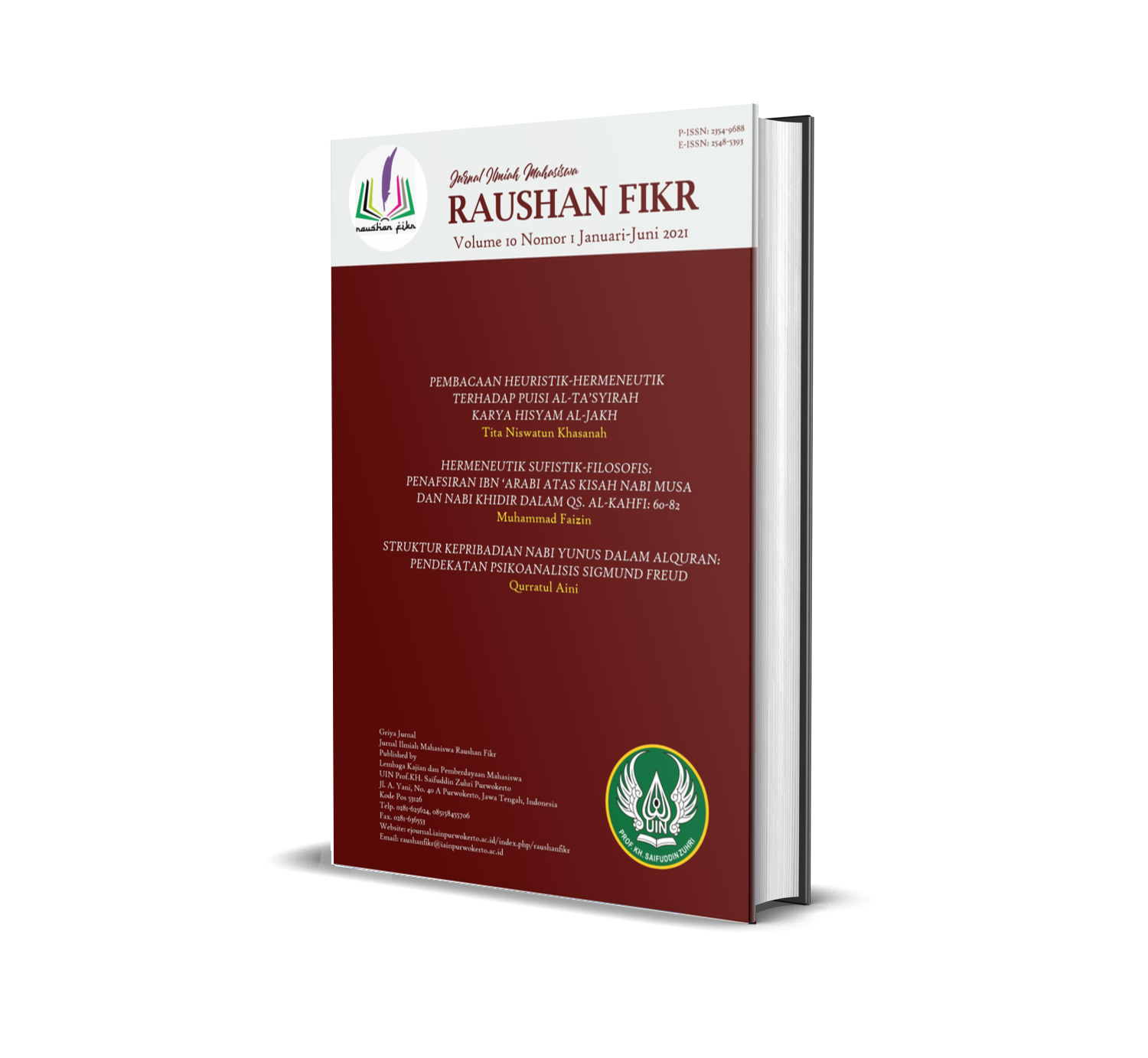
Aini, Q. (2021). Struktur Kepribadian Nabi Yunus dalam Alqur’an (Pendekatan Psikoanalis Sigmund Freud): (Pendekatan Psikoanalis Sigmund Freud). Jurnal Ilmiah Mahasiswa Raushan Fikr, 10(1), 35–45. https://doi.org/10.24090/jimrf.v10i1.4636
Issue
Section
Articles
License
Authors who publish with this journal agree to the following terms:
- Authors retain copyright and grant the journal right of first publication with the work simultaneously licensed under a Creative Commons Attribution-NonCommercial-ShareAlike 4.0 International License that allows others to share the work with an acknowledgement of the work's authorship and initial publication in this journal.
- Authors are able to enter into separate, additional contractual arrangements for the non-exclusive distribution of the journal's published version of the work (e.g., post it to an institutional repository or publish it in a book), with an acknowledgement of its initial publication in this journal.
- Authors are permitted and encouraged to post their work online (e.g., in institutional repositories or on their website) prior to and during the submission process, as it can lead to productive exchanges, as well as earlier and greater citation of published work (See The Effect of Open Access).