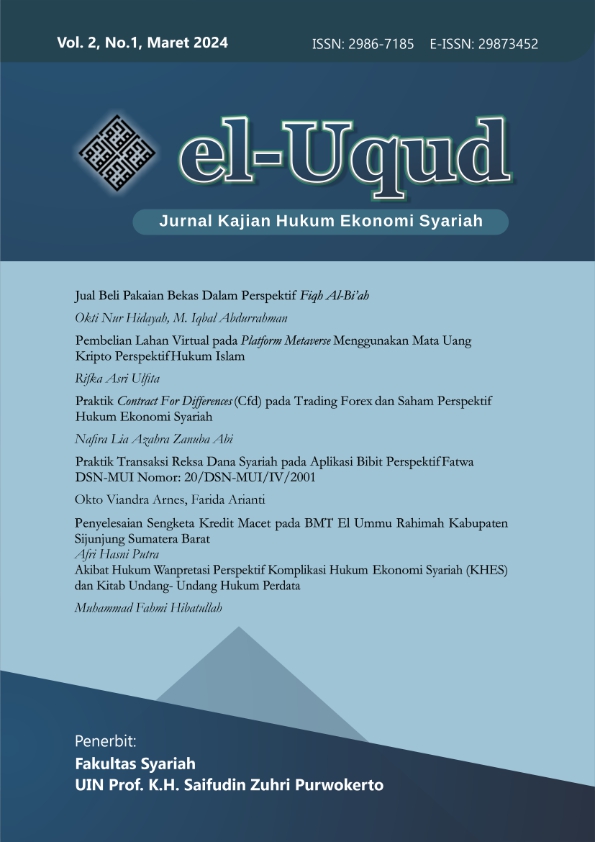
Jual Beli Pakaian Bekas Perspektif Fiqh al-Bi’ah
DOI:
https://doi.org/10.24090/eluqud.v2i1.9512Keywords:
Buying and selling, Secondhand clothing, Fikih al-Bi'ahAbstract
The textile industry has become a strategic sector in Indonesia, but it also ranks as the world's second-largest contributor to pollution. In the current fashion world, there is a trend known as thrifting, which involves buying and selling secondhand clothing. Through the sale of secondhand clothes, no waste is generated from the production of new garments. Islam, as the majority religion embraced by the Indonesian population, has a conceptual framework for addressing environmental issues known as Fikih al-biah. This research will delve into the buying and selling of secondhand clothing from the perspective of Fikih al-bi'ah. The study employs a library research methodology, utilizing secondary data from existing literature, which will be analyzed through the lens of Fikih al-bi'ah. The findings of this research indicate that engaging in the buying and selling of secondhand clothing, commonly referred to as thrifting, from the perspective of Fikih al-biah, or environmental conservation, can contribute to five main aspects of Islamic legal objectives: safeguarding religion, preserving life, protecting lineage, maintaining intellect, and upholding wealth.References
Abadi, Muhammad bin Ya’qub al-Fayrus. Al-Qamus Al-Muhith. Beirut: Muassasah Ar-Risalah, 2005.
Abdurrahim, Amaluddin. Nihayatu As-Sul Fi Syarhi Minhaji Al-Wushul `ila ‘Ilmi Al-Ushul. Beirut: Dar Ibnu Hazm, 1999.
Al-‘Asqalani, Al-Hafizh Ibnu Hajar. Bulugh Al-Maram Min Adillat Al-Ahkam. Translated by Fahmi Aziz and Rohidin Wahid. Jakarta: Pustaka Al-Kautsar, 2015.
Al-Ghazi, Muhammad bin Qosim. Fath Al Qorib Al-Mujib. Kediri: Zamzam Sumber Mata Air Ilmu, 2016.
Al-Qaradawi, Yusuf. Ri’ayah Al-Bi’ah Fi Syari’ah Al-Islam. Kairo: Dar al-Syuruq, 2001.
Al-Qardhawi, Yusuf. Islam Agama Ramah Lingkungan. Translated by Abdullah Hakim Shah. Jakarta: Pustaka Al-Kautsar, 2001.
Bick, Rachel, Erika Halsey, and Christine C. Ekenga. “The Global Environmental Injustice of Fast Fashion.” Environmental Health: A Global Access Science Source 17, no. 1 (2018): 1–4. https://doi.org/10.1186/s12940-018-0433-7.
Departemen Agama RI. Al-Quran Dan Terjemahannya. Jakarta: CV Darus Sunnah, 2013.
Djazuli. Kaidah-Kaidah Fikih: Kaidah-Kaidah Hukum Islam Dalam Menyelesaikan Masalah Masalah Yang Praktis. Jakarta: Kencana, 2006.
Fauzi, Ahmad. “Jual Beli Pakaian Bekas Dalam Perspektif Fikih Muamalah Iqtishodiyah.” Iqtishodia: Jurnal Ekonomi Syariah 4, no. 2 (2019): 235–67. https://doi.org/10.35897/iqtishodia.v4i2.245.
Foltz, Richard C., Frederick M. Denny, and Azizan Baharuddin. Islam and Ecology. United States Of America: Harvard University Press, 2003.
Gumiwang, Agus. “Kemenperin: 100 Tahun Industri Tekstil, Momentum Tingkatkan Kinerja Industri TPT.” Kementerian Perindustrian Republik Indonesia, 2022. https://kemenperin.go.id/artikel/23427/Kemenperin:-100-Tahun-Industri-Tekstil-Momentum-Tingkatkan-Kinerja-Industri-TPT.
Irfan Fatoni, Moh. “Tinjauan Ekonomi Islam Terhadap Praktik Jual Beli Online Pada Usaha Thrifting Di Kota Semarang.” UIN Walisongo, 2022.
Istianah. “Tinjauan Hukum Islam Terhadap Jual Beli Pakaian Bekas Di Pasar Beringharjo Yogyakarta.” Az-Zarqa’ 7, no. 2 (2015): 222–35.
Istiani, Mariatul, and Muhammad Roy Purwanto. “Fiqh Bi ’ Ah Dalam Perspektif Islam.” AT-THULLAB Mahasiswa Studi Islam 1, no. 1 (2022): 26–30.
Kementrian Perindustrian. “Mendorong Kinerja Industri Tekstil Dan Produk Tekstil Di Tengah Pandemi.” Buku Analisis Pembangunan Industri, 2021. file:///C:/Users/MY-COM~1/AppData/Local/Temp/Edisi III - Analisis Industri TPT-rev2.pdf.
Khallâf, Abd al-Wahhâb. Ushûl Al-Fiqh. Kuwait: Dâr al-Qalam, 1978.
Khan, S., and A. Malik. “Environmental and Health Effects of Textile Industry Wastewater, in Environmental Deterioration and Human Health,” 2014.
Kurniawan, Danang. “Prespektif Hukum Islam Tentang Jual Beli Pakaian Bekas.” TAWAZUN : Journal of Sharia Economic Law 2, no. 1 (2019): 87. https://doi.org/10.21043/tawazun.v2i1.5640.
Marfu’ah, Ismy Ummy. “Jual Beli Pakaian Bekas (Thrifting) Melalui Media Sosial Instagram Menurut Perspektif Hukum Ekonomi Syariah.” Universitas Muhammadiyah Surakarta, 2022. http://eprints.ums.ac.id/id/eprint/101814%0Ahttp://eprints.ums.ac.id/101814/1/NASKAH PUBLIKASI.pdf.
Mufid, Sofyan anwar. Islam Dan Ekologi Manusia. Bandung: Penerbit Nuansa, 2010.
Shinta, Fairus. “Kajian Fast Fashion Dalam Percepatan Budaya Konsumerisme.” Jurnal Rupa 3, no. 1 (2018): 62. https://doi.org/10.25124/rupa.v3i1.1329.
Suhendi, Hendi. Fiqh Muamalat. Jakarta: PT Raja Grafindo Persada, 2008.
Susanto, Rahka. “Industri Tekstil: Manis Bagi Ekonomi, Pahit Bagi Lingkungan.” Deutsche Welle, 2022.
Syafe’i, Rachmat. Fikih Muamalah. Bandung: Pustaka Setia, 2001.
Thalhah, and Ahmad Mufid. Fiqih Ekologi: Menjaga Bumi Memahami Makna Kitab Suci. Yogyakarta: Total Media, 2008.
Yafie, Ali. Menggagas Fiqih Sosial: Dari Soal Lingkungan Hidup, Asuransi Hingga Ukhuwah. Bandung: Penerbit Mizan, 1994.
Downloads
Published
How to Cite
Issue
Section
License
Copyright (c) 2024 el-Uqud: Jurnal Kajian Hukum Ekonomi Syariah

This work is licensed under a Creative Commons Attribution-NonCommercial-ShareAlike 4.0 International License.
Authors who publish with this journal agree to the following terms:
- Authors retain copyright and grant the journal right of first publication with the work simultaneously licensed under a Creative Commons Attribution License that allows others to share the work with an acknowledgement of the work's authorship and initial publication in this journal.
- Authors are able to enter into separate, additional contractual arrangements for the non-exclusive distribution of the journal's published version of the work (e.g., post it to an institutional repository or publish it in a book), with an acknowledgement of its initial publication in this journal.
- Authors are permitted and encouraged to post their work online (e.g., in institutional repositories or on their website) prior to and during the submission process, as it can lead to productive exchanges, as well as earlier and greater citation of published work (See The Effect of Open Access).