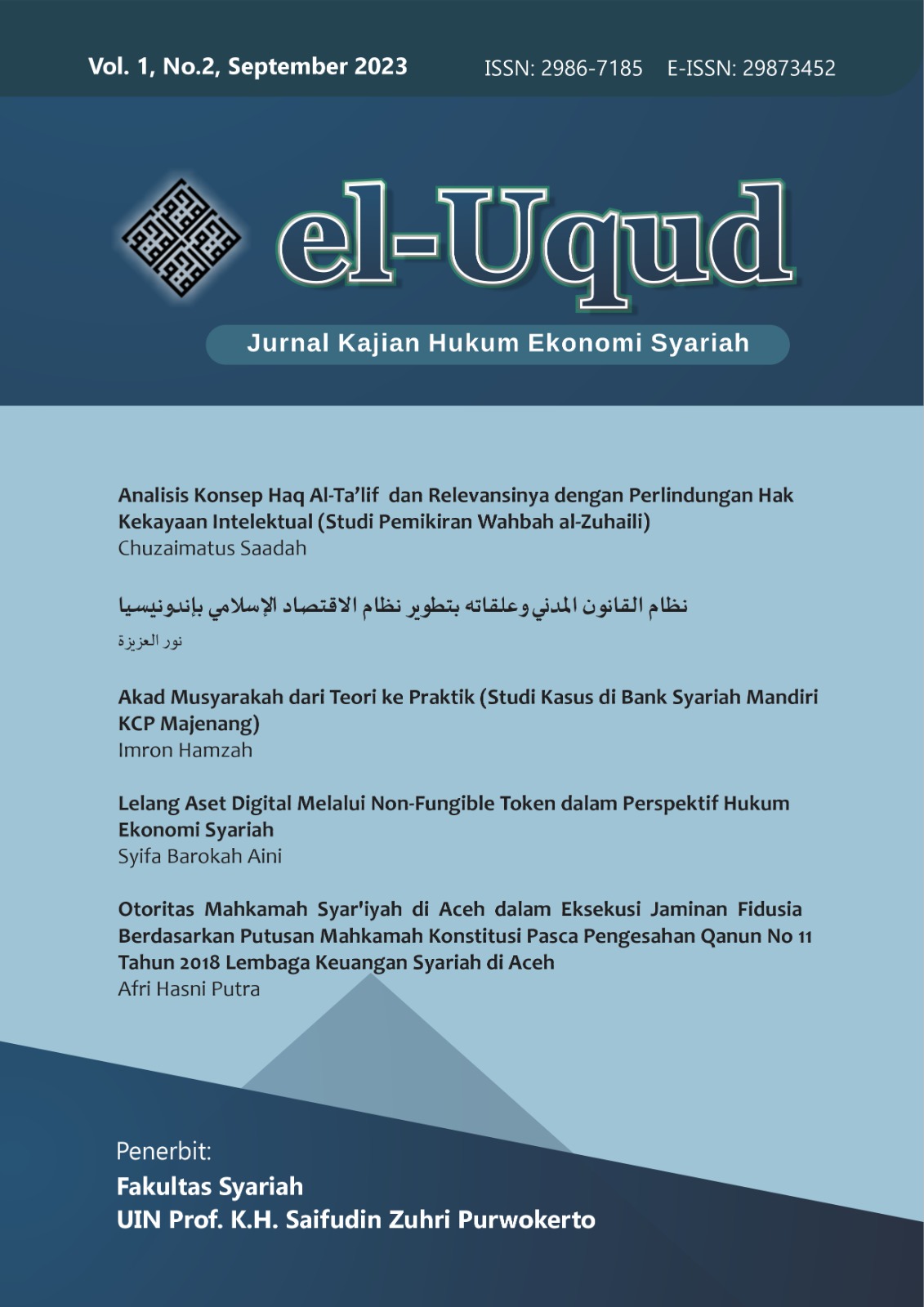
Analisis Konsep Haq Al-Ta’lif dan Relevansinya dengan Perlindungan Hak Kekayaan Intelektual (Studi Pemikiran Wahbah al-Zuhaili)
DOI:
https://doi.org/10.24090/eluqud.v1i2.7953Keywords:
Hak Kekayaan Intelektual, Pemikiran Wahbah az-Zuhaili, Haq at-Ta’lifAbstract
This article discuss the thought of Wahbah al-Zuhaili-as a representation of a personjurist-on intellectual property rights. In Indonesia, violations of intellectual property rights continue to occur even after laws and regulations have regulated them. Even some religious groups consider that plagiarism of written works is permissible in religion. Even though Islam itself regulates and maintains individual rights in such a way through the concept of property rights. Islamic law in the early period did not mention intellectual property rights directly. Wahbah al-Zuhaili in his work discussed haq al-ta’lif (the right of a work). Therefore, to analyze this, the researcher used a library research method with a normative approach. Researcher found that the relevance of the concept haq al-ta'lif with the protection of Intellectual Property Rights in general is first, intellectual property rights recognized by law are protected personal rights advice' even when a country's laws do not provide for it. Second, plagiarizing and disseminating (commercializing) without the rights owner's permission is tyranny which is a vice. Third, the owner of the right has the right to confiscate and stop the production of the perpetrators. Fourth, the owner of the right is entitled to compensation for moral and material losses for the stolen work. Fifth,a work can be used by other parties with the existence of an agreement on a certain object with a specified time.References
Adi, Rianto. Metodologi Penelitian dan Hukum. Jakarta: Granit, 2004.
al-Khafif, Ali. Al-Milkiyyah Fi Syari’ah Al-Islamiyyah Ma’a Al-Muqaranah Bi As-Syari’ah Al-Wadh’iyyah. Beirut: Dar Al-Fikr Al-‘Arabi, 1996.
az-Zuhaili, Wahbah. Al Fiqh al- Islam Wa Adillatuhu . Beirut: Dar al-Fikr, 2004.
—. Al Fiqh al- Islam Wa Adillatuhu, terj. Abdul Hayyie al-Kattani. Jakarta: Gema Insani, 2011.
Farig, Umar Azmar Mahmud. “Dampak Penerapan Trips Agreement Terhadap Masyarakat Komunal Indonesia.” Makalah Universitas Gadjah Mada, 2013.
Freddy Harris, dkk. Modul Kekayaan Intelektual Tingkat Dasar Bidang Hak Cipta. Jakarta: Kementerian Hukum dan HAM, 2020.
—. Modul Kekayaan Intelektual. Jakarta: Kementerian Hukum dan HAM, 2020.
Ghofur, Saiful Amin. Profil Para Mufasir al-Qur’an. Yogyakarta: Pustaka Insan Madani, 2008.
Imzi, A. Husnul Hakim. Ensiklopedia Kitab-Kitab Tafsir. Jawa Barat: Elqis, 2013.
Khairunnisa, Inas. “Hak Kekayaan Intelektual (Hki) Sebagai Objek Waqaf Dalam Hukum Islam.” Iqtishaduna, Vol. 10 No. 2, 2019.
Rahayu, Lisa. “Lisa Rahayu, “Makna Qaulan dalam al-Qur’an; Tinjauan Tafsir Tematik Menurut Wahbah az-Zuhaili.” Skripsi Fakultas Ushuluddin UIN SUSKA Riau, 2010.
Sainul, Ahmad. “Konsep Hak Milik Dalam Islam.” Al-Maqasid, Volume 6 Nomor 2, 2020.
Suryana, Agus. “ Hak Cipta Perspektif Hukum Islam.” Al Mashlahah Jurnal Hukum Dan Pranata Sosial Islam, t.thn.
Suryana, Agus. “Hak Cipta Perspektif Hukum Islam.” Al Mashlahah Jurnal Hukum Dan Pranata Sosial Islam, t.thn.
Syatiby, Imam as. Al-Muwafaqat Fi Ushul AlAhkam Juz II . Beirut : Dar Al-Ma'rifat, t.thn.
Theixar , Regina Natalie , dan I Gusti Ngurah Wairocan. “Subjek Hukum Rahasia Dagang Ditinjau Dari Undang-Undang Rahasia Dagang, Trips Agreement Dan Utsa.” Skripsi, Universitas Udayana, , 2019.
Downloads
Published
How to Cite
Issue
Section
License
Copyright (c) 2023 el-Uqud: Jurnal Kajian Hukum Ekonomi Syariah

This work is licensed under a Creative Commons Attribution-NonCommercial-ShareAlike 4.0 International License.
Authors who publish with this journal agree to the following terms:
- Authors retain copyright and grant the journal right of first publication with the work simultaneously licensed under a Creative Commons Attribution License that allows others to share the work with an acknowledgement of the work's authorship and initial publication in this journal.
- Authors are able to enter into separate, additional contractual arrangements for the non-exclusive distribution of the journal's published version of the work (e.g., post it to an institutional repository or publish it in a book), with an acknowledgement of its initial publication in this journal.
- Authors are permitted and encouraged to post their work online (e.g., in institutional repositories or on their website) prior to and during the submission process, as it can lead to productive exchanges, as well as earlier and greater citation of published work (See The Effect of Open Access).