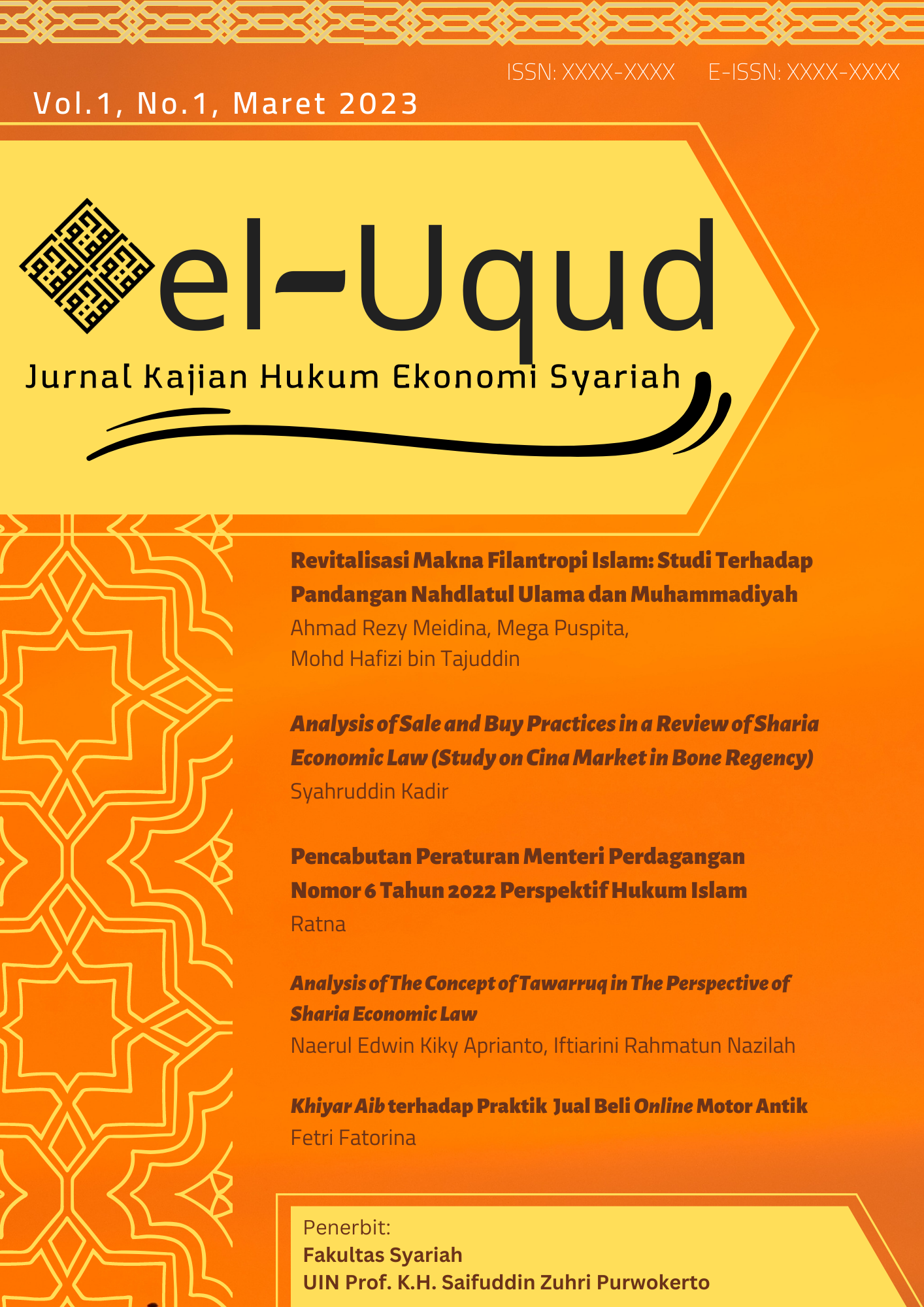
Analysis of Sale and Buy Practices in A Review of Sharia Economic Law
(Study on China Market in Bone Regency)
DOI:
https://doi.org/10.24090/eluqud.v1i1.7739Keywords:
Sharia Economics, Sale Buy, Market.Abstract
The practice of buying and selling which has become the primary activity carried out by the community is still not free from fraud and tyranny. The injustice committed by traders or sellers is to show good merchandise and hide merchandise that is not good or defective. Of course, this causes harm to every buyer or consumer, even though Muslims must know that this behavior is strictly prohibited by religion. This study aims to determine the buying and selling practices practiced by the people in the China market in Bone Regency and to find out the sharia economic system implemented by the people in the China market in Bone Regency. Bone. This research method uses field research like the field through data collection namely observation, interviews, and questionnaires. Direct research examines buying and selling practices carried out by the Muslim community at the China Market in Bone Regency, running like a market as it should be. The China market includes markets that carry out buying and selling transactions through the sale of crops from farmers which are obtained directly from the initial farmers. Apart from that, it is also a center for the wholesale trade of plantation, plantation, and fishery products as well as other basic needs. Fraud and tyranny that occurred in the China market and unbalanced market conditions should not have happened because it is prohibited in Islam. This phenomenon shows a violation of Islamic values and law which has strictly prohibited all forms of tyranny and fraud in buying and selling activities so the sharia economic system in the China market has not been implemented optimally.References
Abdullah, Muh. Wahyuddin, Syahruddin Kadir, and Hassan Alaaraj. “Sharia Financial Literation In Developing Sharia-Based Business For Rural Communities In South Sulawesi.” Ikonomika 5, no. 1 (2020): 117–140. https://jurnal.ut.ac.id/index.php/elqish/article/view/4150/1285.
Departemen Agama RI. Al Qur'an dan Terjemahnya. Edisi Revisi; Semarang: PT. Karya Toha Putra, 1995.
Ghufron A. Mas’adi, Fiqh Muamalah Kontekstual. Cet: I; Jakarta: PT. Raja Grafindo Persada, 2002.
Ihsan, Akmal, Abustan Nur, and Syahruddin Kadir. “Islamic Wealth Management And Corporate Governance.” El-Qish: Journal of Islamic Economics 2, no. 2 (2022): 85–96.
Kadir, Syahruddin. “Labelizing of Manufacturing Halal Industry Products for Achieving Customer Satisfaction In The Perspective of Maslahah Daruriyah.” El-Qish: Journal of Islamic Economics 2, no. 1 (2022): 23–31. https://jurnal.ut.ac.id/index.php/elqish/article/view/4150/1285.
———. “Pengembangan Pengukuran Kinerja Dengan Pendekatan Maslahah Score Card.” Ad-Deenar: Jurnal Ekonomi dan Bisnis Islam 3, no. 2 (2019): 149–172.
Kadir, Syahruddin, and Muhammad Wahyuddin Abdullah. “ISLAMIC ECONOMIC CREATIVE SOLUTIONS FOR SMALL AND.” Iqtishaduna Proceding, no. 1 (2019): 96–107.
Kadir, Syahruddin, Muhammad Wahyuddin Abdullah, and Amiruddin Kadir. “Analisis Pengukuran Kinerja Dengan Pendekatan Maslahah Scorecard.” Jurnal Minds: Manajemen Ide dan Inspirasi 6, no. 1 (2019): 53.
Kadir, Syahruddin, and Muh. Amir Basri. “AMANAH FINANCE MARKETING STRATEGY BULUKUMBA BRANCH IN INCREASING MURABAHAH FINANCING.” Kodifikasia: Jurnal Penelitian Islam 15, no. 02 (2019): 243–258.
Kadir, Syahruddin et all. “Political Stability, Macro Economics, and Islamic Human Development Index (i-Hdi) In Oic Countries.” Jurnal Syarikah 8, no. 2 (2022): 245–253.
Kadir, Syahruddin, Mukhtar Lufti, Nasrullah Bin Sapa, and Abd Hafid. “IMPLEMENTASI AKAD MUSYARAKAH MUTANAQISHAH DI LEMBAGA KEUANGAN ISLAM.” IEB JOURNAL: Islamic Economics and Business Journal 4, no. 2 (2022): 1–19.
Kadir, Syahruddin, and Salfianur. “Pelatihan Ekonomi Mikro Syariah Dalam Meningkatkan Literasi Keuangan Syariah Bagi Masyarakat Desa Bulu-Bulu Kab. Bone Dan Siwa Kab. Wajo.” E-Amal Jurnal Pengabdian Kepada Masyarakat 01, no. 03 (2021): 467–480.
Libus, Ibrahim. Ekonomi Islam Suatu Pengantar. Cet. I; Jakarta: Radar Jaya Offset, 1995.
Mas’adi, Ghufron A. Fiqh Muamalah Kontekstual. Cet: I; Jakarta: PT. Raja Grafindo Persada, 2002.
Muhibbuddin. “Credit: An Islamic Law Perspective.” Al-Mizan 13, no. 2 (2017): 227–242.
Sabiq, Sayyid. Fikih Sunnah 12. Cet: I Jilid 12; Bandung: Alma’arif, 1993.
Setiawahyu, Mia Dwi. “Kecurangan Dalam Jual Beli Menurut Al-Qur ’ a n Perspektif Tafsir Al-Munir.” Lathaif 1, no. 1 (2022): 48–67.
ash-Shawi, Sholah & Abdulloh Al-Muslih. Fikh ekonomi keuangan Islam. Cet, I; Jakarta,Darul-haq, 2005.
Shobirin. “Jual Beli Dalam Pandangan Islam.” BISNIS : Jurnal Bisnis dan Manajemen Islam 3, no. 2 (2016): 239.
Syahril, Syahril, Wahyuddin Abdullah, and Syahruddin Syahruddin. “Model Pemberdayaan Ekonomi Dengan Filantropi Islam Dalam Mewujudkan Kesejahteraan Masyarakat.” IQTISHADIA Jurnal Ekonomi & Perbankan Syariah 6, no. 1 (2019): 25–40.
Syukron, AHmad. “MEMBONGKAR KONSEP ETIKA BISNIS DALAM AL-QUR’AN: SEBUAH PERSPEKTIF EPISTEMOLOGIS.” Ta’qib 4, no. 3 (2014): 1–20.
ZAINI, HASAN. “Perspektif Alqur’an Tentang Pendidikan Karakter (Pendekatan Tafsir Maudhu’I).” Ta’dib 16, no. 1 (2016): 1–17.
al-Zarqa’, Mustafa. al-madkhal al-fiqh al-amm. Dairul Fikri, Beirut, 1967-1968.
Az-Zuhaili. Tafsir al-Munir. In d. Abdul Hayyie al Kattani. Jilid 10 ; Jakarta: Gema Insani, 2016.
Az-Zuhaili Tafsir al-Munir. In d. Abdul Hayyie al Kattani. Jilid 15; Jakarta: Gema Insani, 2016.
Downloads
Published
How to Cite
Issue
Section
License
Copyright (c) 2023 el-Uqud: Jurnal Kajian Hukum Ekonomi Syariah

This work is licensed under a Creative Commons Attribution-NonCommercial-ShareAlike 4.0 International License.
Authors who publish with this journal agree to the following terms:
- Authors retain copyright and grant the journal right of first publication with the work simultaneously licensed under a Creative Commons Attribution License that allows others to share the work with an acknowledgement of the work's authorship and initial publication in this journal.
- Authors are able to enter into separate, additional contractual arrangements for the non-exclusive distribution of the journal's published version of the work (e.g., post it to an institutional repository or publish it in a book), with an acknowledgement of its initial publication in this journal.
- Authors are permitted and encouraged to post their work online (e.g., in institutional repositories or on their website) prior to and during the submission process, as it can lead to productive exchanges, as well as earlier and greater citation of published work (See The Effect of Open Access).