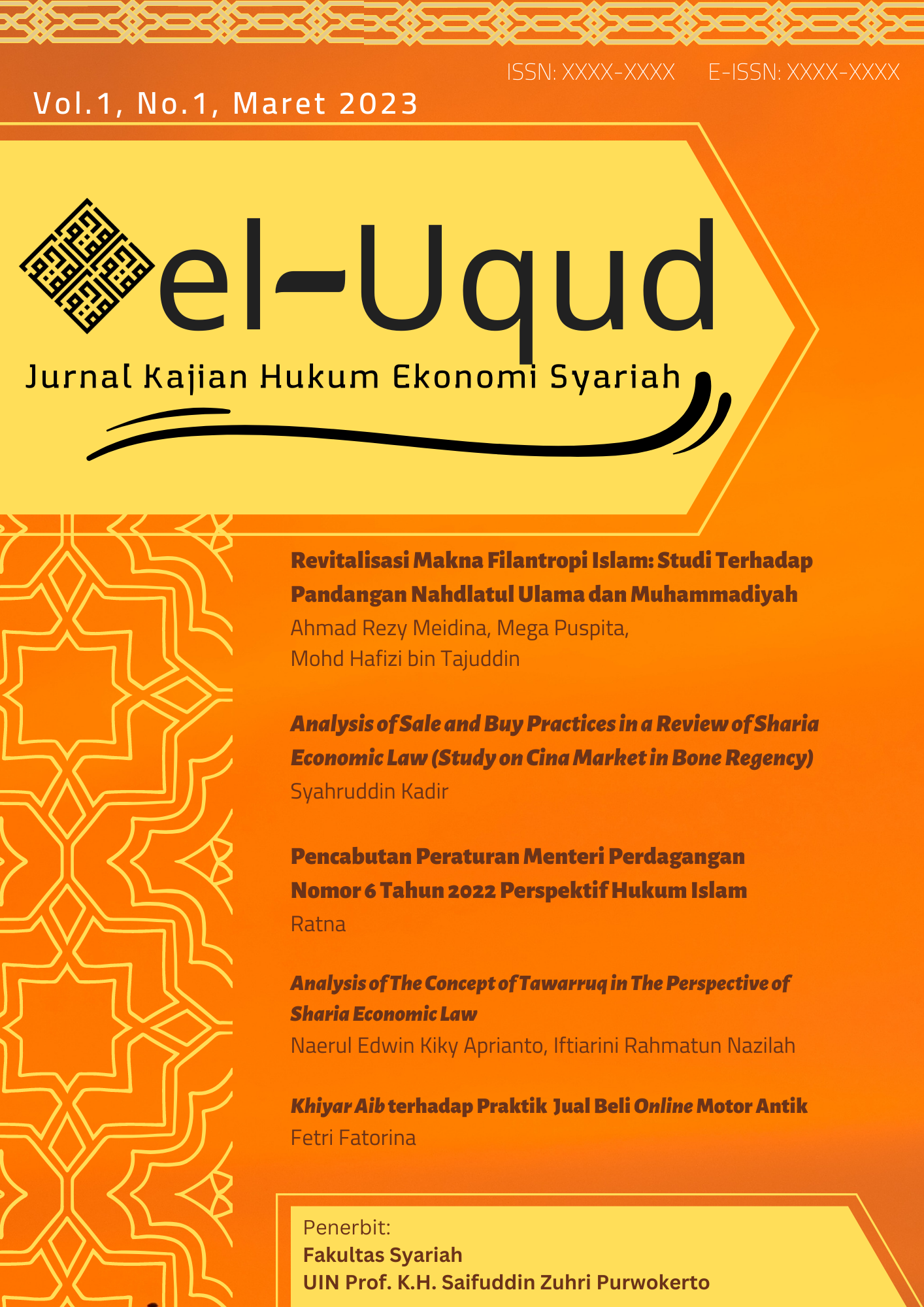
Khiyar Aib Terhadap Praktik Jual Beli Online Motor Antik CB 100
DOI:
https://doi.org/10.24090/eluqud.v1i1.7699Keywords:
Khiyar aib, Jual beli Online, Motor AntikAbstract
Buying and selling online has two sides of view, namely the positive and negative sides. This is due to the difference in buying and selling mechanisms between buying and selling online and buying and selling directly. On the positive side, both parties, namely sellers and buyers, both benefit in terms of ease and speed of access to see the object of sale and purchase, in this case the CB 100 type antique motorbike. On the negative side, buyers tend to be disappointed if the goods purchased do not match those on the promotion. In fact, it is often found that there are defects in the goods purchased. It can be assumed that in the practice of buying and selling online, khiyar rights are not implemented. The problem raised in this research is what is the position of khiyar disgrace in online buying and selling of CB 100 type antique motorbikes? The subjects of this study were the sellers and buyers of the CB 100 community in the Purwokerto area. The object of this research is the online buying and selling transaction of CB 100 type antique motorbikes. The methods used are observation, interviews, documentation. The results of this study state that the position of khiyar disgrace in online buying and selling of antique motorbikes has been fulfilled. But to determine whether to buy or not they use khiyar ru'yah. So that it can be said that online buying and selling of antique CB 100 type motorbikes is a practice that is prohibited by Islam. This practice contains more harm than benefit. Even though according to Islamic law, the buying and selling contract is valid. However, the practices and systems used are contrary to religious rules and prohibited by syara'References
al-Jaziri, Abdullah. 1991. Fiqh Empat Mazhab: bagian Ibadah, Jilid III (Terj. Moh. Zuhri dkk). Semarang: As-Syifa,
az-Zuhaili, Wahbah. 2002. al-Fiqh Islam Wa adillatuhu, Jilid IV,.Damaskus: Darul Fikri.
Chaundry, Muhammad Syarif. 2015. Fundamental Of Islamic Economis Syistem, Jakarta.2015.
Habib Nasir dan Muhammad Hasanudin. 2004. Ensiklopedia Ekonomi dan Perbankan Syariah. Bandung: Kaki Langit,
Harun, Nasroen. 2007. Fiqh Muamalah. Jakarta: Gaya Media Pratama.
Hasanah, Dafiqa. 2019. Konsep Khiyar Pada Jual Beli Pre-Order Online Shop Dalam Perspektif Hukum Islam. Jurnal: Iqtishoduna, Vol.8 Nomor.2 Oktober 2019.
Ibnu Rusyd, Abdul Wahid Muhammad. 2007. Bidayatul Mujtahid, Terj. Ghazali Said, .Jakarta: Pustaka Amani.
Lestari , Ayu. 2014. Bisnis Online Syariah. Jakarta: Kompas Gramedia.
Mardani. 2012. Fiqih Ekonomi Syariah. Jakarta: Kencana.
Muhammad Azzam, Abdul Aziz. 2010. Fiqih Muamalat Sistem Transaksi Dalam Fiqih Islam. Jakarta: Amzah.
Qardhawi, Yusuf . 2007. Halal dan Haram dalam Islam. Surakarta: Era Intermedia.
Subekti. 2002. Hukum Perjanjian. Jakarta: Intermasa.
Syafei, Rahmat. 2001. Fiqh Muamalah. Bandung: Pustaka Setia.
Syarifudin, Amir. 2013. Garis-Garis Besar Fiqh. Bogor: Kencana.
Downloads
Published
How to Cite
Issue
Section
License
Copyright (c) 2023 el-Uqud: Jurnal Kajian Hukum Ekonomi Syariah

This work is licensed under a Creative Commons Attribution-NonCommercial-ShareAlike 4.0 International License.
Authors who publish with this journal agree to the following terms:
- Authors retain copyright and grant the journal right of first publication with the work simultaneously licensed under a Creative Commons Attribution License that allows others to share the work with an acknowledgement of the work's authorship and initial publication in this journal.
- Authors are able to enter into separate, additional contractual arrangements for the non-exclusive distribution of the journal's published version of the work (e.g., post it to an institutional repository or publish it in a book), with an acknowledgement of its initial publication in this journal.
- Authors are permitted and encouraged to post their work online (e.g., in institutional repositories or on their website) prior to and during the submission process, as it can lead to productive exchanges, as well as earlier and greater citation of published work (See The Effect of Open Access).