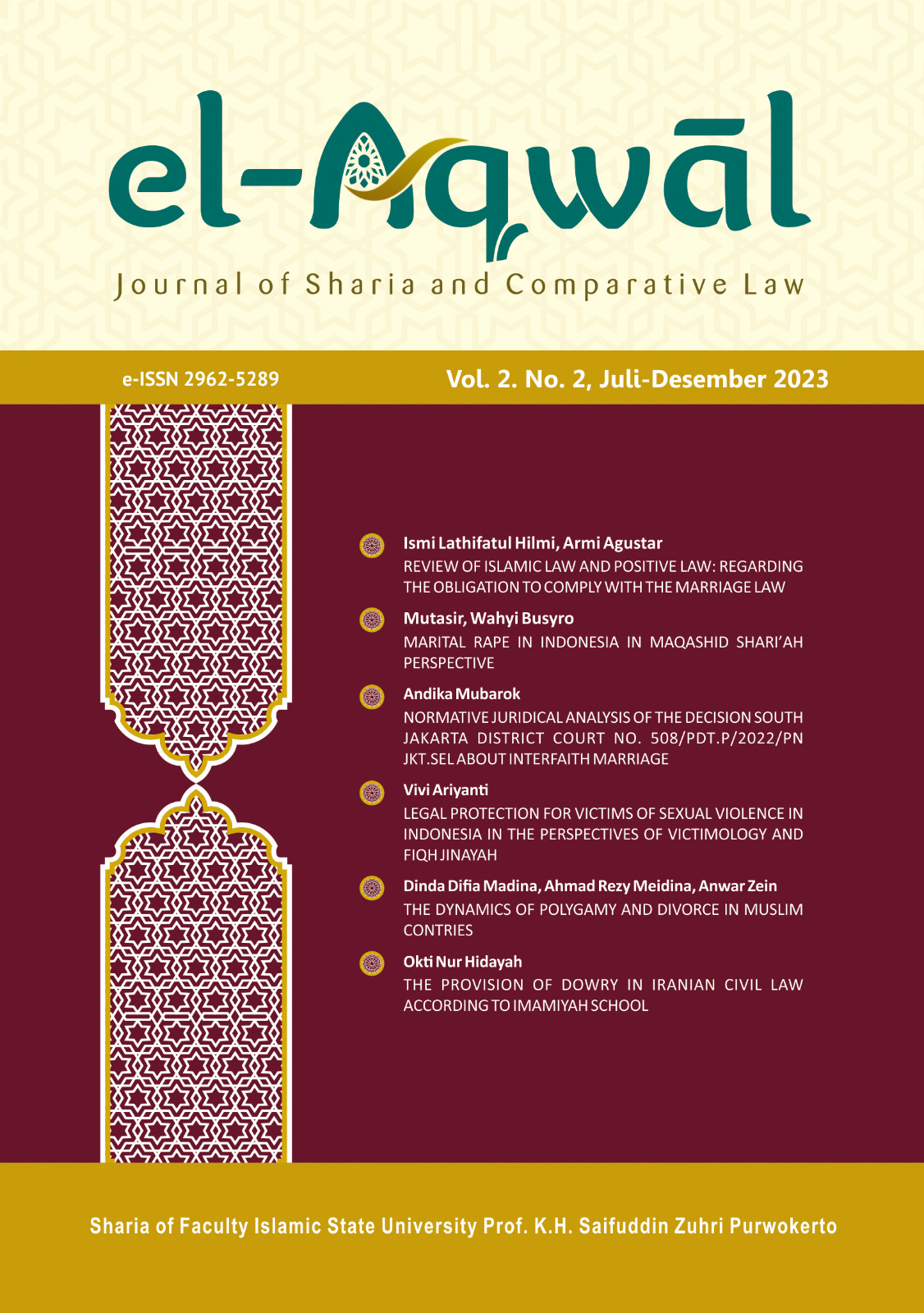
Review of Islamic Law and Positive Law: Regarding the Obligation to Comply with the Marriage Law
DOI:
https://doi.org/10.24090/el-aqwal.v2i2.7786الكلمات المفتاحية:
Law، Ijma’، Liabilityالملخص
This paper aims to examine the views of positive law and Islamic law on the obligation to comply with the Marriage Law. As it is known that Indonesia is a country that adheres to two laws, namely Islamic law and Positive law, then in taking a view of a provision must take into account these two aspects. This research will look at the need to obey the law under Islamic law and the positive, relevance of ijma’ to such obligations. This paper uses a normative legal approach that results in the obligation to comply with laws and regulations has been regulated in positive law, especially Article 27 paragraph (1) of the 1945 Constitution, and is also regulated in the Qur'an QS. An- Nisa verses 59 and 83, which are law-abiding as well as obeying ulil amri because state laws are formed by ulil amri and are the solution of the problems of the people using the approach of the text of revelation and publication, then it is ijma’ which is in accordance with the concept of ushul and the decision must be obeyed.التنزيلات
المراجع
Analisyah. "Ulil Amri and the Power of His Legal Products (Study of the Perspective of the Aceh Besar Salafi Teungku Dayah)."Analysis 21, no. 2 (2014): 265.
Dahlan, Abdul Aziz.Encyclopedia of Islamic Law 1. Jakarta: Van Hoeve's New Attempt, 2006.
Dalimunthe, Dermina. "The Process of Forming Laws According to Law No. 12 of 2011 concerning Formation of Legislation."Jurisprudence: Islamic and civil sciences 3, no. 1 (2017): 66–82.
Deden Hidayat. "The Relevance of Ijma' and Qiyas in the Structure of Islamic Law and Positive Legal Structures in Indonesia."Istinbath: Law Journal 16 (2019): 67–81.
Hasanuddin Muhammad, Agus Alimuddin, Lisda Aisyah, Muhammad Wahdini. "Ijma' in the Context of Establishing Law in a State."Istinbath: Law Journal 17, no. 1 (2020): 202–218.
Manan, Abdul.Various Problems of Islamic Civil Law in Indonesia. Jakarta: Prenada Media Group, 2000.
Marzuki, Peter Mahmud.Legal Research. Jakarta: Kencana Prenada Media Group, 2005.
Muhammad Abu Zahrah.Ushul Al-Fiqh. Cairo: Darul Fkr al-Araby, 1958.
Muhammad Arafat. "Mandatory Policy to Comply with Law No. 1 of 1974 on Marriage.” Research gate Islamic University of Indonesia, no. 1 (2022): 1–15.
Nasution, Khoiruddin. "Bases of Compulsory Compliance with the Marriage Law (Uup): A Study of the Thoughts of Muhammad 'Abduh."ADHKI: Journal of Islamic Family Law 1, no. 1 (2019): 1–16.
Putra, Muh Yunan, and M Hi. "Comply with Government Regulations and Laws According to Islamic Shari'a."Sangaji, Journal of Sharia and Legal Thought 4, no. 1 (2020): 19–40.
Rozi Andrini, Mawardi Muhammad Saleh, Indra Hadi. "Basic Compulsory Obedience to the Marriage Law Reviewed According to Islamic Law."An-Nida’ 45, no. 1 (2021): 95–114.
Sharifuddin, Amir.Usul Fiqh: Volume 1. Jakarta: Science Discourse Logos, 1997.
Yaqin, N A. "State Law Argument as a Source of Islamic Law in the Thought of Sayyid Muḥammad Rasyîd Riḍâ and Wahbah Az-Zuḥailî."Al-Mazaahib: Journal of Comparative Law 5 (2018): 215–235.
Zaidan, Abd Karim.Al-Wajiz Fi Ushul Al-Fiqh. Beirut: Muassasah al-Risalah, 1998.
Indonesian Constitution
التنزيلات
منشور
كيفية الاقتباس
إصدار
القسم
الرخصة
الحقوق الفكرية (c) 2023 Ismi Lathifatul Hilmi, Armi Agustar

هذا العمل مرخص بموجب Creative Commons Attribution-ShareAlike 4.0 International License.
Authors who publish with this journal agree to the following terms: Authors retain copyright and grant the journal right of first publication with the work simultaneously licensed under a Creative Commons Attribution-ShareAlike 4.0 International License that allows others to share the work with an acknowledgment of the work's authorship and initial publication in this journal.