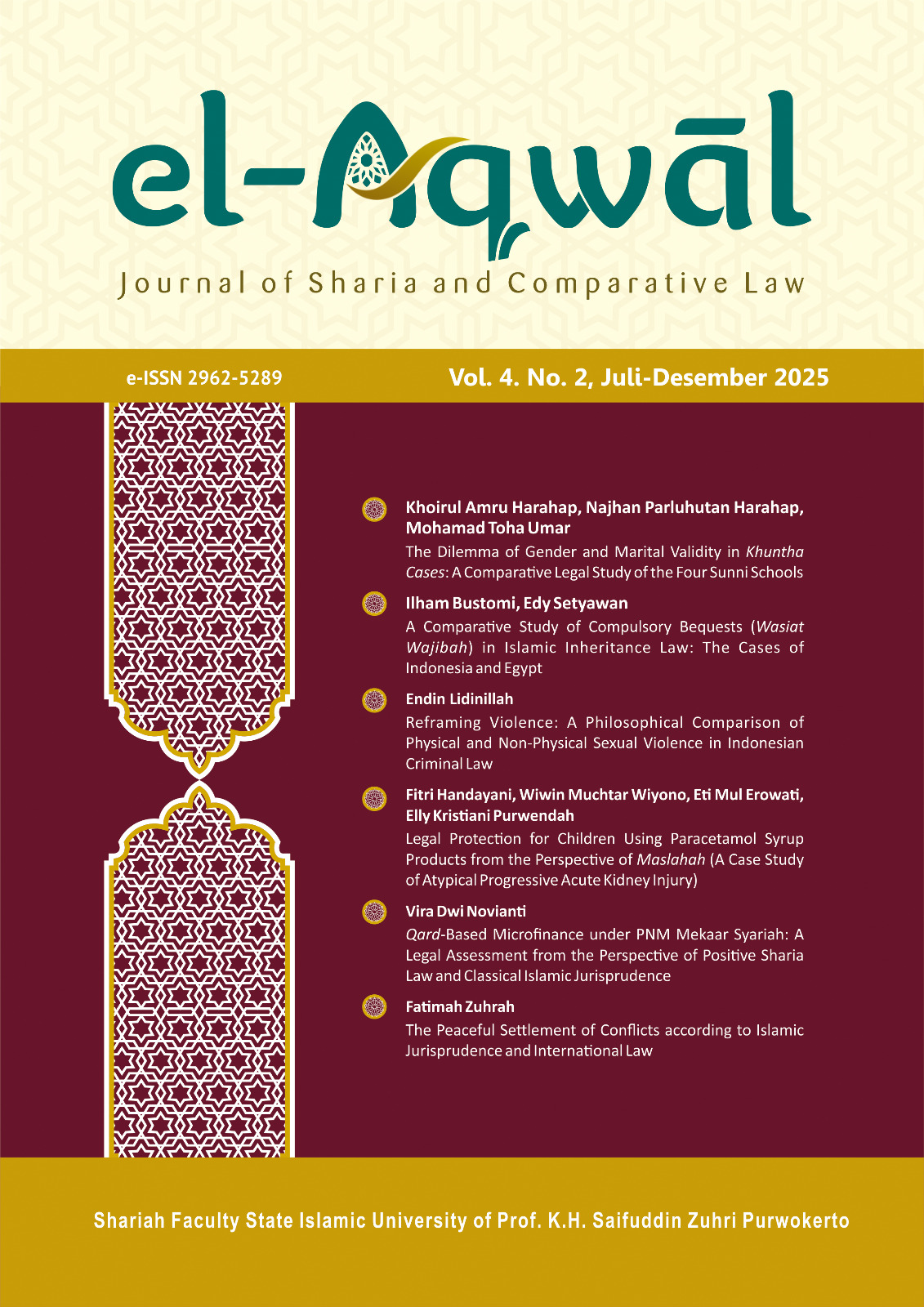
The Peaceful Settlement of Conflicts according to Islamic Jurisprudence and International Law
Review of ‘Islamic Law and International Law: Peaceful Resolution of Disputes’ by Emilia Justyna Powell, Oxford University Press, 2020.
DOI:
https://doi.org/10.24090/el-aqwal.v4i2.15259Keywords:
Islamic law, international law, resolution, settlementAbstract
This review examines Islamic Law and International Law: Peaceful Resolution of Disputes (Oxford University Press, 2020) by Emilia Justyna Powell, a groundbreaking interdisciplinary study that explores how Islamic legal traditions influence the engagement of Muslim-majority states with international dispute resolution mechanisms. Drawing from original empirical data and classical Islamic jurisprudence, Powell argues that domestic legal structures—whether secular, Islamic, or hybrid—significantly shape states' preferences for international conflict resolution methods. The book highlights both the consonance and dissonance between Islamic law and international law, particularly in the context of peaceful settlement. Powell challenges prevailing assumptions of uniformity among Islamic Law States and demonstrates the importance of legal pluralism in international relations. Through critical analysis, this review assesses the strengths of Powell’s approach—her empirical rigor, legal-philosophical insight, and contribution to debates on global justice—while also noting the limitations, including the need for a more nuanced understanding of hybrid legal systems and broader geopolitical factors. Overall, the book is a significant scholarly contribution that bridges comparative law, Islamic studies, and international legal theory, offering valuable insights into the evolving dynamics of legal identity and interstate conflict management.Downloads
References
Ahmad, Nehaluddin, Mohammed Hussain, and Pehin Haji Ahmad. “Classical Islamic Legal Account of Modern International Law.” Manchester Journal of Transnational Islamic Law & Practice 16, no. 1 (2020): 175–97.
Ali, Muhammad Yusuf. The Meaning of the Holy Qur’an Complete Translation with Selected Notes. United Kingdom: The Islamic Foundation, 2009.
Baderin, Mashood A. “The Evolution of Islamic Law of Nations and the Modern International Order: Universal Peace through Mutuality and Cooperation.” American Journal of Islam and Society 17, no. 2 (2000): 57–80.
Bailliet, Cecilia M. “Islamic Law and International Law: Peaceful Dispute Resolution.” Manchester Journal of Transnational Islamic Law & Practice 18, no. 1 (2022): 284–88.
Bouzenita, Anke Iman. “The Siyar: An Islamic Law of Nations?” Asian Journal of Social Science 35, no. 1 (2007): 19–46. https://doi.org/https://doi.org/10.1163/156853107X170150.
Konstantinidis, Ioannis. “Islamic Law and International Law: Peaceful Resolution of Disputes.” International Review of Law 9, no. 1 (2020): 246.
Maula, Bani Syarif. “Examining the Handling of Rohingya Refugees in Indonesia through the Lens of International Law and Maqāsid Al-Shari’ah: An Exploration of Islamic Humanitarianism.” Mazahib: Jurnal Pemikiran Hukum Islam 23, no. 1 (2024): 1–40.
Niedermeier, Alexander. “Review of Powell, Emilia (2020): Islamic Law and International Law: Peaceful Resolution of Disputes, Oxford and Others, Oxford University Press.” Review of Economics and Political Science 5, no. 4 (2020): 335–55.
Powell, Emilia Justyna. Islamic Law and International Law: Peaceful Resolution of Disputes. Oxford: Oxford University Press, 2020.
Powell, Emilia Justyna. “Islamic Law States and Peaceful Resolution of Territorial Disputes.” International Organization 69, no. 4 (2015): 777–807.
Powell, Emilia Justyna. “Islamic Law States and the International Court of Justice.” Journal of Peace Research 50, no. 2 (2013): 203–17.
Simmons, Beth A. “Islamic Law and International Law: Peaceful Resolution of Disputes. By Emilia Justyna Powell. New York, NY: Oxford University Press, 2020. Pp. Xiv, 314. Index.” American Journal of International Law 114, no. 4 (2020): 791–96.
Downloads
Published
How to Cite
Issue
Section
License
Copyright (c) 2025 Fatimah Zuhrah

This work is licensed under a Creative Commons Attribution-ShareAlike 4.0 International License.
Authors who publish with this journal agree to the following terms: Authors retain copyright and grant the journal right of first publication with the work simultaneously licensed under a Creative Commons Attribution-ShareAlike 4.0 International License that allows others to share the work with an acknowledgment of the work's authorship and initial publication in this journal.