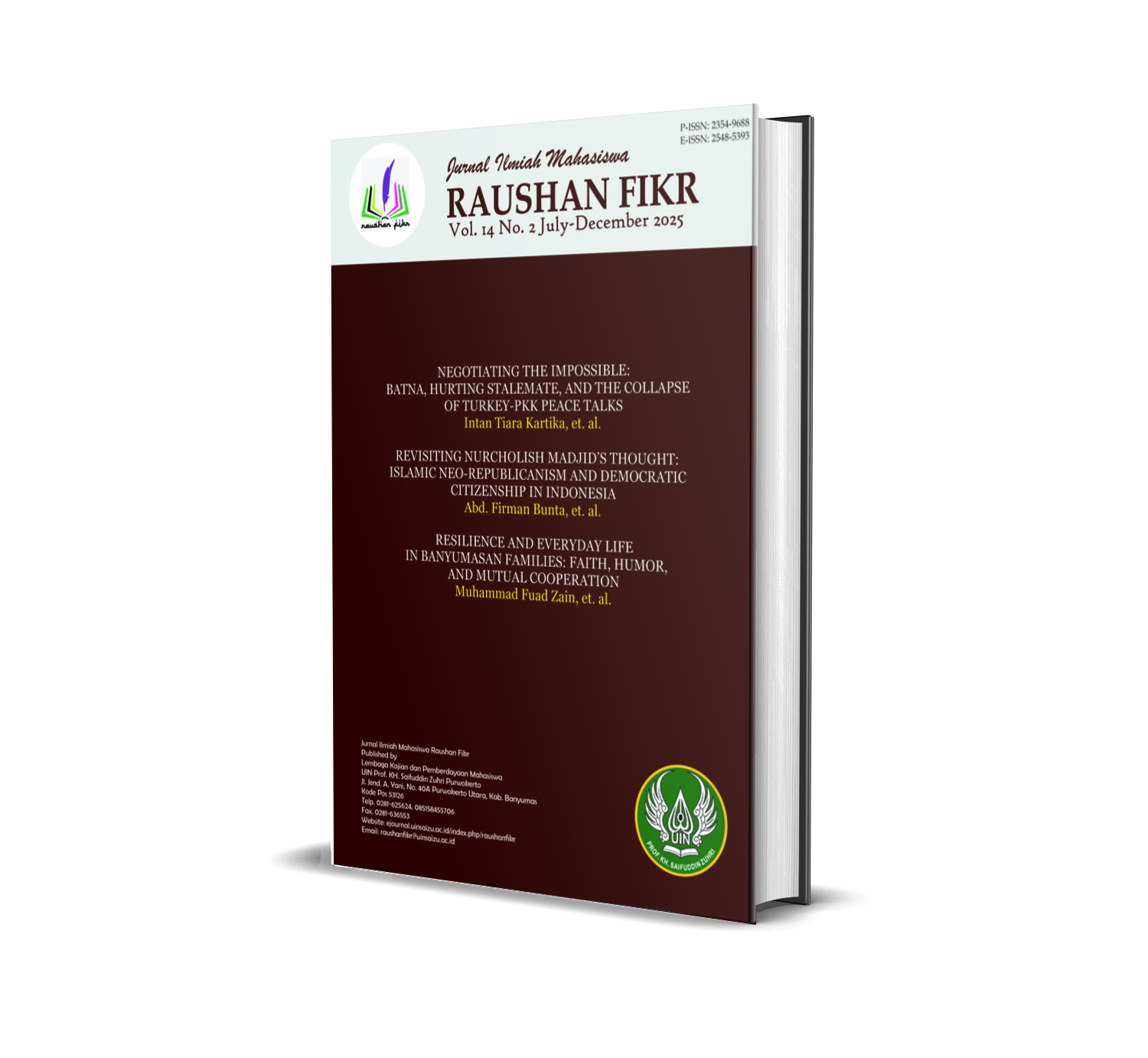
Cover, Table of Contents, and Editorial Note – Vol. 14 No. 2 (2025)
Keywords:
Table of ContentAbstract
Raushan Fikr Journal Volume 14, No. 2 (2025) presents twenty-one scholarly contributions that exemplify the evolving landscape of contemporary Islamic studies. The articles span five domains—social-religious studies, Islamic education, Islamic economy, theology and thought, and Islamic law—each addressing critical intersections of faith, society, and practice. Studies in the social-religious section engage themes of conflict resolution, halal certification in community markets, democratic citizenship, local resilience, and spiritual care for the elderly. Contributions to Islamic education highlight innovative pedagogical approaches, including digital games, problem-based learning, and creative classroom integration. The Islamic economy section offers analyses of financial ethics, marketing innovation, risk management, public service quality, agribusiness, and the global modest fashion industry. In theology, comparative reflections revisit liberationist thought and reimagine mahabbah across classical traditions. The legal dimension examines governance through Islamic principles of amanah, ‘adalah, and maslahah. Collectively, this volume underscores the journal’s commitment to rigorous, interdisciplinary, and socially relevant scholarship.Downloads
Download data is not yet available.
References
Cover, Table of Contents, and Editorial Note – Vol. 14 No. 2 (2025)
Downloads
Published
2025-10-01
How to Cite
Budiyono, A. (2025). Cover, Table of Contents, and Editorial Note – Vol. 14 No. 2 (2025). Jurnal Ilmiah Mahasiswa Raushan Fikr, 14(2), i-xi. Retrieved from https://ejournal.uinsaizu.ac.id/index.php/raushanfikr/article/view/15345
Issue
Section
Table of Contents
License
Copyright (c) 2025 Alief Budiyono

This work is licensed under a Creative Commons Attribution-NonCommercial-ShareAlike 4.0 International License.
Authors who publish with this journal agree to the following terms:
- Authors retain copyright and grant the journal right of first publication with the work simultaneously licensed under a Creative Commons Attribution-NonCommercial-ShareAlike 4.0 International License that allows others to share the work with an acknowledgement of the work's authorship and initial publication in this journal.
- Authors are able to enter into separate, additional contractual arrangements for the non-exclusive distribution of the journal's published version of the work (e.g., post it to an institutional repository or publish it in a book), with an acknowledgement of its initial publication in this journal.
- Authors are permitted and encouraged to post their work online (e.g., in institutional repositories or on their website) prior to and during the submission process, as it can lead to productive exchanges, as well as earlier and greater citation of published work (See The Effect of Open Access).