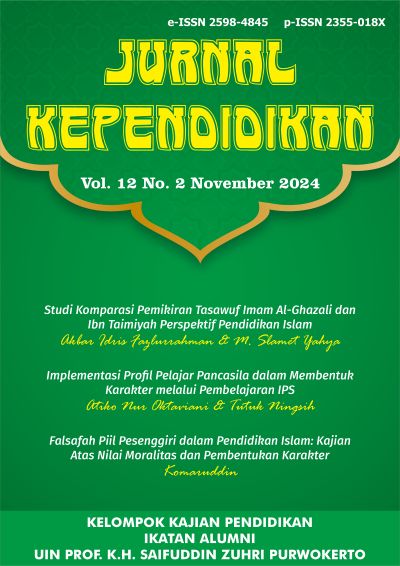
Falsafah Piil Pesenggiri Dalam Pendidikan Islam: Kajian Atas Nilai Moralitas dan Pembentukan Karakter
DOI:
https://doi.org/10.24090/jk.v12i2.12668Keywords:
Character, morality, islamic educationAbstract
This research examines the incorporation of the Piil Pesenggiri philosophy within Islamic education, with a specific emphasis on moral and character development. Piil Pesenggiri, representing the philosophical framework of the Lampung community, includes values such as honesty, honor, responsibility, and solidarity, which contribute to the character development of students in the realm of Islamic education. This study utilizes a literature review approach to analyze the significance of these values in relation to the principles of Islamic education, which seek to develop individuals of noble character. The research findings demonstrate that integrating local values such as Piil Pesenggiri into the Islamic education curriculum enriches character development and improves students' comprehension of cultural identity in accordance with Islamic teachings.Downloads
References
Amaliah, D., Sariyatun, S., & Musaddad, A. A. (2018). Values of Piil Pesenggiri: Morality, Religiosity, Solidarity, and Tolerance. International Journal of Multicultural and Multireligious Understanding, 5(5), 179. https://doi.org/10.18415/ijmmu.v5i5.340
Andi Prastowo, Suyadi, Sutrisno. (2021). Pendidikan Islam Unggul di Era Revolusi Industri 4.0 dan Merdeka Belajar. Kencana.
Ayyuhda, C. (t.t.). Nilai-Nilai Kearifan Lokal Kitab Kuntara Raja Niti Sebagai Pedoman Laku Masyarakat Lampung.
Hadikusuma, H. (1977). Adat Istiadat Daerah Lampung. Depdikbud.
Hayatunnisa Hayatunnisa, Jenika Fejrin, Milki Salwa Nor Azizah, Muhamad Ilham, Wayan Gastiadirrijal, Syahidin Syahidin, & Muhamad Parhan. (2024). Konsep Etika Dan Moralitas Sebagai Materi Dalam Pembelajaran Pendidikan Agama Islam. ALFIHRIS : Jurnal Inspirasi Pendidikan, 2(2), 77–84. https://doi.org/10.59246/alfihris.v2i2.765
Mahmudi, M. U., & Solehuddin, M. S. (t.t.). Agama dan Pendidikan dalam Perspektif Filsafat Pendidikan Islam.
Mujiburrahman. (2010). Islam, moralitas, dan pendidikan: Refleksi kritis atas pendidikan karakter di Indonesia. Rajawali Press.
Munawir, M., Ahmad, W. M. A., & Athirah, Z. (2024). Pengaruh Pendidikan Islam terhadap Pembentukan Karakter Peserta Didik. Jurnal Basicedu, 8(2), 1420–1427. https://doi.org/10.31004/basicedu.v8i2.7361
Palyanti, M., Ernita, S., & Peranita, R. (t.t.). Makna Nilai Piil Pesenggiri Sebagai Pendidikan Karakter dalam Pembelajaran Bahasa Indonesia: Perspektif Pendidikan Islam.
Priamantono, R. (2020). Implementation of Local Wisdom Values of Piil Pesenggiri as Character Education in Indonesian History Learning. VNU Journal of Science: Education Research. https://doi.org/10.25073/2588-1159/vnuer.4366
Rimanto, R., Hermanto, A., Arsyad, M., & Rohmawati, A. (2022). Examining Piil Pesenggiri Philosophy of Life Concept in the Context of Religious Moderation. Analisis: Jurnal Studi Keislaman, 22(1), 133–152. https://doi.org/10.24042/ajsk.v22i1.12445
Shalahuddin, M., Tansah, L., Hasanah, A., & Arifin, B. S. (t.t.). PENANAMAN NILAI AKHLAK BERBASIS PENDIDIKAN ISLAM SEBAGAI LANDASAN TEORI PENDIDIKAN KARAKTER DI SEKOLAH.
Sutrisno, M. A. (2012). Pendidikan Islam Berbasis Problem Sosial. Ar-Ruzz Media.
Yanti, F. A., Sukarelawan, Moh. I., Thohir, M. A., & Perdana, R. (2022). Development of Scientific Learning Model Based on Local Wisdom of “Piil Pesenggiri” to Improve Process Skills and Character Values of Elementary School Students. Jurnal Penelitian Pendidikan IPA, 8(2), 499–506. https://doi.org/10.29303/jppipa.v8i2.1236
Yanuar Arifin. (2018). Pemikiran-pemikiran Emas Para Tokoh Pendidikan Islam Dari Klasik hingga Modern. IRCiSoD.
Yusri, N., Ananta, M. A., Handayani, W., & Haura, N. (2023). Peran Penting Pendidikan Agama Islam dalam Membentuk Karakter Pribadi yang Islami. Jurnal Pendidikan Islam, 1(2), 12. https://doi.org/10.47134/pjpi.v1i2.115
Downloads
Published
How to Cite
Issue
Section
License
Copyright (c) 2024 Komaruddin Komaruddin

This work is licensed under a Creative Commons Attribution 4.0 International License.
Authors who publish with this journal agree to the following terms: Authors retain copyright and grant the journal right of first publication with the work simultaneously licensed under a Creative Commons Attribution 4.0 International License that allows others to share the work with an acknowledgment of the work's authorship and initial publication in this journal.