RUANG SAKRAL-PROFAN PADA MASJID JAMI' PITI MUHAMMAD CHENG HOO PURBALINGGA
DOI:
https://doi.org/10.24090/vastutara.v1i2.15440Keywords:
Sacred and Profane Space, Architectural Acculturation, Cheng Hoo MosqueAbstract
The conception of sacred and profane space, pioneered by Durkheim and Eliade, is a fundamental dichotomy where the sacred space is a separate, consecrated domain that serves as a locus for transcendent manifestation, while the profane space is the ordinary, mundane world. In Javanese mosque architecture, this dichotomy is manifested through a tiered spatial hierarchy comprising the sacred core space that requires the highest purity for ritual worship, the transitional/buffer space that mediates worldly activities supporting the worship, and the External Profane Space for purely socio-economic activities. Masjid Jami' PITI Muhammad Cheng Hoo Purbalingga replicates this functional hierarchy, yet it utilizes Chinese acculturation as a visual-cultural marker in its profane and transitional zones. Conversely, the sanctity of its core space is strictly maintained by universal Islamic theological markers (such as calligraphy and Qibla orientation), making it a model of inclusivity that expands the boundaries of profanity for both cultural and functional accommodation.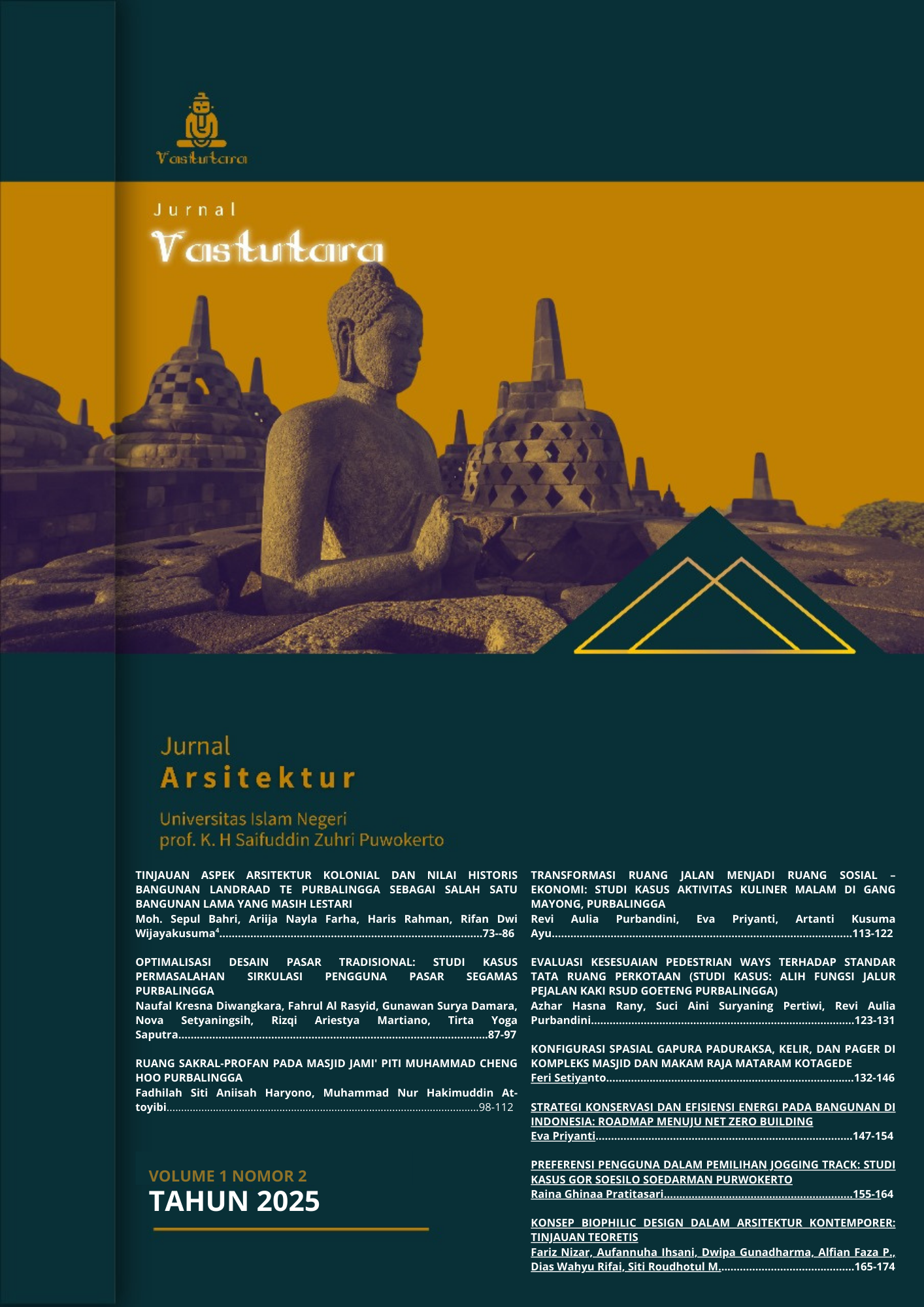
Downloads
Published
2025-12-04
Issue
Section
Articles
License
Copyright (c) 2025 Jurnal Vastutara

This work is licensed under a Creative Commons Attribution-NonCommercial-ShareAlike 4.0 International License.
You are free to:
- Share — copy and redistribute the material in any medium or format for any purpose, even commercially.
- Adapt — remix, transform, and build upon the material for any purpose, even commercially.
- The licensor cannot revoke these freedoms as long as you follow the license terms.
Under the following terms:
- Attribution — You must give appropriate credit, provide a link to the license, and indicate if changes were made. You may do so in any reasonable manner, but not in any way that suggests the licensor endorses you or your use.
- ShareAlike — If you remix, transform, or build upon the material, you must distribute your contributions under the same license as the original.
- No additional restrictions — You may not apply legal terms or technological measures that legally restrict others from doing anything the license permits.
Notices:
You do not have to comply with the license for elements of the material in the public domain or where your use is permitted by an applicable exception or limitation.
No warranties are given. The license may not give you all of the permissions necessary for your intended use. For example, other rights such as publicity, privacy, or moral rights may limit how you use the material.