OPTIMALISASI DESAIN PASAR TRADISIONAL: STUDI KASUS PERMASALAHAN SIRKULASI PENGGUNA PASAR SEGAMAS PURBALINGGA
DOI:
https://doi.org/10.24090/vastutara.v1i2.13920Keywords:
Market, Traditional, Circulation, Segamas PurbalinggaAbstract
This study investigates the main issues faced by the Segamas Traditional Market in Purbalingga. This research focuses on visitor circulation and the layout of trading zones that do not meet the standards of a traditional market. Data were obtained through field observations, interviews, and documentation using a qualitative descriptive approach based on case studies. The research results show that narrow circulation paths, unorganized vendor zoning, and a lack of supporting facilities hinder economic activities and visitor comfort. The spatial design approach offered by the researchers includes dividing the market into three main categories: dry zone, semi-dry zone, and wet zone, based on the nature of the commodities. Additionally, technical recommendations are formulated by considering SNI standards and national regulations regarding traditional markets. The redesign of the market block is carried out to improve space efficiency, make the buildings more viable, and enhance the market's function as a sustainable local economic center. This research contributes to the discussion on the revitalization of traditional markets, relying on adaptive public policies and participatory spatial planning principles.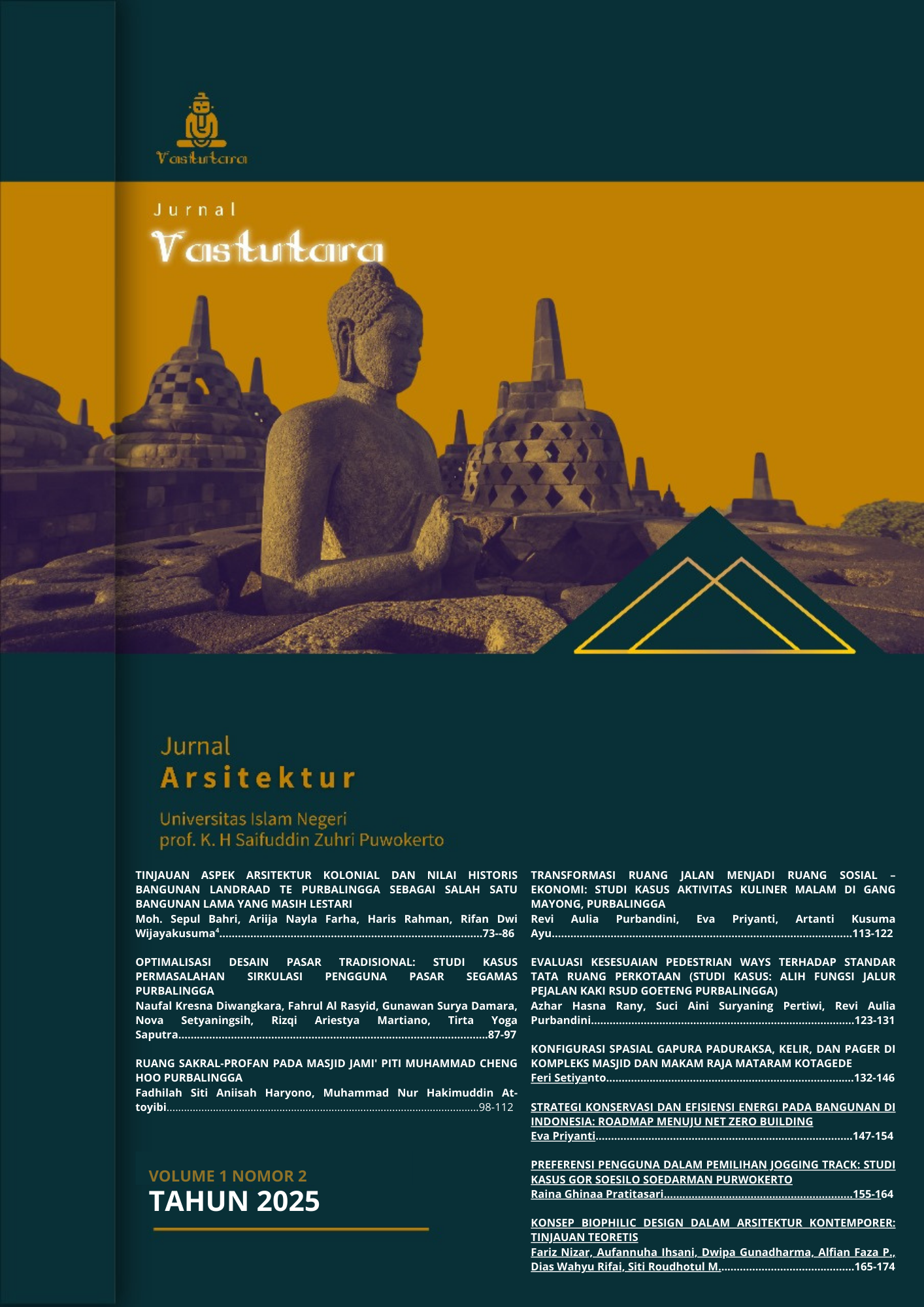
Downloads
Published
2025-12-04
Issue
Section
Articles
License
Copyright (c) 2025 Jurnal Vastutara

This work is licensed under a Creative Commons Attribution-NonCommercial-ShareAlike 4.0 International License.
You are free to:
- Share — copy and redistribute the material in any medium or format for any purpose, even commercially.
- Adapt — remix, transform, and build upon the material for any purpose, even commercially.
- The licensor cannot revoke these freedoms as long as you follow the license terms.
Under the following terms:
- Attribution — You must give appropriate credit, provide a link to the license, and indicate if changes were made. You may do so in any reasonable manner, but not in any way that suggests the licensor endorses you or your use.
- ShareAlike — If you remix, transform, or build upon the material, you must distribute your contributions under the same license as the original.
- No additional restrictions — You may not apply legal terms or technological measures that legally restrict others from doing anything the license permits.
Notices:
You do not have to comply with the license for elements of the material in the public domain or where your use is permitted by an applicable exception or limitation.
No warranties are given. The license may not give you all of the permissions necessary for your intended use. For example, other rights such as publicity, privacy, or moral rights may limit how you use the material.