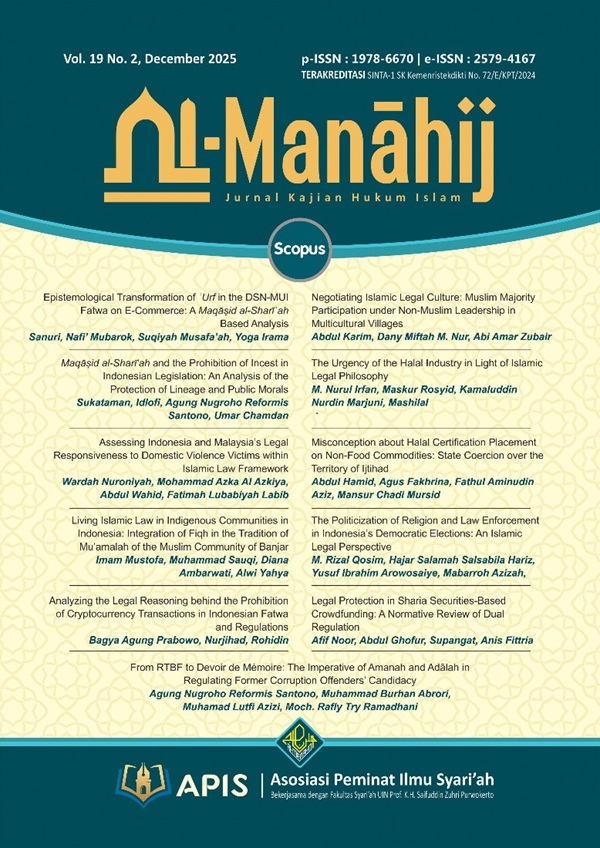
From RTBF to Devoir de Mémoire: The Imperative of Amanah and Adālah in Regulating Former Corruption Offenders' Candidacy
DOI:
https://doi.org/10.24090/mnh.v19i2.15489Keywords:
Right to Be Forgotten, Islamic Leadership Ethics, Devoir de Mémoire, Political Corruption, 'AdālahAbstract
The Indonesian regulation permitting ex-corruption convicts to run for public office after a five-year waiting period creates a critical normative dilemma, particularly when intersecting with the EU-centric' Right to Be Forgotten' (RTBF). This article explicitly aims to analyze and challenge the applicability of the RTBF framework to the candidacy of former corruption offenders by re-examining it through the lens of Islamic leadership ethics, specifically the principles of amanah, adālah, and fiqh siyasah. Using a normative-juridical approach, this study analyzes Indonesian electoral regulations and the RTBF doctrine, synthesized with classical and contemporary Islamic jurisprudence, with particular emphasis on Maqāshid al-Sharīʿah and the doctrine of sadd al-dharāʿīʿ. The findings reveal two key points: First, the five-year waiting period fundamentally misapplies RTBF by equating public records of corruption with private data; this article proposes its antithesis, devoir de mémoire (the duty to remember), as the required public policy framework. Second, Islamic jurisprudence establishes adālah (moral integrity) as a binding legal qualification (sharṭ) for public office, and corruption legally and perpetually nullifies this qualification. The study concludes that spiritual taubah (repentance) is distinct from public-legal qualification (ḥaqq al-ummah) and does not automatically restore eligibility. Therefore, disqualifying former corrupt officials does not violate rights but represents a necessary implementation of sadd al-dharā’iʿ to safeguard public amanah and protect the public interest.Downloads
References
Abdallah, Abdulkarim, Fadil Çitaku, Marianne Waldrop, Don Zillioux, Lumturie Preteni Çitaku, and Yawar Hayat Khan. "A Review of Islamic Perspectives on Leadership." International Journal of Scientific Research and Management (IJSRM), 2019. https://doi.org/10.18535/ijsrm/v7i11.sh02.
Abu, Md, and Md. Abu Issa Gazi. "Islamic Perspective of Leadership in Management: Foundation, Traits, and Principles." International Journal of Management and Accounting, 2020, 1–9. https://doi.org/10.34104/ijma.020.0109.
Afriyanto, D., F. Febrian, and I. Rumesten. "The Quasi-Judicial Authority of Bawaslu in the Perspective of Das Sollen and Fiqh Siyasah." Nurani: Jurnal Kajian Syari’ah dan Masyarakat 25, no. 2 (2025): 462–72. https://doi.org/10.19109/nurani.v25i2.30257.
Agustina, Nova, Eza Tri Yandy, and Sayuti. “Kontestasi Politik Mantan Terpidana Korupsi Dalam Pemilihan Umum (Studi Putusan Mahkamah Agung Nomor 30 P/HUM/2018).” Tanfidziy: Jurnal Hukum Tata Negara Dan Siyasah 3, no. 1 (June 30, 2024): 45–63. https://doi.org/10.47766/TANFIDZIY.V3I1.2777.
Al-Bukhārī, Muḥammad bin Ismā’īl. Ṣaḥīḥ Al-Bukhārī. Edited by Muṣṭafā Dīb Al-Bughā. Dimasyq: Dār Ibn Kathīr, 1993.
al-Bukhārī, Muḥammad bin Ismā’īl bin Ibrāhīm bin al-Mughīrah. Ṣaḥīḥ Al-Bukhārī. Edited by Jamā’ah min al-’Ulamā'. Būlāq Miṣr: As-Sulṭāniyyah, 1894.
Al-Ghazālī. Al-Mustashfā Min ‘Ilm Al-Uṣūl. Beirut: Dār al-Kutub al-‘Ilmiyyah, 1993.
Al-Ghazālī, Abū Ḥāmid. Iḥyā’ ’Ulūm Ad-Dīn. Bayrūt: Dār al-Ma’rifah, n.d.
Al-Māwardī, Abū al-Ḥasan ’Alī. Al-Ahkām as-Sulṭāniyyah. Kairo: Dār al-Ḥadīth - al-Qāhirah, 1996.
Al-Qaradāwī, Yūsuf. Fiqh Al-Dawlah Fī Al-Islām. Kairo: Maktabah Wahbah, 1997.
Al-Qurṭubī, Muḥammad ibn Aḥmad. Al-Jāmi’ Li-Aḥkām Al-Qur’ān. Edited by Aḥmad Al-Bardūnī. Ath-Thāniy. al-Qāhirah: Dār al-Kutub al-Miṣriyyah, 1964.
Al-Raysuni, Ahmad, and Nancy Roberts. Imam Al Shatibi's Theory of the Higher Objectives and Intents of Islamic Law. International Institute of Islamic Thought, 2005. https://doi.org/10.2307/j.ctvkjb1w9.
al-Rāzī, Fakhr al-Dīn. Mafātīḥ Al-Ghayb. Al-Thālithah. Bayrūt: Dār Iḥyā’ al-Turāth al-‘Arabī, 1999.
al-Ṭabarī, Abū Ja'far Muḥammad ibn Jarīr. Jāmi’ Al-Bayān ’an Ta’wīl Āy Al-Qur’ān. Edited by Ibn' Abd al-Muḥsin. Al-Ūlā. Vol. J. 8. Turkī: Dār Hajr , 2001.
Ali, Bukhari, Agustin Hanapi, Abdul Jalil Salam, Muhammad Syauqi, and Nadhilah Filzah. "The Preemptive Approach of Ulama in Aceh to Eradicating Corruption." El-Mashlahah 14, no. 2 (2024): 361–80. https://doi.org/10.23971/el-mashlahah.v14i2.8885.
Ali, Zulfiqar. "Conflict between Social Structure and Legal Framework: Political Corruption in {Pakistan}." Commonwealth & Comparative Politics 54, no. 1 (January 2016): 115–37. https://doi.org/10.1080/14662043.2015.1124497.
Alimin, Nur Sofia Nabila Binti, Siti Rahmah Awang, Tahir Ahmad, Jimaain Safar, and Shukri Mohd Nain. "Trustworthiness: The Core of Leadership in Islam." SHS Web of Conferences 56 (2018): 3002. https://doi.org/10.1051/shsconf/20185603002.
Allo, Zet Tadung, M. Syukri Akub, Aswanto Aswanto, Ratnawati Ratnawati, and Andi Muhammad Aswin Anas. "Strengthening Dominus Litis Principle for Effective Corruption Case Management in Indonesia: Harmonizing Positive Law and Islamic Legal Principles." Jurnal Ilmiah Mizani: Wacana Hukum, Ekonomi Dan Keagamaan 12, no. 2 (October 1, 2025): 529–50. https://doi.org/10.29300/MZN.V12I2.8415.
Andini, Orin Gusta, Nilasari Nilasari, and Andreas Avelino Eurian. "Restorative Justice in Indonesia Corruption Crime: A Utopia." LJIH 31, no. 1 (April 2023): 72–90. https://doi.org/10.22219/ljih.v31i1.24247.
Antari, Putu Eva Ditayani. "The Interpretation of Misconduct Act as a Reason to Dismiss President: An Ethical Approach." De Jure: Jurnal Hukum dan Syar'iah 13, no. 1 (2021): 14–31. https://doi.org/10.18860/j-fsh.v13i1.12122.
Ashraf-Khan, Mohammed Veqar, and Mohammad Shahadat Hossain. "Governance: Exploring the Islamic Approach and Its Relevance for the Modern Context." International Journal of Islamic Khazanah 11, no. 1 (2021): 29–40. https://doi.org/10.15575/ijik.v11i1.10433.
Ashsubli, Muhammad. 2017. “Perspektif Hukum Islam Terhadap Pencalonan Diri dan Kampanye untuk Jabatan Politik”. JURIS (Jurnal Ilmiah Syariah) 15 (1): 11–20. https://doi.org/10.31958/juris.v15i1.484.
Asrin, Ahmad. "Anti-Corruption Education Urgency for State Islamic Religious Teachers." Budapest International Research and Critics Institute (BIRCI-Journal) Humanities and Social Sciences 4, no. 1 (2021): 50–57. https://doi.org/10.33258/birci.v4i1.1535.
Attahiru, Mustapha Sidi. "Justice And Islamic Work Ethics: A Framework For Leaders Of Public And Private Organizations." International Journal of Research -Granthaalayah 9, no. 11 (2021): 214–26. https://doi.org/10.29121/granthaalayah.v9.i11.2021.4397.
az-Zuḥaylī, Wahbah. At-Tafsīr Al-Munīr Fī Al-’Aqīdah Wa Ash-Sharī’ah Wa Al-Manhaj. Al-Ūlā. Bayrūt: Dār al-Fikr, 1991.
Berezhnova, Julia. "Networks, Resources, and Isomorphism: Corruption from an Organizational Sociology Perspective." Journal of Economic Sociology, no. 5 (2023): 128–47. https://doi.org/10.17323/1726-3247-2023-5-128-147.
Bigo, Didier, Engin F Isin, and Evelyn Ruppert. "Data Politics. Worlds, Subjects, Rights." HAL (Le Centre pour la communication scientifique directe), 2019. https://hal-sciencespo.archives-ouvertes.fr/hal-03385170.
Birliği, Avrupa, Kamu Sektöründe, Unutulma Hakkı, Bireysel Gizlilik Ile Kamu, Yararı Arasındaki, Dengenin Sağlanması, and Ahmet Küçük. "The Right to Be Forgotten in the European Union Public Sector: Balancing Individual Privacy and Public Interest." Trabzon Üniversitesi Hukuk Fakültesi Dergisi 3, no. 2 (September 25, 2025): 321–61. https://dergipark.org.tr/tr/pub/truhfd/issue/94836/1757166.
Botutihe, Darwin. “Politik Hukum Pemenuhan Hak Dipilih Dalam Pemilihan Kepala Daerah Pasca Reformasi Di Indonesia (Studi Pencalonan Mantan Terpidana).” Universitas Islam Indonesia, 2024. https://dspace.uii.ac.id/handle/123456789/51429.
Byrum, Kristie. "The European Right to Be Forgotten: A Challenge to the United States Constitution's First Amendment and to Professional Public Relations Ethics." Public Relations Review 43, no. 1 (March 2017): 102–11. https://doi.org/10.1016/j.pubrev.2016.10.010.
Cárdenas Gracia, Jaime. "Noción, Justificación y Críticas al Principio de Proporcionalidad*." Boletín Mexicano de Derecho Comparado 47, no. 139 (January 2014): 65–100. https://doi.org/10.1016/S0041-8633(14)70501-0.
Christianto, Hwian. “Konsep Hak Untuk Dilupakan Sebagai Pemenuhan Hak Korban Revenge Porn Berdasarkan Pasal 26 Undang-Undang Informasi Dan Transaksi Elektronik.” Mimbar Hukum: Jurnal Berkala Fakultas Hukum Universitas Gadjah Mada 32, no. 2 (2020): 175–92.
Cofone, Ignacio N., y Catalina Turriago Betancourt. "The Right to Be Forgotten in Peace Processes." In The Right to Be Forgotten, edited by Ignacio N Cofone, 1st ed., 76–101. Abingdon, Oxon; New York, NY: Routledge, 2020.: Routledge, 2020. https://doi.org/10.4324/9781003017011-6.
Devine, John. "The Political Privacy Dilemma: Private Lives and Public Office." Journal of Applied Philosophy 41, no. 3 (2023): 391–408. https://doi.org/10.1111/japp.12683.
Ernasari, Nopit. “Perlindungan Data Pribadi Dalam Penegakan Hukum Pidana Di Era Digital Ditinjau Dari Perspektif Implementasi Prinsip Right to Be Forgotten Di Indonesia.” Jurnal Surya Kencana Satu : Dinamika Masalah Hukum Dan Keadilan 15, no. 2 (November 4, 2024): 163–74. https://doi.org/10.32493/JDMHKDMHK.V15I2.44591.
Fadlillah, Istiqomah. "Participation of Former Corruption Prisoner in Elections in Islamic Perspective." Jurnal Ilmiah Mahasiswa Raushan Fikr 11, no. 1 (2022): 54–77. https://doi.org/10.24090/jimrf.v11i1.6533.
———. "Participation of Former Corruption Prisoner in Elections in Islamic Perspective." Jurnal Ilmiah Mahasiswa Raushan Fikr 11, no. 1 (November 2022): 54–77. https://doi.org/10.24090/jimrf.v11i1.6533.
Fariz, Donal. “Pembatasan Hak Bagi Mantan Terpidana Korupsi Menjadi Calon Kepala Daerah.” JK 17, no. 2 (August 2020): 309. https://doi.org/10.31078/jk1724.
Fauzi, Muhammad, Mardian Idris Harahap, and Muhammad Roihan Nasution. “Pemimpin Yang Adil Dalam Al-Qur’ān (Studi Komparasi Ayat-Ayat Kepemimpinan Menurut Tafsīr Ibnu Kaṡīr Dan Tafsīr Sayyid Quṭhb).” Kamaya Jurnal Ilmu Agama 7, no. 1 (2024): 125–37. https://doi.org/10.37329/kamaya.v7i1.3152.
Fazlioglu, Muge. "Forget Me Not: The Clash of the Right to Be Forgotten and Freedom of Expression on the Internet." International Data Privacy Law 3, no. 3 (2013): 149–57. https://doi.org/10.1093/idpl/ipt010.
Fleming, Peter, Stelios Zyglidopoulos, Maria Boura, and Spyros Lioukas. "How Corruption Is Tolerated in the Greek Public Sector: Toward a Second-Order Theory of Normalization." Business & Society 61, no. 1 (January 2022): 191–224. https://doi.org/10.1177/0007650320954860.
Gang, Wang. "Systematic Interpretation of the Statute of Limitations for Criminal Prosecution." In Renmin Chinese Law Review, edited by Jichun Shi, 234–63. Edward Elgar Publishing, 2024. https://doi.org/10.4337/9781035343720.00013.
Ghafran, C. M., dan S. Yasmin. 2020. "Ethical Governance: Insight from the Islamic perspective and an empirical enquiry." Journal of Business Ethics 167 (3): 513–533. https://doi.org/10.1007/s10551-019-04170-3.
Global Legal Insights. "Saudi Anti-Corruption Law Mandates Dismissal for Convicted Government Employees." 12 August 2024.
Hakim, Putri Rahmah Nur, Irwan Abdullah, Mayadina Rohmi Musfiroh, Suraya Sintang, and Ahamed Sarjoon Razick. "Contesting Sharia and Human Rights in the Digital Sphere: Media Representations of the Caning Controversy under the Qanun Jinayat in Aceh." Journal of Islamic Law 6, no. 2 (2025): 206–35. https://doi.org/10.24260/jil.v6i2.3600.
Hariyanto, Muhammad Mutawalli Mukhlis, and Daud Rismana. "The Role and Authority of the Deputy Regional Head According to Islamic Principles Within the Framework of Regional Government Law." JURIS (Jurnal Ilmiah Syariah) 24, no. 1 (2025): 13–27. https://doi.org/10.31958/juris.v24i1.12678.
Hartati, Zarkasi, Syamsir, Firmansyah Putra, Dimas Subekti, and Zainal Amin Ayub. "Legal Aspects of Political Party Internal Conflict Resolution: A Case Study in Indonesia." Al-Risalah: Forum Kajian Hukum dan Sosial Kemasyarakatan 25, no. 1 (2025): 53–69. https://doi.org/10.30631/alrisalah.v25i1.1842.
Hermawan, Rido, Kurniawan, Rr Dewi Anggraeni, Abdul Rahman Kadir, and Achmad Syahid. "Navigating Indonesia's State Ideology: The Siyāsah Shar'iyyah Framework." Ahkam: Jurnal Ilmu Syariah 25, no. 2 (2025): 359–76. https://doi.org/10.15408/ajis.v25i2.48776.
Hidayat, Syamsul, Rodliyah, Amiruddin Amiruddin, and Lalu Parman. "Reformulation of Certain Circumstances Indicator as a Prerequisite for the Imposition of the Death Penalty in Corruption Crime." JurnalIUS-KHK 12, no. 1 (April 2024): 43–54. https://doi.org/10.29303/ius.v12i1.1350.
Ibn' Āshūr, Muḥammad aṭ-Ṭāhir. At-Taḥrīr Wa at-Tanwīr. Vol. J. 4. Tūnis: Ad-Dār at-Tūnisiyyah, 1984.
Ifandi, Teguh, and Idaul Hasanah. "Maslahat (Benefits) in Fiqh Awlâwiyât: A Comparison between Yûsuf al-Qarâdhawî's View and Abdus Salam Alî al-Karbulî's." Al-'Adalah 21, no. 1 (2024): 1–19. https://doi.org/10.24042/adalah.v21i1.213.
Indonesia Corruption Watch. “Temuan ICW dalam Daftar Calon Tetap Calon Anggota Legislatif: 56 Mantan Terpidana Korupsi Mencalonkan Diri pada Pemilu 2024 Mendatang | ICW.” Siaran pers, 6 November 2023. https://antikorupsi.org/id/temuan-icw-dalam-daftar-calon-tetap-calon-anggota-legislatif-56-mantan-terpidana-korupsi.
Indonesia, Komisi Pemilihan Umum. Peraturan Komisi Pemilihan Umum Nomor 10 Tahun 2023 tentang Pencalonan Anggota Dewan Perwakilan Rakyat, Dewan Perwakilan Rakyat Daerah Provinsi, dan Dewan Perwakilan Rakyat Daerah Kabupaten/Kota, Pub. L. No. 10 (2023).
———. Peraturan Komisi Pemilihan Umum Republik Indonesia Nomor 20 Tahun 2018 tentang Pencalonan Anggota Dewan Perwakilan Rakyat, Dewan Perwakilan Rakyat Daerah Provinsi, dan Dewan Perwakilan Rakyat Daerah Kabupaten/Kota, Pub. L. No. 20 (2018).
Indonesia, Mahkamah Agung Republik. Putusan Mahkamah Agung Republik Indonesia Nomor 46 P/HUM/2018, Pub. L. No. 46 P/HUM/2018 (2018).
Indonesia, Mahkamah Konstitusi Republik. Ikhtisar Putusan Perkara Nomor: 56/PUU-XVII/2019 Tentang Syarat Menjadi Calon Kepala Daerah Bagi Mantan Koruptor, Pub. L. No. 56 (2019).
———. Ikhtisar Putusan Perkara Nomor 2/PUU-XX/2022, Pub. L. No. 2 (2022).
———. Putusan Perkara Mahkamah Konstitusi Republik Indonesia Nomor 4/PUU-VII/2009 tentang Inkonstitusional Bersyarat Pasal “Tidak Pernah Dijatuhi Pidana” terhadap Jabatan Publik yang Dipilih, Pub. L. No. 4 (2009).
Indonesia, Pemerintah Pusat. Undang-undang (UU) Nomor 12 Tahun 2003 tentang Pemilihan Umum Anggota Dewan Perwakilan Rakyat, Dewan Perwakilan Daerah, dan Dewan Perwakilan Rakyat Daerah, Pub. L. No. 12 (2003).
———. Undang-undang (UU) Nomor 27 Tahun 2022 tentang Pelindungan Data Pribadi, Pub. L. No. 27 (2022).
———. Undang-undang Republik Indonesia Nomor 10 Tahun 2008 tentang Pemilihan Umum Anggota Dewan Perwakilan Rakyat, Dewan Perwakilan Daerah, dan Dewan Perwakilan Rakyat Daerah, Pub. L. No. 10 (2008).
———. Undang-undang Republik Indonesia Nomor 10 Tahun 2016 tentang Perubahan Kedua atas Undang-undang Nomor 1 Tahun 2015 tentang Penetapan Peraturan Pemerintah Pengganti Undang-undang Nomor 1 Tahun 2014 tentang Pemilihan Gubernur, Bupati, dan Walikota Menjadi U (2016).
Irawati, Arista Candra, and Eugenia Brandao da Silva. "Beyond Formality in Indonesian Pretrial Law: KUHAP Reform, Human Rights, and Islamic Law." Al-Ahkam 35, no. 2 (2025): 261–86. https://doi.org/10.21580/ahkam.2025.35.2.28399.
Itmam, Muhammad Shohibul, Sirajul Munir, Lukman Santoso, Taufikin, and Abdelmalek Aouich. "Legal Politics of Mining Spatial Planning in Sumenep District: Maqāṣid Syarī’ah Overview." Ijtihad: Jurnal Wacana Hukum Islam dan Kemanusiaan 25, no. 1 (2025): 1–27. https://doi.org/10.18326/ijtihad.v25i1.1-27.
Jenderal, Majelis Permusyawaratan Rakyat Sekretariat. "Undang-Undang Dasar Negara Republik Indonesia Tahun 1945," n.d.
Jha, Chandan Kumar. "Condoning Corruption: Who Votes for Corrupt Political Parties?" Journal of Economic Behavior & Organization 215 (November 2023): 74–88. https://doi.org/10.1016/j.jebo.2023.08.026.
Kadek, Ni; Dhea Ardi Prabasari; Kadek Januarsa; Adi Sudharma; and Michael Angelo. "The Right to Be Forgotten: Regulation of Personal Data Deletion in Indonesia." KRTHA BHAYANGKARA 18, no. 3 (December 23, 2024): 541–58. https://doi.org/10.31599/KRTHA.V18I3.3291.
Kaleh, E El, and Eugenie A Samıer. "The Ethics of Islamic Leadership: A Cross-Cultural Approach for Public Administration." Administrative Culture 14, no. 2 (2013): 188–211. https://pureportal.strath.ac.uk/en/publications/the-ethics-of-islamic-leadership-a-cross-cultural-approach-for-pu.
Kamali, Mohammad Hashim. Maqāṣid Al-Sharī‘ah, Ijtihad and Civilisational Renewal. Washington: The International Institute of Islamic Thought, 2012.
Katrino, Iqbal, and Yus Afrida. "People's Sovereignty in the System Presidential Threshold in the Perspective Siyāsah Al-Syar'iyyah." El-Mashlahah 11, no. 2 (2021): 187–204. https://doi.org/10.23971/elma.v11i2.3259.
Kavak, Özgür. “Hal‘, İstifa Ve İhtilal: İslam Devletlerinde İktidarin El Değiştirmesi Üzerine Bazi Tespitler.” Divan Disiplinlerarası Çalışmalar Dergisi 24, no. 47 (2019): 141–96. https://doi.org/10.20519/divan.670042.
Khan, Abdulkarim Abdallah A N D Fadil Çitaku A N D Marianne Waldrop A N D Don Zillioux A N D Lumturie Preteni Çitaku A N D Yawar Hayat. "A Review of Islamic Perspectives on Leadership." International Journal of Scientific Research and Management (IJSRM), November 2019. https://doi.org/10.18535/ijsrm/v7i11.sh02.
Klingenberg, A. M. "Catches to the Right to Be Forgotten, Looking from an Administrative Law Perspective to Data Processing by Public Authorities." International Review of Law, Computers & Technology 30, no. 1–2 (January 2016): 67–75. https://doi.org/10.1080/13600869.2015.1125161.
Ledoux, Sébastien. "'Devoir de Mémoire': The Post-Colonial Path of a Post-National Memory in France: A Study of the Development of the 'Taubira Law.'" National Identities 15, no. 3 (September 2013): 239–56. https://doi.org/10.1080/14608944.2013.779643.
Lukes, Steven. Power: A Radical View. Second Edition. London: Palgrave Macmillan, 2005.
Maietta, Angelo. "The Right to Be Forgotten." Revista de Estudos Constitucionais, Hermenêutica e Teoria do Direito (RECHTD), ISSN-e 2175-2168, Vol. 12, No. 2, 2020 (Ejemplar Dedicado a: Maio/Agosto), Págs. 207-226 12, no. 2 (2020): 207–26. https://doi.org/10.4013/rechtd.2020.122.03.
Malaysia. Pemerintah. "Federal Constitution of Malaysia." WIPO Lex / Government of Malaysia, revisi. Kuala Lumpur: Government Printer.
Maryanto, Muh. Isna Nurdin Wibisana, and Bambang Sumardjoko. "Contemporary Islamic Legal Perspectives on Qualification Policy Politics in Indonesia." MILRev: Metro Islamic Law Review 4, no. 2 (2025): 1009–27. https://doi.org/10.32332/milrev.v4i2.11305.
Moreno Bobadilla, Ángela. "El Derecho al Olvido Digital: Una Brecha Entre Europa y Estados Unidos." RCom 18, no. 1 (February 2019): 259–76. https://doi.org/10.26441/RC18.1-2019-A13.
Mubarrak, Zahrul, Imran Abu Bakar, Muslem Hamdani, Musrizal, and Khalilullah. "The Urgency of the Islamic Law and Contemporary Societal Challenges: The Flexibility of al-Maslahah in Determining the Hierarchy of Maqāṣid al-Sharīʿah." El-Usrah: Jurnal Hukum Keluarga 8, no. 1 (2025): 344–65. https://doi.org/10.22373/pxydd884.
Muhammad, Nabilah. “Ada 49 Caleg Mantan Napi Korupsi di Pemilu 2024, Ini Partai Asalnya.” Databoks, 7 November 2023. https://databoks.katadata.co.id/politik/statistik/de07440ff5e15d6/ada-49-caleg-mantan-napi-korupsi-di-pemilu-2024-ini-partai-asalnya.
Nur, Efa Rodiah, Liky Faizal, Abd. Qohar, and Harapandi Dahri Syahrum. "Reinforcing the Role of the Gakkumdu Center in Electoral Law Enforcement: A Contemporary Analysis from the Perspective of Fiqh Siyasah Dusturiyah." MILRev: Metro Islamic Law Review 4, no. 2 (2025): 1281–96. https://doi.org/10.32332/milrev.v4i2.11108.
Nurjanah, Siti, Agus Salim Ferliadi, Wahyu Abdul Jafar, Wihda Yanuar Firdaus, and Fatin Hamamah. "Mitigating the Digital Age Impact: Collaborative Strategies of State and Religious Institutions for Family Harmony in Indonesia." El-Usrah: Jurnal Hukum Keluarga 7, no. 2 (2024): 713–41. https://doi.org/10.22373/ujhk.v7i2.25754.
Obeidi, Ali Hadi Al, Zeyad Jaffal, and Jamal Barafi. "Conditions for Exercising the 'Right to Be Forgotten' on Social Media under the 2021 UAE Data Protection Law." GPLR 5, no. Issue 3 (August 2024): 109–18. https://doi.org/10.54648/GPLR2024019.
Oganesian, Tigran D. “Правовые Основы, Пределы и Стандарты Применения Права Быть Забытым: Опыт Европейского Союза.” Вестник Санкт-Петербургского Университета. Право 14, no. 3 (September 28, 2023): 750–67. https://doi.org/10.21638/spbu14.2023.312.
Okello-Obura, Constant. "Effective Records and Information Management as a Catalyst for Fighting Corruption." Information Development 29, no. 2 (May 2013): 114–22. https://doi.org/10.1177/0266666912451847.
Osman, Amr. "The Right to Be Forgotten: An Islamic Perspective." Hum Rights Rev 24, no. 1 (March 2023): 53–73. https://doi.org/10.1007/s12142-022-00672-2.
Pakistan. National Assembly. Constitution of the Islamic Republic of Pakistan. 1973 (diubah hingga 31 Mei 2018). Islamabad: National Assembly of Pakistan.
Pander Maat, Eva, Daan Van Maurik, Rosario Garza Islas, and Giancarlo Piscitelli. "The Right to Be Forgotten in the UK: A Case Note on the English and Welsh High Court Reasoning in NT1 & NT2 v. Google and the Post-Brexit Prospects in the GDPR Era." ERPL 30, no. Issue 2 (May 2022): 263–90. https://doi.org/10.54648/ERPL2022014.
Pemerintah Pusat Indonesia. Undang-undang (UU) Nomor 7 Tahun 2017 tentang Pemilihan Umum, Pub. L. No. 7 (2017). https://peraturan.bpk.go.id/details/37644/uu-no-7-tahun-2017.
Politou, Eugenia, Efthimios Alepis, Maria Virvou, and Constantinos Patsakis. "The General Data Protection Regulation." In Privacy and Data Protection Challenges in the Distributed Era, 26:13–39. Cham: Springer International Publishing, 2022. https://doi.org/10.1007/978-3-030-85443-0_3.
Pressly, Lowry. "The Right to Be Forgotten and the Value of an Open Future." Https://Doi.Org/10.1086/731431 135, no. 1 (October 1, 2024): 65–87. https://doi.org/10.1086/731431.
Prysyazhnyuk, Olexandr, Yuriy Shovkun, Maksym Korniienko, Yevhen Pashchenko, and Nana Charles Nguindip. "Re-evaluating the Views in Combating Corruption Criminal Offenses Under Martial Law." Syariah: Jurnal Hukum dan Pemikiran 24, no. 2 (2024): 285–98. https://doi.org/10.18592/sjhp.v24i2.14876.
Qosim, M. Rizal, Hajar Salamah Salsabila Hariz, Yusuf Ibrahim Arowosaiye, Mabarroh Azizah, and Idamatussilmi. " The Politicization of Religion and Law Enforcement in Indonesia's Democratic Elections: An Islamic Legal Perspective." Al-Manahij: Jurnal Kajian Hukum Islam 19, no. 2 (2025): 313–34. https://doi.org/10.24090/mnh.v19i2.15244.
Rahmat, Widya, and Luci Afiani Oktavia. “Urgensi Administrasi Publik dalam Islam : Tinjauan Maslahah Mursalah.” Jurnal Hadratul Madaniyah 11, no. 1 (2024): 62–68. https://doi.org/10.33084/jhm.v11i1.7578.
Ramadhani, Evyta Rosiyanti, Ayudya Rizqi Rachmawati, and Roro Hera Kurnikova. "Integrating Islamic Values with the Right to Be Forgotten: A Legal Approach to Addressing Deepfake Pornography in Indonesia." De Jure: Jurnal Hukum Dan Syar’iah 17, no. 1 (April 12, 2025): 112–31. https://doi.org/10.18860/J-FSH.V17I1.28880.
Reynolds, Gabriel Said, and Amir Moghadam. "Repentance in the Quran, Hadith, and Ibn Qudāma's Kitāb Al-Tawwābīn." Journal of the American Oriental Society 141, no. 2 (2021). https://doi.org/10.7817/jameroriesoci.141.2.0381.
Riady, R., F. Febrian, N. Nashriana, and M. Yusuf. "Reformulating the Reversal of the Burden of Proof in Corruption Cases: Integrating Positive Law and Islamic Legal Principles." Nurani: Jurnal Kajian Syari’ah dan Masyarakat 25, no. 2 (2025): 514–28. https://doi.org/10.19109/nurani.v25i2.30483.
Rofi Wahanisa, R. Benny Riyanto, Syahwal, Eko Mukminto, and Uche Nnawulezi. "From Justice to Politics: The Constitutional Court's Role in Structured and Systematic Election Violations." Lesrev 9, no. 1 (May 2025). https://doi.org/10.15294/lslr.v9i1.21103.
Rothstein, Bo, and Eric M. Uslaner. "All for All: Equality, Corruption, and Social Trust." World Politics 58, no. 1 (October 2005): 41–72. https://doi.org/10.1353/WP.2006.0022.
Sajid, Mohammed Hashim Ali. "Islamic Perspectives on Good Governance: A Comprehensive Analysis." International Journal of Applied Research 10, no. 10 (2024): 100–104. https://doi.org/10.22271/allresearch.2024.v10.i10b.12077.
Santono, Agung Nugroho Reformis, Luqman Hakim, and Anfasa Naufal Reza Irsali. "Can Islamic Law Mitigate Corruption?" Peradaban Journal of Religion and Society 4, no. 2 (2025): 97–121. https://doi.org/10.59001/pjrs.v4i2.314.
Saptono, Prianto Budi, Ismail Khozen, and Ferry Jie. "Obedience to Uli'il-Amr and Tax Compliance: Islamic Scholarly Perceptions." Journal of Islamic Thought and Civilization 13, no. 1 (2023). https://doi.org/10.32350/jitc.131.08.
Sholihah, Amanatus. "Retraction of the Corruptor's Political Right in Islamic Criminal Law Perspective." Walisongo Repository (Walisongo State Islamic University). Walisongo State Islamic University, 2018.
Siahaan, Leonardo. “Putusan Nomor 87/Puu-Xx/2022 Demi Keadilan Berdasarkan Ketuhanan Yang Maha Esa Mahkamah Konstitusi Republik Indonesia.” Bekasi, 2022. https://www.mkri.id/public/content/persidangan/putusan/putusan_mkri_8784_1669787264.pdf.
Siregar, Muhammad Habibi, Nofri Andy.N, Zulkarnain Abdurrahman, Muhiddinur Kamal, and Zainal Zainal. "Digital Fiqh and Ethical Governance: Negotiating Islamic Normativity and Online Narcissism in Contemporary Indonesia." JURIS (Jurnal Ilmiah Syariah) 24, no. 1 (2025): 181–91. https://doi.org/10.31958/juris.v24i1.13218.
Sitaresmi, Adhisty, Mas Rahmah, Suparto Wijoyo, and Adhitya Panji Anom. "Legal Frameworks for Cybersecurity and Data Protection in Cloud-Based Notarial Systems in Indonesia: An Intersectional Analysis of Positive Law and Islamic Legal Principles." Al-'Adalah 22, no. 1 (2025): 29–62. https://doi.org/10.24042/adalah.v22i1.26813.
Sodiqin, Ali, and Anwar M. Radiamoda. "The Dynamics of Islamic Constitution: From the Khilāfah Period to the Nation-State." Journal of Islamic Law 2, no. 2 (2021): 138–67. https://doi.org/10.24260/jil.v2i2.241.
Subekti. “Mantan Napi Korupsi Melenggang Menjadi Anggota Dewan: Nurdin Halid dan Desy Yusandi | tempo.co.” Tempo.co, 29 Maret 2024. https://www.tempo.co/politik/mantan-napi-korupsi-melenggang-menjadi-anggota-dewan-nurdin-halid-dan-desy-yusandi-72783.
Sukataman, Idlofi, Agung Nugroho Reformis Santono, and Umar Chamdan. "Maqāṣid Al-Sharī‘ah and the Prohibition of Incest in Indonesian Legislation: An Analysis of the Protection of Lineage and Public Morals." Al-Manahij: Jurnal Kajian Hukum Islam 19, no. 2 (2025): 205–26. https://doi.org/10.24090/mnh.v19i2.14989.
Suparno, Rusli, and Ia Hidarya. "A New Restorative Justice Paradigm in the Sociology of Islamic Law in Indonesia: Nahdlatul Ulama and Muhammadiyah's Responses to Corruption Cases." Syariah: Jurnal Hukum dan Pemikiran 24, no. 2 (2024): 480–502. https://doi.org/10.18592/sjhp.v24i2.16221.
Tambunan, Derwin. "Indonesia under Threat: The Danger of Corruption to Political Legitimacy." Asian Journal of Comparative Politics 8, no. 1 (March 2023): 112–40. https://doi.org/10.1177/20578911221124965.
Taufiq, Muhammad, Jihan Amalia Syahidah, Muhammad Fauzinudin Faiz, and Erie Hariyanto. "Tengka, Identity Politics, and the Fiqh of Civilization: The Authority of Madura’s Kiai in the Post-Truth Era." Ijtihad: Jurnal Wacana Hukum Islam dan Kemanusiaan 24, no. 1 (2024): 139–65. https://doi.org/10.18326/ijtihad.v24i1.139-165.
Taufiqurrohman, A.H. Asari, Mohamad Hidayat Muhtar, Ahmad, Nur Mohamad Kasim, and Suwitno Yutye Imran. "The Role of Islamic Law, Constitution, and Culture in Democracy in the UAE and Indonesia." Ahkam: Jurnal Ilmu Syariah 24, no. 1 (2024): 83–100. https://doi.org/10.15408/ajis.v24i1.33155.
Ud Din, Salah, Sharifah Hayaati Syed Ismail, and Raja Hisyamudin Raja Sulong. "Combating Corruption Based on Al-Siyasah Al-Syar'iyyah Perspective: A Literature Review." International Journal of Ethics and Systems. Emerald Publishing Limited, 2023. https://doi.org/10.1108/ijoes-12-2022-0312.
Uslaner, Eric M. "Trust and Corruption." In The New Institutional Economics of Corruption, 90–106. Routledge, 2004. https://doi.org/10.4324/9780203413920-9.
Utama, Budi, Angkasa Angkasa, Kuat Puji Prayitno, Tedi Sudrajat, and Muhammad Ainun Najib. "Islamic Law Analysis of the Prosecutor’s Authority in Asset Forfeiture from Corruption." Al-Ahkam 35, no. 2 (2025): 313–48. https://doi.org/10.21580/ahkam.2025.35.2.26343.
Utami, Husni Putri, RR. Rina Antasari and Eti Yusnita. "From Conviction to Candidacy: A Juridical and Siyasah Analysis of the Waiting Period for Former Corruptors under the Election Law." Jurnal Mediasas: Media Ilmu Syari’ah Dan Ahwal Al-Syakhsiyyah 8, no. 2 (July 1, 2025): 473–81. https://doi.org/10.58824/MEDIASAS.V8I2.360.
Vavra, Ashley Nicole. "The Right to Be Forgotten: An Archival Perspective." The American Archivist 81, no. 1 (March 2018): 100–111. https://doi.org/10.17723/0360-9081-81.1.100.
Wahyuni, Fitri, Ishaq Ishaq, and Aris Irawan. "Criminal Sanctions for Corruption Crimes Based on Perspective Study of Renewal Law and the Relationship with Islamic Criminal Law." Al-Risalah 21, no. 2 (December 2021): 219–33. https://doi.org/10.30631/alrisalah.v21i2.795.
Walker, Robert Kirk. "Note – The Right to Be Forgotten." Hastings Law Journal 64, no. 1 (2012): 257. https://repository.uchastings.edu/cgi/viewcontent.cgi?article=1200%5C&context=hastings%5C_law%5C_journal.
Wibowo, Waskito, Yuli Yasin, Mohammad Syairozi Dimyathi, and Saepul Anwar. "Min al-Hall ilā al-Qawmiyyah: Fiqh as-Siyāsah li al-Qam‘i al-Jadalī Tijāh al-Jamā‘āt al-Islāmiyyah bi Indūnīsiyā." al-Ihkam: Jurnal Hukum dan Pranata Sosial 20, no. 1 (2025): 284–311. https://doi.org/10.19105/al-lhkam.v20i1.8557.
Yunita, I Made, Anak Agung Putu Sugiantiningsih, and Mohammad Hidayaturrahman. "Vote Buying among Madurese Muslim; Islamic Law Standpoint." al-Ihkam: Jurnal Hukum dan Pranata Sosial 19, no. 2 (2024): 444–69. https://doi.org/10.19105/al-lhkam.v19i2.13025.
Zanetti, Véronique. "Proportionality and Compromises." J. Moral Philos. 17, no. 1 (February 2020): 75–97. https://doi.org/10.1163/17455243-20182843.
Zhang, Dawen, Pamela Finckenberg-Broman, Thong Hoang, Shidong Pan, Zhenchang Xing, Mark Staples, and Xiwei Xu. "Right to Be Forgotten in the Era of Large Language Models: Implications, Challenges, and Solutions." AI and Ethics, 2024. https://doi.org/10.1007/s43681-024-00573-9.
Downloads
Published
How to Cite
Issue
Section
License
Copyright (c) 2025 Agung Nugroho Reformis Santono, Muhammad Burhan Abrori, Muhamad Lutfi Azizi, Moch. Rafly Try Ramadhani

This work is licensed under a Creative Commons Attribution-ShareAlike 4.0 International License.
Authors who publish with this journal agree to the following terms:
- Authors retain copyright and grant the journal right of first publication with the work simultaneously licensed under a Creative Commons Attribution License that allows others to share the work with an acknowledgement of the work's authorship and initial publication in this journal.
- Authors are able to enter into separate, additional contractual arrangements for the non-exclusive distribution of the journal's published version of the work (e.g., post it to an institutional repository or publish it in a book), with an acknowledgement of its initial publication in this journal.
- Authors are permitted and encouraged to post their work online (e.g., in institutional repositories or on their website) prior to and during the submission process, as it can lead to productive exchanges, as well as earlier and greater citation of published work (See The Effect of Open Access).