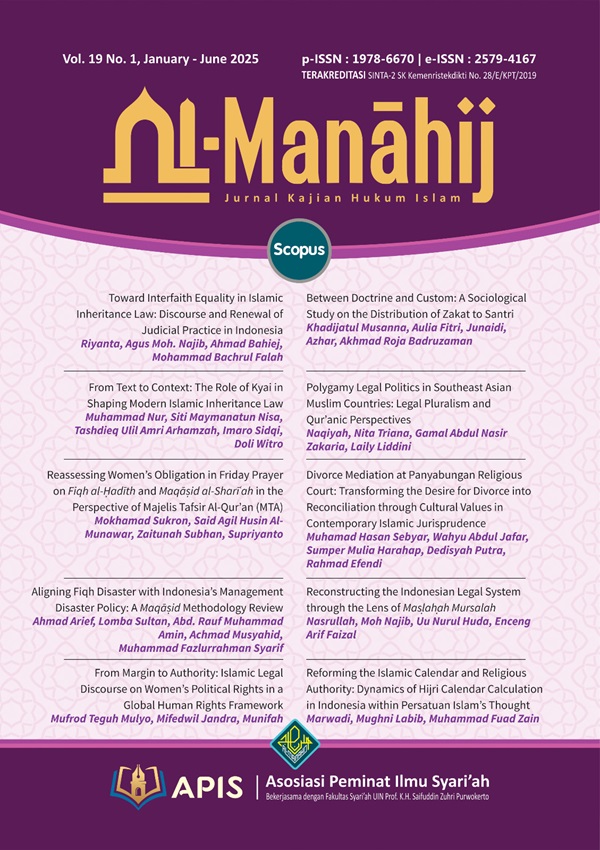
From Margin to Authority: Islamic Legal Discourse on Women’s Political Rights in a Global Human Rights Framework
DOI:
https://doi.org/10.24090/mnh.v19i1.13247Keywords:
Protection of Women’s, Political Rights, human rights, Islamic ValuesAbstract
This article examines the protection of women’s political rights in Islam concerning international human rights conventions. While numerous studies have addressed the historical evolution of women’s political participation, limited attention has been given to the normative foundations of Islamic teachings supporting such rights. This study seeks to fill that gap by focusing on how Islamic values uphold and safeguard women’s political rights. Employing a legal-normative approach, the research examines classical and contemporary legal literature and religious interpretations, particularly referring to the Qur’an Surah Al-Mumtahanah (60:12) as key textual evidence. The findings reveal that Islamic teachings not only permit but actively encourage women’s involvement in political life, challenging conservative interpretations that limit their participation under religious pretexts. This research contributes to scholarly discourse by fostering reconciliation between Islamic principles and global human rights standards, promoting a more inclusive and empowering view of women in Muslim societies. It also refutes prevalent misconceptions regarding Islam’s stance on women’s political engagement. Future studies are encouraged to conduct comparative analyses of how women’s political rights are implemented across diverse Islamic and non-Islamic socio-political contexts.Downloads
References
Abdullah, Fuady, Nova Anggraini Putri, and Youssof Salhein. “Revisiting ‘Iddah: A Critical Analysis of Gender Equality in Indonesian Feminist Islamic Legal Discourse.” JURIS (Jurnal Ilmiah Syariah) 22, no. 2 (December 15, 2023): 275. https://doi.org/10.31958/juris.v22i2.10320.
Abdullah, Muhammad Amin. “Islamic Studies in Higher Education in Indonesia: Challenges, Impact and Prospects for the World Community.” Al-Jami’ah: Journal of Islamic Studies 55, no. 2 (December 2017): 391–426. https://doi.org/10.14421/ajis.2017.552.391-426.
Abdulmelik, N, and T Belay. “Advancing Women’s Political Rights in Africa: The Promise and Potential of ACDEG .” Africa Spectrum 54, no. 2 (2019): 147–61. https://doi.org/10.1177/0002039719881321.
Ahmad. “Islamic Rule and the Empowerment of the Poor and Pious.” Econometrica 82, no. 1 (2014): 229–69. https://doi.org/10.3982/ECTA9878.
Al-Marakeby, Muhammad. “Rethinking Modern Fatwa Typology: An Ethnographic Study on Al-Azhar Fatwa Council.” Islamic Studies Review 1, no. 2 (2022): 197–216. https://doi.org/10.56529/isr.v1i2.85.
Alfani, Ilzam Hubby Dzikrillah, Mukhsin Mukhsin, Muhammad Hafidz Khusnadin, Siti Chodijah, and Asya Dwina Luthfia. “Qur’anic Perspective of Gender Equality: Classical and Modern Tafsir.” Gender Equality: International Journal of Child and Gender Studies 11, no. 1 (2025): 33–52.
Amin, Qasim. Modernist and Fundamentalist Debates in Islam. Edited by Mansoor Moaddel and Kamran Talattof. Modernist and Fundamentalist Debates in Islam: A Reader. New York: Palgrave Macmillan US, 2000. https://doi.org/10.1007/978-1-137-09848-1.
Arief Budiman, Muhammad Saifullah, and Bahrul Ulum. “Wājibah Will for Non-Muslim Heirs in Indonesia: A Legal Political Perspective Based on Justice and Welfare.” Ijtihad : Jurnal Wacana Hukum Islam Dan Kemanusiaan 24, no. 2 (December 28, 2024): 223–50. https://doi.org/10.18326/ijtihad.v24i2.223-250.
Barnes, Tiffany D., and Stephanie M. Burchard. “‘Engendering’ Politics: The Impact of Descriptive Representation on Women’s Political Engagement in Sub-Saharan Africa.” Comparative Political Studies 46, no. 7 (2013): 767–90. https://doi.org/10.1177/0010414012463884.
Begum, Mohamed Sulthan Ismiya, Indriaty Ismail, Zul’Azmi Yaakob, Ahamed Sarjoon Razick, and Mohamed Mahroof Ali Abdullah. “Gender Equity in Muslim Family Law: Modern and Contemporary ‘Ulamā’s View.” Al-Ahkam 34, no. 2 (2024): 221–56. https://doi.org/10.21580/ahkam.2024.34.2.20773.
Bennett, Linda Rae. “Women, Islam and Modernity.” Women, Islam and Modernity, no. July (2005). https://doi.org/10.4324/9780203391389.
Bullough, Amanda, K. Galen Kroeck, William Newburry, Sumit K. Kundu, and Kevin B. Lowe. “Women’s Political Leadership Participation around the World: An Institutional Analysis.” Leadership Quarterly 23, no. 3 (2012): 398–411. https://doi.org/10.1016/j.leaqua.2011.09.010.
Caprioli, Mary. “Gendered Conflict.” Journal of Peace Research 37, no. 1 (January 2000): 51–68. https://doi.org/10.1177/0022343300037001003.
Carpiuc, Cecilia Rocha. “Women and Diversity in Latin American Political Science.” European Political Science 15, no. 4 (2016): 457–75. https://doi.org/10.1057/s41304-016-0077-4.
Childs, Sarah, and Mona Lena Krook. “Analysing Women’s Substantive Representation: From Critical Mass to Critical Actors.” Government and Opposition 44, no. 2 (January 2009): 125–45. https://doi.org/10.1111/j.1477-7053.2009.01279.x.
Daniah, Izza Annafisatud. Handbook of Islamic Sects and Movements. Islamic Studies Review. Vol. 1, 2022. https://doi.org/10.56529/isr.v1i2.87.
Eger, Claudia. “Equality and Gender at Work in Islam: The Case of the Berber Population of the High Atlas Mountains.” Business Ethics Quarterly 31, no. 2 (2021): 210–41. https://doi.org/10.1017/beq.2020.21.
Faidi, Ahmad. “Sistem Kekhalifahan Dan Konstruksi Budaya Politik Arab.” AL-IHKAM: Jurnal Hukum & Pranata Sosial 13, no. 1 (July 31, 2018): 187–225. https://doi.org/10.19105/al-lhkam.v13i1.1478.
Faizah, Nur, Ahmad Rezy Meidina, Achmad Lubabul Chadziq, Moch. Iqbal, and M. Shaiful Umam. “The Role of Indonesian Women Ulama Congress (KUPI) in the Search for Gender Equality-Based Islamic Law.” Al-’Adalah 21, no. 2 (December 2024): 323. https://doi.org/10.24042/adalah.v21i2.23698.
Fakhyadi, Defel, Muhammad Adib Samsudin, Vito Dasrianto, Muhammad Danil, and Ade Arga Wahyudi. “Reconstructing Gender Relations for Family Resilience in Minangkabau: Integrating Islamic Law and Customary Law.” Al-Ahkam 35, no. 1 (April 29, 2025): 1–30. https://doi.org/10.21580/ahkam.2025.35.1.22906.
Fernández, Juan J., and Celia Valiente. “Gender Quotas and Public Demand for Increasing Women’s Representation in Politics: An Analysis of 28 European Countries.” European Political Science Review 13, no. 3 (2021): 351–70. https://doi.org/10.1017/S1755773921000126.
Fernando, Henky, Yuniar Galuh Larasati, Irwan Abdullah, Ismail Ismail, Ahmad Yunani, M Nastain, and Leanne Morin. “The Controversy of Indonesian Democracy Practices in The Post-Reform.” Al-Risalah: Forum Kajian Hukum Dan Sosial Kemasyarakatan 24, no. 2 (December 30, 2024): 159–77. https://doi.org/10.30631/alrisalah.v24i2.1594.
Firdayanti, Novia, Triono Ali Mustofa, and Nur Saadah Hamisan Khair. “Gender Equality in the Perspective of the Qur’an.” Advances in Social Science, Education and Humanities Research 1 (2024): 142–48. https://doi.org/10.2991/978-2-38476-102-9_13.
Fish, M. Steven. “Islam and Authoritarianism.” World Politics 55, no. 1 (October 2002): 4–37. https://doi.org/10.1353/wp.2003.0004.
Habi, Nuraida Fitri, and Muhammad Atho Mudzhar. “Women, Islamic Law and Custom in Pucuk Induk Undang Nan Limo Manuscript of Jambi.” Ahkam: Jurnal Ilmu Syariah 24, no. 2 (2024): 233–50. https://doi.org/10.15408/ajis.v24i1.38557.
Hanani, Silfia, Nelmaya Nelmaya, Zakiyah Ulya, Elsa Aldian, Ahmad Yunus Bin Mohd Noor, and Sitto Rahmana. “Islamic Legal Approach in Preventing Women’s Involvement in Spreading Hoaxes on Social Media.” JURIS (Jurnal Ilmiah Syariah) 23, no. 2 (October 7, 2024): 281. https://doi.org/10.31958/juris.v23i2.13082.
Hasim, Fuad, and Saadatul Maghfira. “Dialektika Pengangkatan Menteri Perspektif Al Mawardi Dan Ibn Khaldun.” Journal of Law, Society, and Islamic Civilization 12, no. 1 (n.d.): 1–11.
Inayatillah, Inayatillah. “Acehnese Women in Public Spaces: Theirmovement and Political Participation.” Jurnal Ilmiah Peuradeun 11, no. 1 (January 30, 2023): 117. https://doi.org/10.26811/peuradeun.v11i1.823.
Ismail, Nurjannah, Muhammad Firdaus, and Edi Darmawijaya. “Gender Equality in the Qur’an: An Analysis of Surah an-Nisa’ Verses 1 and 34 in the Exegesis of Al-Tabari and Al-Rāzī.” Gender Equality: International Journal of Child and Gender Studies 10, no. 2 (September 2024): 224. https://doi.org/10.22373/equality.v10i2.25932.
Ismail, Zulfikar, and Maisyarah Rahmi Hasan. “Islamic Legal Modernism and Women’s Emancipation in Tunisia.” Mazahib, February 2021, 281–314. https://doi.org/10.21093/mj.v19i2.2800.
Joshi, M, and L Olsson. “War Termination and Women’s Political Rights.” Social Science Research 94 (2021). https://doi.org/10.1016/j.ssresearch.2020.102523.
Jubba, Hasse, Ahmad Sunawari Long, Zuly Qodir, Umar Werfete, and Muhamad Nastain. “Changes in the Political Behavior of Towani Tolotang as a Minority Religious Group: Fiqh Al-‘Aqaliyyāt Perspective.” AL-IHKAM: Jurnal Hukum & Pranata Sosial 18, no. 2 (December 29, 2023): 392–419. https://doi.org/10.19105/al-lhkam.v18i2.10184.
Karp, Jeffrey A., and Susan A. Banducci. “When Politics Is Not Just a Man’s Game: Women’s Representation and Political Engagement.” Electoral Studies 27, no. 1 (2008): 105–15. https://doi.org/10.1016/j.electstud.2007.11.009.
Kertamukti, Rama, Shaun M Anderson, and Asrul Zain Asy’ari. “Empowering Rural Women through Transformative Leadership: Insights from KWT Pawon Gendis.” Jurnal Ilmiah Peuradeun 13, no. 1 (January 30, 2025): 647. https://doi.org/10.26811/peuradeun.v13i1.1244.
Khasanah, Nur, Achmad Irwan Hamzani, and Havis Aravik. “Hermeneutics of the Qur’an: A Study of Muhammad Syahrur’s Thoughts on the Men and Women Equality.” Nurani: Jurnal Kajian Syari’ah Dan Masyarakat 20, no. 1 (June 2020): 25–36. https://doi.org/10.19109/nurani.v20i1.5339.
Krook, M L, and J R Sanín. “Violence against Women in Politics: A Defense of the Concept.” Politica y Gobierno 23, no. 2 (2016): 459–90.
M.Jakfar, Tarmizi, Maizuddin, Misri A. Muchsin, Sri Chalida, and Nadhilah Filzah. “Efforts to Moderate Islamic Law Understanding through Hadith Studies in Aceh and West Sumatra Mosques.” AL-IHKAM: Jurnal Hukum & Pranata Sosial 20, no. 1 (May 12, 2025). https://doi.org/10.19105/al-lhkam.v20i1.14609.
Matondang, Ikhwan. “Resolving Human Rights Violation Cases in Aceh, Indonesia.” Al-Risalah: Forum Kajian Hukum Dan Sosial Kemasyarakatan 24, no. 1 (June 29, 2024): 61–70. https://doi.org/10.30631/alrisalah.v24i1.1539.
Miller, Henry. “The British Women’s Suffrage Movement and the Practice of Petitioning, 1890–1914.” The Historical Journal 64, no. 2 (March 2021): 332–56. https://doi.org/10.1017/S0018246X20000035.
Mir‐Hosseini, Ziba. “Muslim Women’s Quest for Equality: Between Islamic Law and Feminism.” Critical Inquiry 32, no. 4 (June 2006): 629–45. https://doi.org/10.1086/508085.
Mofrad, Hosein Khoshdel, Lida Maddi, and Mohammad Nasehi. “A Comparative Analysis of the Social Interpretational Approach of Sayyid Qutb in Fi Zilal Al-Quran and Muhammad Jawad Mughniyah in Al-Kashaf with a Focus on Family.” Islamic Studies and Quranic Research in the Contemporary World 2, no. 1 (2023): 133–48. https://doi.org/10.22034/iscw.2023.713414.
Muhammad, Husain, and Ramlani Lina Sinaulan. “Analysis Women’s Political Participation In Public Administration Review From Gender Mainstream.” European Journal of Research Development and Sustainability 3, no. 5 (2022): 18–22.
Muhibbu-Din, Mahmudat O. “Feminism and Modern Islamic Politics: The Fact and the Fallacy.” International Journal of Islamic Thought 15 (2019): 44–59. https://doi.org/10.24035/ijit.15.2019.005.
Muqtada, Muhammad Rikza, Istianah, Ahmad Sharifuddin bin Mustapha, and Abdul Mufid. “Fiqh Contestation on Women’s Public Leadership in Indonesia and Malaysia: Reproducing Qur’anic and Hadith Interpretations.” AL-IHKAM: Jurnal Hukum & Pranata Sosial 19, no. 1 (June 30, 2024): 221–48. https://doi.org/10.19105/al-lhkam.v19i1.13163.
Najafli, Emin, Eduard Kisiliuk, Oleksandr Dubenko, Serhii Burlakov, and Volodymyr Yarmaki. “Ensuring Human Rights in Ukraine during Introduction of Martial Law: Constitutional and Administrative Aspect.” Syariah: Jurnal Hukum Dan Pemikiran 24, no. 1 (April 18, 2024): 52–72. https://doi.org/10.18592/sjhp.v24i1.12527.
Putra, Dedisyah, and Nuriza Acela. “Human Rights Protection in the Islamic Family Law: A Case Study Concerning Domestic Violences.” El-Usrah: Jurnal Hukum Keluarga 6, no. 1 (2023): 1–16.
Rahbari, Ladan. “When Gender Turns Right: Racializing Islam and Femonationalism in Online Political Discourses in Belgium.” Contemporary Politics 27, no. 1 (2020): 41–57. https://doi.org/10.1080/13569775.2020.1813950.
Rahmaniah, Aniek, Emy Susanti, Dwi Windyastuti Budi Hendrarti, and Ulfi Andrian Sari. “The Movement of Muhammadiyah Women: Religious Values, Culture, and Gender Equality.” Jurnal Ilmiah Peuradeun 13, no. 1 (January 30, 2025): 669. https://doi.org/10.26811/peuradeun.v13i1.1089.
Ramli, Angraini binti, and Radwan Jamal Elatrash. “Woman Participation in Politics: Toward an Ideal Model in the Perspective of Siyasa Al-Shar’iyya.” Al-Risalah: Forum Kajian Hukum Dan Sosial Kemasyarakatan 21, no. 1 (June 2021): 1–11. https://doi.org/10.30631/alrisalah.v21i1.564.
Rizal, Deri, Irman Irman, Dewi Putri, Miftahurrahmah Miftahurrahmah, Yustiloviani Yustiloviani, and Kamaluddin Kamaluddin. “Reinterpreting Religious Texts on Gender Equality: The Perspective of Ahmad Syafii Maarif.” JURIS (Jurnal Ilmiah Syariah) 23, no. 2 (November 20, 2024): 327. https://doi.org/10.31958/juris.v23i2.10233.
Rusli, Ris’An, Wijaya, Alfi Julizun Azwar, and Devi Aulia Utami. “Rechtsstaat from the Perspective of Al-Ghazali and Ibn Khaldun.” International Journal of Law and Society 4, no. 1 (2025): 1–21. https://doi.org/10.59683/ijls.v4i1.106.
Schneider, Monica C., and Angela L. Bos. “The Application of Social Role Theory to the Study of Gender in Politics.” Political Psychology 40, no. S1 (2019): 173–213. https://doi.org/10.1111/pops.12573.
Shabana, Ayman. “Islamic Normative Principles Underlying Fatwas on Assisted Reproductive Technologies: Al-Azhar Fatwa on Artificial Insemination1.” Muslim World 111, no. 3 (2021): 511–33. https://doi.org/10.1111/muwo.12406.
Smith, Sonya G., and Jeanne C. Sinkford. “Gender Equality in the 21st Century: Overcoming Barriers to Women’s Leadership in Global Health.” Journal of Dental Education 86, no. 9 (2022): 1144–73. https://doi.org/10.1002/jdd.13059.
Sommer, U, and V Asal. “A Comparative Analysis of Women’s Political Rights, 1981–2004: The Role of Legal Traditions.” Journal of Women, Politics and Policy 41, no. 4 (2020): 416–40. https://doi.org/10.1080/1554477X.2019.1701935.
Suharsono, Agus, Nanik Prasetyoningsih, and Sunyoto Usman. “Women’s Inheritance Rights in Indonesia from the Perspective of the Triangular Concept of Legal Pluralism.” El-Mashlahah 14, no. 2 (2024): 259–80.
Sulaeman, Otong, Dodon Alfiander, Oktari Kanus, Sri Nur Rahmi, and Bekti Utomo. “Negotiating Gender Justice in Minangkabau Marital Disputes: Between Adat, Islamic, and State Law.” JURIS (Jurnal Ilmiah Syariah) 24, no. 1 (March 11, 2025): 39. https://doi.org/10.31958/juris.v24i1.11848.
Sulastri Caniago, Firdaus, Zainal Azwar, Dian Pertiwi, and Dasrizal Marah Nainin. “Gender Integration in Islamic Politics: Fiqh Siyasah on Women’s Political Rights since Classical to Contemporary Interpretations.” MILRev: Metro Islamic Law Review 3, no. 2 (December 30, 2024): 411–31. https://doi.org/10.32332/milrev.v3i2.9962.
Syatar, Abdul, Muhammad Imran, M. Ilham, Kurniati, Marilang, and Kamaluddin Nurdin Marjuni. “Examining Call for the Dissolution of Indonesian Ulema Council: Siyāsah Syar’íyyah Perspective.” Juris: Jurnal Ilmiah Syariah 22, no. 2 (2023): 199–211. https://doi.org/10.31958/juris.v22i2.6678.
Umar, Musa Kabir, and Mubarak Ahmed Mashi. “Democratization Process and the Unfolding Historical Dialetics of Women Political Participation in Sub-Saharan Africa.” International Journal of Applied Research in Social Sciences 1, no. 4 (2020): 159–71. https://doi.org/10.51594/ijarss.v1i4.40.
Vespestad, May Kristin, and Anne Clancy. “Exploring the Use of Content Analysis Methodology in Consumer Research.” Journal of Retailing and Consumer Services 59, no. December 2020 (2021): 102427. https://doi.org/10.1016/j.jretconser.2020.102427.
Wathani, Syamsul, Habib Ismail, and Akhmad Mughzi Abdillah. “Reconstruction of Women’s Fiqh: An Analysis of Muhammad Shahrūr’s Contemporary Reading in a Hermeneutic Perspective.” JIL: Journal of Islamic Law 3, no. 2 (August 11, 2022): 159–75. https://doi.org/10.24260/jil.v3i2.860.
Widiastuti, Tika, Imron Mawardi, Siti Zulaikha, Hüseyin Ergun, and Zainal Abidin. “Strategic Solutions for Women’s Empowerment through Islamic Social Finance in Light of Maqaŝid Sharia: A Delphi-ANP Approach.” AL-IHKAM: Jurnal Hukum & Pranata Sosial 20, no. 1 (May 2025). https://doi.org/10.19105/al-lhkam.v20i1.16831.
Woods, Megan, Trena Paulus, David P. Atkins, and Rob Macklin. “Advancing Qualitative Research Using Qualitative Data Analysis Software (QDAS)? Reviewing Potential Versus Practice in Published Studies Using ATLAS.Ti and NVivo, 1994–2013.” Social Science Computer Review 34, no. 5 (2016): 597–617. https://doi.org/10.1177/0894439315596311.
Zainal, Asliah, Muh. Asrianto Zainal, Ahmad Sultra Rustan, Anita Rezki, Ananta Prayoga Hutama Syam, and Dwi Setianingsih. “Navigating Politics: How Non-Elite Women in Eastern Indonesia Counteract Dynastic Power.” Jurnal Ilmiah Peuradeun; Vol 13 No 2 (2025): Jurnal Ilmiah PeuradeunDO - 10.26811/Peuradeun.V13i2.2088 , May 30, 2025.
Zuhriah, Erfaniah, Suud Fuadi, Imam Sukadi, and Zahrah Salsabillah Ashari. “Dimensions of The Islamic Law and Human Rights in The Protection of Children from Convicted Parents.” De Jure: Jurnal Hukum Dan Syar’iah 16, no. 2 (December 2024): 432–55. https://doi.org/10.18860/j-fsh.v16i2.25150.
Downloads
Published
How to Cite
Issue
Section
License
Copyright (c) 2025 Mufrod Teguh Mulyo, Mifedwil Jandra , Munifah

This work is licensed under a Creative Commons Attribution-ShareAlike 4.0 International License.
Authors who publish with this journal agree to the following terms:
- Authors retain copyright and grant the journal right of first publication with the work simultaneously licensed under a Creative Commons Attribution License that allows others to share the work with an acknowledgement of the work's authorship and initial publication in this journal.
- Authors are able to enter into separate, additional contractual arrangements for the non-exclusive distribution of the journal's published version of the work (e.g., post it to an institutional repository or publish it in a book), with an acknowledgement of its initial publication in this journal.
- Authors are permitted and encouraged to post their work online (e.g., in institutional repositories or on their website) prior to and during the submission process, as it can lead to productive exchanges, as well as earlier and greater citation of published work (See The Effect of Open Access).