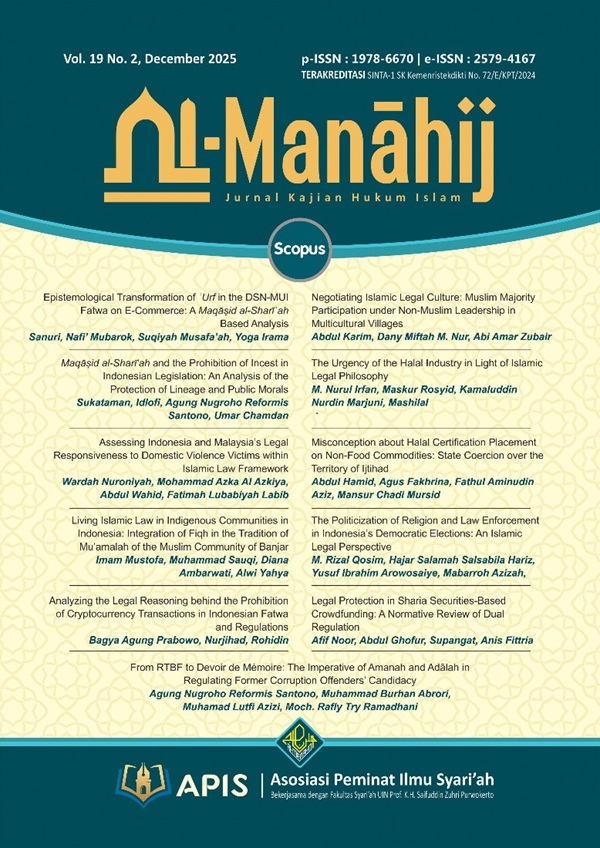
Epistemological Transformation of ʿUrf in the DSN-MUI Fatwa on E-Commerce: A Maqāṣid al-Sharīʿah Based Analysis
DOI:
https://doi.org/10.24090/mnh.v19i2.13145Keywords:
Digital ʿUrf, Maqāṣid al-Sharī‘ah, DSN-MUI Fatwa, Contemporary Islamic Law, E-CommerceAbstract
The rapid growth of digital platforms in global commerce has reshaped conventional transactional norms, including among Indonesian Muslims, raising normative debates on the legitimacy of e-commerce within Islamic jurisprudence. While prior studies have addressed e-commerce in Islamic legal discourse, few have examined the transformation of ʿurf (customary practice) as a legitimate legal source in the digital age. This study introduces the DigitalʿUrf Alignment Model (DUAM), an integrative legal-epistemological framework that systematizes the adaptation of classical ʿurf to digital contexts through maqāṣid al-sharīʿah based validation. Employing a qualitative-normative approach, the research analyzes Fatwa No. 146/2021, issued by the National Sharia Council of the Indonesian Ulema Council (DSN-MUI), classical and contemporary fiqh sources, and emerging digital transaction models. It integrates concepts from uṣūl al-fiqh, maqāṣid al-sharī‘ah, and socio-philosophical reasoning to reconceptualize ʿurf as a dynamic category of legal interpretation. The findings affirm that digital ʿurf, structured through DUAM, enables its institutionalization as a normative legal source for fatwa and provides a scalable method for integrating classical jurisprudence with digital finance regulations.Downloads
References
‘Abbas, Nuruddin. Al-Taqrib Bain Al-Qawaid Al-Usuliyyah Fima La Nassa Fih,. Beirut: Dar Ibn Hazm li al-Taba’ah wa al-Nashr wa al-Tauzi’, 2008.
Al-Kasani, Abu Bakr. Badā’iʿ Al‑Ṣanā’i’ Fī Tartīb Al‑Sharā’i’. Juz 5, Kitāb Al‑Buyū’. Dār al‑Kut. Beirut: Dār al‑Kutub al‑’Ilmiyyah, 2003.
Al-Nawawi, Yahya Ibn Sharaf. Rawḍat Al‑Ṭālibīn. Dār Ibn Ḥa. Vol. Juz 3. Beirut: Dār Ibn Ḥazm, 2019.
Al-Raysuni, Ahmad. Naẓariyyat Al-Maqāṣid ʿinda Al-Imām Al-Shāṭibī. Dār al-Kal. Tūnis: Dār al-Kalimah, 1995.
Al-Shatibi, Abu Ishaq. Al-Muwāfaqāt Fī Uṣūl Al-Sharīʿah. 2. Dār Ibn ʿA. Beirut: Dār Ibn ʿAffān, 2003.
Al-Shatibi, Ibrahim Ibn Musa. Al-Muwāfaqāt Fī Uṣūl Al-Sharī‘Ah. 2. Beirut. Beirut: Dār al-Kutub al-‘Ilmiyyah, 2003.
Al-Suyuti, Jalal Al-Din. Al-Ashbah Wa Al-Naẓāʾir. Muḥammad A. Beirut: Muʾassasat al-Kutub al-Thaqāfiyyah, 2003.
Al-Zilmu, Mustafa Ibrahim. Dilalat Al-Nusus Wa Turuq Istimbat Al-Ahkam Fi Daw’ Usul Al-Fiqh Al-Islami. Baghdad: Matba’ah As’ad, 1983.
Al-Zuhayli, Muhammad Mustafa. Al-Wajiz Fi ‘Usul Al-Fiqh Al-Islami. 1st ed. Beirut: Dar al-Khair, 2006.
Al-Zuhayli, Wahbah. Usul Al-Fiqh Al-Islam. 2nd ed. Beirut: Dar al-Fikr, 1986.
Al‑Zuhayli, Wahbah. Al‑Fiqh Al‑Islāmī Wa Adillatuh. 4. Dār al‑Fik. Vol. Juz 9. Damascus: Dār al‑Fikr, 1997.
Alkhan, Ahmed Mansoor, and M Kabir Hassan. “Does Islamic Microfinance Serve Maqāsid Al-Shari’a?” Borsa Istanbul Review 21, no. 1 (June 2021): 57–68. https://doi.org/10.1016/j.bir.2020.07.002.
Amri, Mohamed Cherif El, and Mustafa Omar Mohammed. “Analysis of Fatwas on FinTech.” In Islamic FinTech: Insights and Solutions, edited by Mohd Ma’Sum Billah, 73–90. Cham: Springer International Publishing, 2021.
Amri, Mohamed Cherif El, Mustafa Omar Mohammed, and Mohammed M S AlKhalili. “Fintech Adoption and Its Investment Impact in Islamic Social Finance: The Case of Zakat.” QIJIS (Qudus International Journal of Islamic Studies) 12, no. 2 (June 2025): 213–54. https://doi.org/10.21043/qijis.v12i2.17069.
Andriyaldi. “Al-’Urf Theory and Its Relevance to Contemporary Jurisprudence Issues.” Al-Hurriyah: Jurnal Hukum Islam 6, no. 2 (June 2021): 118–30. https://doi.org/10.30983/alhurriyah.v6i2.4784.
Asikin, Zenal. “Diverse E-Commerce Business Models In Indonesia: A Cluster Analysis From The National E-Commerce Survey.” Business Review and Case Studies 5, no. 2 (June 2024): 318–28. https://doi.org/10.17358/brcs.5.2.319.
Aslami, Nuri, Nurul Izzah, and Azhari Akmal Tarigan. “The Concept Of Taradin In Online Buying The Study of Surah An-Nisa’ Version 29.” Al-Masharif: Jurnal Ilmu Ekonomi Dan Keislaman 9, no. 2 (June 2021): 235–50. https://doi.org/10.24952/masharif.v9i2.4764.
Astuti, Miguna, Anastasia Bernadin Dwi Mardiatmi, Afrina Sari, and Fransisca Iriani Roesmala Dewi. “Addressing MSMEs Customer Complaints in Indonesia’s Digital Economy: Insights from Sharia and Consumer Protection Law.” JURIS (Jurnal Ilmiah Syariah) 23, no. 2 (June 2024): 395–409. https://doi.org/10.31958/juris.v23i2.13216.
Asyiqin, Istianah Zainal. “Islamic Economic Law in the Digital Age: Navigating Global Challenges and Legal Adaptations.” Media Iuris 8, no. 1 (June 2025): 95–112. https://doi.org/10.20473/mi.v8i1.61800.
Athoillah, Mohamad Anton, Mohd Roslan Mohd Nor, Heri Khoiruddin, and Rohimin Rohimin. “The Historicity of the Economic Verses on Fatwa of DSN-MUI about Sharia Electronic Money.” Jurnal Ilmiah Peuradeun 9, no. 1 (January 30, 2021): 1. https://doi.org/10.26811/peuradeun.v9i1.545.
Atiyah, Ghassan Adhab, Nazura Abdul Manap, Ahmed Ismael Ibrahim, and Abdur Rahman. “Legitimacy of Smart Contracts from the Perspective of Islamic Law: A Case Study of Blockchain Transactions.” Al-Istinbath: Jurnal Hukum Islam 9, no. 1 (June 2024): 155–92. https://doi.org/10.29240/jhi.v9i1.8726.
Azam, Muhammad, Saleh Hashem Al-Farjani, Anis Mashdurohatun, Atta Elsonbaty, and Mohammed Abdullah Salman. “E-Contract Withdrawal Rights in E-Commerce: A Comparative Analysis of the Egyptian Consumer Protection Law and Islamic Jurisprudential Perspectives.” Ulul Albab: Jurnal Studi Dan Penelitian Hukum Islam 8, no. 2 (June 2025): 215–30. https://doi.org/10.30659/jua.v8i2.44766.
Batubara, Chuzaimah, Mustapa Khamal Rokan, Muhammad Firdaus Bin Abdul Manaf, Sukiati Sukiati, and Isnaini Harahap. “Realizing Justice and Maṣlaḥah in E-Commerce: Fiqh Muamalah Insights and Challenges in Malaysia and Indonesia.” JURIS (Jurnal Ilmiah Syariah) 23, no. 2 (June 2024): 253–67. https://doi.org/10.31958/juris.v23i2.12356.
Bitawi, Muhammad ‘Abd al-Mu’izz. Falsafatu Al-Akhlaq Fi Al-Shari’ah Al-Islamiyyah: Dirasah Fi ‘Ilm Qawaid Al-Fiqh. Herndon: Al-Ma’had al-’Alam li al-Fikr al-Islami, 2018.
Council, National Sharia Council – Indonesian Ulema. “Fatwa DSN MUI No.146 Online Shop.” MUI, February 2021.
Dong, Charles. “The Integration of Blockchain Technology in the Digital Economy: Ensuring Security and Transparency in Digital Transactions.” Transactions on Economics, Business and Management Research 13, no. 1 (June 2024): 163–68. https://doi.org/10.62051/wjr0qs22.
Faizi, and Mohd Sollehudin Bin Shuib. “Sharia Governance in Islamic Financial Institutions: A Comparative Review of Malaysia and Indonesia.” EL DINAR: Jurnal Keuangan Dan Perbankan Syariah 12, no. 1 (June 2024): 89–107. https://doi.org/10.18860/ed.v12i1.25135.
Fajar, Mokhammad Samson, and Abdul Qodir Zaelani. “Transformation of Dowry from Traditional Practices to Maqashid Sharia: A Causal Analysis of Women’s Dignity and Family Harmony.” Ulul Albab: Jurnal Studi Dan Penelitian Hukum Islam 8, no. 2 (June 2025): 198–214. https://doi.org/10.30659/jua.v8i2.41634.
Fauzi. “‘Urf and Its Role in The Development of Fiqh: Comparative Study of Famliy Law Between Egypt and Indonesia.” El-Usrah: Jurnal Hukum Keluarga 7, no. 1 (June 2024): 346–71. https://doi.org/10.22373/ujhk.v7i1.23968.
Gomes, Alysson Cáceres, Francisco Bezerra de Lima Junior, Rodrigo Duarte Soliani, Pollyana Rufino de Souza Oliveira, Dion Alves de Oliveira, Reinaldo Maia Siqueira, Leonardo Augusto Rodrigues da Silva Nora, and Jailson Juracy Souza de Macêdo. “Logistics Management in E-Commerce: Challenges and Opportunities.” Revista de Gestão e Secretariado 14, no. 5 (June 2023): 7252–72. https://doi.org/10.7769/gesec.v14i5.2119.
Habib, Fakhry Emil, and Nofiardi. “The Impact of Using E-Wallets for the Ease of Muslim Consumers Transacting Maqashid Sharia Approach.” EKONOMIKA SYARIAH : Journal of Economic Studies 7, no. 1 (June 2023): 47–58. https://doi.org/10.30983/es.v7i1.6401.
Haisyi, Noorwahidah. “Examining the Application of Al-’Urf in Islamic Financial Contracts: Insights and Implications for Modern Banking Products.” At-Taradhi: Jurnal Studi Ekonomi 14, no. 1 (June 2023): 58–73. https://doi.org/10.18592/at-taradhi.v14i1.10246.
Halik, Abdul. “The Impact on Trust and Online Buying Decisions Through Information Quality, Celebrity Endorser and Price Perception at Instagrams in Surabaya.” Archives of Business Research 8, no. 2 (June 2020): 79–97. https://doi.org/10.14738/abr.82.7796.
Handayani, Syafika, and Fatimah Zahara. “Legal Consequences of Product Quality Tadlis in E-Commerce Shopee Perspective of DSN MUI Fatwa Number 146 of 2021 on Online Shop Based on Sharia Principles.” Journal Equity of Law and Governance 4, no. 2 (June 2024): 294–99. https://doi.org/10.55637/elg.4.2.10009.294-299.
Hardiyanti, Istiqom Shinta, Ahmad Agus Hidayat, Siska Arie Novita, and Sajiyo Sajiyo. “Analysis of the Dsn Mui Fatwa on Sharia Electronic Money from the Perspective of Qiyas (a Study on Linkaja Syariah Application).” Istinbath 23, no. 1 (June 2024): 66–78. https://doi.org/10.20414/ijhi.v23i1.644.
Hassan, Syed Ameer, and Masooma Batool. “Concept of ‘Urf (Custom) in Islamic Law and Its Application in Social Affairs: An Analytical Study.” Mohi Ud Din Journal of Islamic Studies 2, no. I (June 2024): 1–30.
Hassan, Syed Ameer, and Hafiz Muhammad Khan. “A Comparative Study of Urf As A Source of Islamic Law and Custom As A Source of Western Law.” Elementary Education Online 20, no. 2 (June 2021): 1934–41.
Hefni, Wildani, Imam Mustofa, and Rizqa Ahmadi. “Looking for Moderate Fiqh: The Thought of Mohammad Hashim Kamali on the Reformation of Rigidity and Inflexibility in Islamic Law.” Al-Istinbath: Jurnal Hukum Islam 10, no. 1 (June 2025): 30–57. https://doi.org/10.29240/jhi.v10i1.10694.
Hidayati, Tri, Muhammad Syarif Hidayatullah, Parman Komarudin, and Atika Atika. “Digitalization of Islamic Finance: Epistemological Study of the National Sharia Board-Indonesian Council of Ulama’s Fatwa.” Al-Ahkam 33, no. 2 (October 31, 2023): 255–78. https://doi.org/10.21580/ahkam.2023.33.2.17324.
Hidayatullah, Busyro, and Ismail. “Review of Fiqh Muamalah on Online Transactions in Digital Era.” GIC Proceeding 2, no. 1 (June 2024): 58–64.
Ibn ‘Ashur, Muhammad Al-Tahir. Maqāṣid Al-Syarī‘ah Al-Islāmiyyah. Dār al-Naf. Beirut: Dār al-Nafā’is, 2001.
Ibn Hanbal, Ahmad. Al‑Musnad. Juz 1. Cairo: Dār al‑Hadīth, 1995.
Ibn Kathir, Isma’il Ibn ‘Umar. Al-Bidayah Wa Al-Nihayah. Dar al‑Kut. Beirut: Dar al‑Kutub al‑Ilmiyyah, 2015.
Katuri, Desi Ramananda Kishore. “Streamlining Procure-to-Pay Processes in Large-Scale Companies with ERP Finance Systems.” European Journal of Computer Science and Information Technology 13, no. 38 (June 2025): 174–90. https://doi.org/10.37745/ejcsit.2013/vol13n38174190.
Khalaf, Wahab. Mashadir Al-Tashri‘ Al-Islami Fi Ma Laysa Nashsh Fih. Kuwait: Dar alQalam, 1972.
Khodamoradi, Soraya. “Prophetic Descent in the Early Modern Tariqa Muhammadiyya Khalisa.” In Dynamics of Islam in the Modern World, 267–91. Brill, 2022. https://doi.org/https://doi.org/10.1163/9789004512535_012.
Khoiri, Nispul, Muniruddin, Ahmad Muhajir, and Mohd Roslan Bin Rosnon. “Fiqh Nusantara: Exploring the Discourse and Complexity of Indonesian Islamic Jurisprudence.” Multidisciplinary Science Journal 7, no. 10 (June 2025): 2025584. https://doi.org/10.31893/multiscience.2025584.
Khotimah, Umi Khusnul. “Online Buying and Selling from the Perspective of Maqasid Shariah.” Journal of Sharia Economics 5, no. 2 (June 2023): 218–36. https://doi.org/10.35896/jse.v5i2.595.
Kuswaya, Adang, and Muhammad Ali. “The Concept of Peace in the Qur’an: A Socio-Thematic Analysis of Muslims’ Contestation in Salatiga, Indonesia.” Qudus International Journal of Islamic Studies 9, no. 1 (2021): 73–102. https://doi.org/10.21043/QIJIS.V9I1.10483.
Mach-Król, Maria, and Bartłomiej Hadasik. “On a Certain Research Gap in Big Data Mining for Customer Insights.” Applied Sciences 11, no. 15 (June 2021): 6993. https://doi.org/10.3390/app11156993.
Mubarak, Darihan, Norfaizah Othman, Mariani Abdul-majid, and Suhaila Nadzri. Maqasid-Shariah and Well-Being: A Systematic Literature Review. Selangor: E-Proceedings of the 1st International Conference on Islamic Economics 2022, 2023.
Mubarak, Syaugi, Faqih El Wafa, and Yusuf Asyahri. “Legal Harmonization of International Trade Contracts in the Framework of Islamic Transaction Law.” Syariah: Jurnal Hukum Dan Pemikiran 24, no. 2 (2024): 376–92. https://doi.org/10.18592/sjhp.v24i2.13977.
Muhammad, Pauzi, Yoesi Primadiya Fitri, A Alak, and Pidayan Sasnifa. “The Digital Revolution of Islamic Entrepreneurship: A Study on Upholding the Principles of E-Commerce Legitimacy in Marketplaces.” Al-Mustashfa: Jurnal Penelitian Hukum Ekonomi Syariah 9, no. 2 (June 2024): 321–37. https://doi.org/10.24235/jm.v9i2.18179.
Munadi, and Budi Iswanto. “The Concept Maslahah of Najamuddin Al Tufi and It’s Relevance of Sharia Business.” IQTISHODUNA: Jurnal Ekonomi Islam 9, no. 2 (June 2020): 151–66. https://doi.org/10.36835/iqtishoduna.v9i2.526.
Munifatussaidah, Asma, Jihan Nabila Zahara, and Fuad Zein. “Digital Wallet Transactions: Insight from Islamic Economic and Legal Perspective.” Jurnal Ekonomi Dan Bisnis Airlangga 34, no. 2 (June 2024): 301–17. https://doi.org/10.20473/jeba.V34I22024.301-317.
Musadad, Ahmad, Baihaqi, Khoirun Nasik, A Mufti Khazin, and Mochamad Syaifudin. “The Role of The Taysir Manhaji Method in The Development of Islamic Economic Law in Indonesia Through DSN-MUI Fatwas.” Journal of Islamic Economic Laws 8, no. 01 (June 2025): 130–54. https://doi.org/10.23917/jisel.v8i01.7607.
Musadad, Ahmad, Umi Indasyah Zahro, and Mustaniroh. “Indigenousization of Sharia Economics in Indonesia: Thought Study of KH. Ma’ruf Amin.” Proceeding International Conference on Law, Economy, Social and Sharia (ICLESS) 2, no. 1 (June 2024): 643–62.
Musarrofa, Ita, and Holilur Rohman. “’Urf of Cyberspace: Solutions to the Problems of Islamic Law in the Digital Age.” Al-Ahkam 33, no. 1 (June 2023): 63–88. https://doi.org/10.21580/ahkam.2023.33.1.13236.
Mustapha, Ramlan, and Siti Norma Aisyah Malkan. “Maqasid Al-Shariah in the AI Era: Balancing Innovation and Islamic Ethical Principles.” International Journal of Islamic Theology & Civilization (E-ISSN-3009-1551) 3, no. 3 (June 2025): 1–21. https://doi.org/10.5281/zenodo.15381828.
Nashmi, ‘Ajil Jasim. Al-Mustashriqun Wa Masadir Al-Tashri’ Al-Islami, Al-Majlis Al-Watani Li Al-Thaqafah Wa Al-Qanun Wa Al-Adab, 1984.
Noor, Afif, Ali Maskur, Arifana Nur Kholiq, Aisa Rurkinantia, Saifudin Saifudin, Arina Hukmu Adila, and Maruf Maruf. “Maslahah-Based Protection of Fund Recipients in Fintech Lending Through Empowerment and Justice.” El-Mashlahah 15, no. 1 (2025): 1–20. https://doi.org/10.23971/el-mashlahah.v15i1.7786.
Nugraha, Ahmad Lukman. “Islamic Marketing Mix 7P: New Business Strategy in Modern Era.” Islamic Business Review Islamicobr (2025).
Nugroho, Randhy, and Ely Nurhayati. “E-Commerce and Ethical Business Practices: The Role of DSN-MUI Fatwa.” Share: Jurnal Ekonomi Dan Keuangan Islam 14, no. 1 (June 2025): 67–89. https://doi.org/10.22373/share.v14i1.23296.
Nurlaela, Nunung, Muthi Luthfiyana, Andini Sulastri, and Evy Sulvy Wahyunita. “Reviewing the Fatwas Related to Fintech Applications in Islamic Financial Institutions in Indonesia.” Share: Jurnal Ekonomi Dan Keuangan Islam 9, no. 2 (June 2020): 206–26. https://doi.org/10.22373/share.v9i2.7989.
Polasik, Michal, Jakub Górka, Gracjan Wilczewski, Janusz Kunkowski, Karolina Przenajkowska, and Natalia Tetkowska. “Time Efficiency of Point-of-Sale Payment Methods: Empirical Results for Cash, Cards and Mobile Payments.” edited by José Cordeiro, Leszek A Maciaszek, and Joaquim Filipe, 306–20. Springer, 2013. https://doi.org/10.1007/978-3-642-40654-6_19.
Putri, Rafika Chudriana. “The Importance of Online Shopping Based on Sharia Economic Principles: A Review of Dsn-Mui Fatwa.” Proceeding International Seminar on Islamic Studies 4, no. 1 (2023): 1683–90. https://doi.org/https://doi.org/10.3059/insis.v0i0.14297.
Rahmaniah, Amelia, Fuad Luthfi, and Muhammad Haris. “The Role of Digitalization in Enhancing Legal Competencies of Sharia Economic Law Graduates: A Case Study of Graduate Users in South Kalimantan.” Syariah: Jurnal Hukum Dan Pemikiran 23, no. 1 (July 21, 2023): 61–77. https://doi.org/10.18592/sjhp.v23i1.10077.
Rahmatya, Mila Dwi, Mohd Syahiran Abdul Lathif, and Mohd Hapiz Mahaiyadin. “Exploring The Ethical Aspects And Compliance Practices In Shopee’s Return And Refund Policies From The Shariah Perspective.” Al-Qanatir: International Journal of Islamic Studies 33, no. 5 (June 2024): 230–46.
Sakouili, Abderrahmane, and Chroqui Razane. “Risk Management of Financial Instruments in Islamic Banks: An Overview.” Uluslararası İslam Ekonomisi ve Finansı Araştırmaları Dergisi 5, no. 1 (June 2019): 20–39. https://doi.org/10.25272/ijisef.419518.
Santika, Ana, and M Lathoif Ghozali. “The Role of Al-Urf in Contemporary Islamic Economic Legal Issues: Sustainable Business Production Development.” Istinbath 23, no. 2 (June 2024): 336–50. https://doi.org/10.20414/ijhi.v23i2.692.
Sanuri. “The Strategic Role of Qiyas Theory on Elasticity of Islamic Law in Solving Contemporary Issues.” Al-Qanun: Jurnal Pemikiran Dan Pembaharuan Hukum Islam 26, no. 2 (June 2023): 137–48. https://doi.org/10.15642/alqanun.2023.26.2.137-148.
Satyawan, Nicole Nadya Aurelie, and Sentot Basuki Prayitno. “Building Loyalty in Indonesia ’s E-Commerce Giants: The Interplay of Service, Trust, and Satisfaction.” Indonesia Accounting Research Journal 12, no. 1 (June 2024): 17–28.
Setyawan, Edy, Muhammad Chairul Huda, Afif Muamar, Didi Sukardi, and Muhammad Feby Ridho Pangestu. “Legal Age for Marriage: SDGs and Maslahah Perspectives in Legal Policy Change in Indonesia.” Al-Manahij: Jurnal Kajian Hukum Islam 17, no. 2 (2023): 183–198. https://doi.org/10.24090/mnh.v17i2.9506.
Shuhufi, Muhammad, Fatmawati Fatmawati, Muhammad Qadaruddin, Jalaluddin B, Muttaqien Muhammad Yunus, and Nainunis M.Nur. “Islamic Law and Social Media: Analyzing the Fatwa of Indonesian Ulama Council Regarding Interaction on Digital Platforms.” Samarah: Jurnal Hukum Keluarga Dan Hukum Islam 6, no. 2 (June 2022): 823–43. https://doi.org/10.22373/sjhk.v6i2.15011.
Subekti, Rahayu. “Central Bank of Indonesia Projects 2024 Digital Transactions to Rise 9.11 Percent.” Republika.Co.Id, June 2024.
Sunah, Abu and Ahmad Fahmi. Al-‘Urf Wa Al-‘Adah Fi Ra’Yi Al-Fuqaha. Mesir: Maktabah al-Azhar, 1947.
Suwarno, Adam Jody, and Lilik Indayani. “Influential Factors on Online Repurchase Intentions: A Study on Tokopedia Marketplace.” Academia Open 9, no. 2 (June 2024): 10.21070/acopen.9.2024.5367-10.21070/acopen.9.2024. https://doi.org/10.21070/acopen.9.2024.5367.
Syarifuddin, Amir. Ushul Fiqih. Jakarta: Kencana, 2008.
Taskinsoy, John. “Say Good Bye to Physical Cash and Welcome to Central Bank Digital Currency.” Rochester, NY: Social Science Research Network, June 2021. https://doi.org/10.2139/ssrn.3972858.
Tjiptono, Fandy, Ghazala Khan, Soo Yeong Ewe, and Maria Dharmesti. “Consumer Behavior During and Post-COVID-19 in Indonesia and Malaysia.” In COVID-19 and the Evolving Business Environment in Asia: The Hidden Impact on the Economy, Business and Society, edited by Andrei O J Kwok, Motoki Watabe, and Sharon G M Koh, 205–33. Singapore: Springer Nature, 2022.
Uula, Mimma Maripatul, and Darwis Harahap. “The Implementation of Maqasid Shariah in Economic Studies.” Journal of Islamic Economics Literatures 4, no. 1 (June 2023). https://doi.org/10.58968/jiel.v4i1.223.
Wijaya, Abdi, Achmad Musyahid Idrus, Tahani Asri Maulidah, Mulham Jaki Asti, and Nurjannah Nurjannah. “The Implementation of E-Commerce Consumer Option Rights (Khiyar) in Realizing Transaction Justice: A Study of Maqasid Al-Shariah.” Al-Manahij: Jurnal Kajian Hukum Islam 17, no. 1 (June 2023): 69–82. https://doi.org/10.24090/mnh.v17i1.7673.
Wu, Qun, Weiqi Tan, Ligang Zhou, Muhammet Deveci, Dragan Pamucar, and Witold Pedrycz. “An Integrated Decision Support Framework for Exploring the Barriers and Potential Application Scenarios in Metaverse Hospitality.” Journal of Industrial Information Integration 45 (June 2025): 100825. https://doi.org/10.1016/j.jii.2025.100825.
Xu, Xu, Yuxiao Fan, and Xiaohua Wang. “Mass Customization-Oriented Customer Demand Response Service Platform Based on Cloud Computing and Internet of Things.” IEEE Access 10, no. 1 (June 2022): 11763–71. https://doi.org/10.1109/ACCESS.2021.3138957.
Yufriadi, Ferdi, Fadilla Syahriani, and Abdullah A Afifi. “Trade Transformation In The Digital Era: Agency Role, Opportunities And Challenges.” AL-IMAM: Journal on Islamic Studies, Civilization and Learning Societies 5, no. 1 (June 2024): 13–23. https://doi.org/10.58764/j.im.2024.5.55.
Zhang, Ruochi, Yi Li, and Li Fang. “PBTMS: A Blockchain-Based Privacy-Preserving System for Reliable and Efficient E-Commerce.” Electronics 14, no. 6 (June 2025): 1177. https://doi.org/10.3390/electronics14061177.
Zulkifli, Siti Navillah, and Sharifah Norzehan Syed Yusuf. “Maqasid Syariah and Digital Transformation of Halal Supply Chain With Governance Elements.” European Proceedings of Social and Behavioural Sciences Building a (June 2023). https://doi.org/10.15405/epsbs.2023.11.9.
Downloads
Published
How to Cite
Issue
Section
License
Copyright (c) 2025 Sanuri, Nafi' Mubarok, Suqiyah Musafa’ah, Yoga Irama

This work is licensed under a Creative Commons Attribution-ShareAlike 4.0 International License.
Authors who publish with this journal agree to the following terms:
- Authors retain copyright and grant the journal right of first publication with the work simultaneously licensed under a Creative Commons Attribution License that allows others to share the work with an acknowledgement of the work's authorship and initial publication in this journal.
- Authors are able to enter into separate, additional contractual arrangements for the non-exclusive distribution of the journal's published version of the work (e.g., post it to an institutional repository or publish it in a book), with an acknowledgement of its initial publication in this journal.
- Authors are permitted and encouraged to post their work online (e.g., in institutional repositories or on their website) prior to and during the submission process, as it can lead to productive exchanges, as well as earlier and greater citation of published work (See The Effect of Open Access).