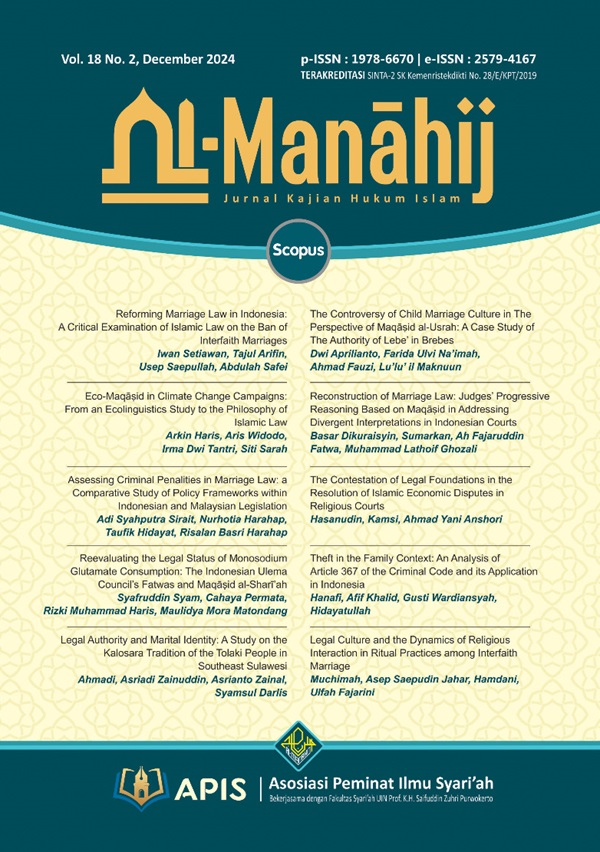
Legal Culture and the Dynamics of Religious Interaction in Ritual Practices among Interfaith Marriage
DOI:
https://doi.org/10.24090/mnh.v18i2.11659Keywords:
Legal culture, Interfaith couples, Religious interaction, SEMA Number 2 of 2023Abstract
This study examines the legal culture dealing with the interaction of religious practices and rituals among interfaith couples in Purwokerto, Central Java, emphasizing the social and legal dynamics influencing family life. In Indonesian society, interfaith marriage presents a complex issue, intersecting between state legal regulations and religious doctrines. By using qualitative methods through in-depth interviews and analysis of legal documents, this research delves into how interfaith couples navigate their daily lives, compromise the religious differences, and adapt to the prevailing legal framework. Legal culture component in legal system, comprising values and attitudes that influence the operation of the law, this research argues that legal culture significantly influences the practices in n t both social and and religious rituals, struggling the efforts to maintain household harmony. The issuance of Supreme Court Circular (SEMA) Number 2 of 2023 gave impact to the comprehensive legal interpretation and adaptation. This study demonstrates of understanding the interrelation of law, religion, and social practices within Indonesia’s religious pluralism and its implications for the legal acknowledgment and spiritual lives of interfaith couples.Downloads
References
Annisa, Firdha. “Ritual Unggahan Pada Komunitas Adat Bokokeling (Studi Kasus Pada Komunitas Adat Bonokeling Di Kabupaten Banyumas Menggunakan Teori Liminalitas Victor Turner).” SOSIALITAS; Jurnal Ilmiah Pend. Sos Ant 8, no. 1 (2019).
Asman, Asman, and Resali bin Muda. “Marriage Agreement Controversy in Indonesia-Malaysia Border Communities in Sambas Regency.” El-Mashlahah 13, no. 1 (2023): 1–16.
Asy’ari, Asy’ari, and Triansyah Fisa. “Interfaith Marriage in Perspectives of Classical and Modern Scholars.” Al-Manahij: Jurnal Kajian Hukum Islam, November 2022, 287–300. https://doi.org/10.24090/mnh.v16i2.6772.
Aziz, Safrudin. “Tradisi Pernikahan Adat Jawa Keraton Membentuk Keluarga Sakinah.” IBDA: Jurnal Kajian Islam Dan Budaya 15, no. 1 (2017): 22–41.
Bahrodin, Imam, Muliaty Amin, Firdaus Muhammad, Suf Kasman, La Ode Ismail Ahmad, and Muhammad Amri. “The Strategy of Religious Harmony Forum (FKUB) for Realizing A Religious Moderation in Sorong City.” International Journal of Religion 5, no. 10 (June 2024): 817–28. https://doi.org/10.61707/8fmcns25.
BPS Kabupaten Banyumas. “Jumlah Kasus Dan Penanganan Kasus Kekerasan Terhadap Anak Menurut Kecamatan Di Kabupaten Banyumas.” Badan Pusat Statistik Kabupaten Banyumas, 2022.
———. “Jumlah Penduduk Menurut Jenis Kelamin (Jiwa), 2016-2018,” 2018.
Budiman, Ikhwan. “Keluarga Sakinah Pada Pasangan Beda Agama Perpsektif Hukum IsIam Studi Kasus Di Kecamatan Bacukiki Barat Di Parepare.” IAIN Parepare, 2024.
Cooley, Charles Horton. “The Looking-Glass Self.” The Production of Reality: Essays and Readings on Social Interaction, 1902, 126–28.
Damanik, Deniansyah, Ahmad Rezy Meidina, Ridlo Adlinnas, and Shofie Nurul Azizah. “Religious Moderation By Organization Of Islamic Al-Jam’iyatul Washliyah (Character, Identity, And Attitude).” Islamadina : Jurnal Pemikiran Islam 24, no. 2 (September 2023): 233. https://doi.org/10.30595/islamadina.v24i2.17089.
Echols, John M, and Hassan Shadily. “An English-Indonesian Dictionary (Kamus Inggris Indonesia).” Jakarta: PT Gramedia, Cet 26 (2005).
Edi Gunawan, Budi Rahmat Hakim, Reza Adeputra Tohis, and Imam Mash’ud. “Interfaith Marriage of North Sulawesi Multicultural Community in Minority Fiqh Perspective.” AL-IHKAM: Jurnal Hukum & Pranata Sosial 19, no. 2 (October 18, 2024): 384–412. https://doi.org/10.19105/al-lhkam.v19i2.8072.
Eka Aditya, Mochammad Rizky, Dinda Khoirunnisa, Fawwas Fawwas, Ajid Qiston, and Aisyah Zarah Azizah. “The Problem of Interfaith Marriage in Indonesia: A Juridical-Normative Approach.” El-Usrah: Jurnal Hukum Keluarga 6, no. 2 (December 2023): 456. https://doi.org/10.22373/ujhk.v6i2.20059.
Erawadi, Erawadi, and Fadlan Masykura Setiadi. “Exploring Religious Harmony Through Dalihan Na Tolu: Local Wisdom in Peacebuilding in Indonesia.” Jurnal Ilmiah Peuradeun 12, no. 3 (September 30, 2024): 1379. https://doi.org/10.26811/peuradeun.v12i3.1398.
Guntoro, Heru. Toleransi Umat Beragama Di Banyumas Tuai Pujian (2024).
Indonesia, Republik. Undang-Undang Dasar Negara Republik Indonesia Tahun 1945. Sekretariat Jenderal Mpr Ri, 2002.
Jauhari, M Sofwan, and Abdul Ghoni. “The Level of People’s Obedience to MUI Fatwas (COVID-19, Bank Interest, and Interfaith Marriage).” AHKAM : Jurnal Ilmu Syariah 20, no. 2 (December 2020). https://doi.org/10.15408/ajis.v20i2.18685.
Juliansyahzen, Muhammad Iqbal. “Dialektika Hukum Islam Dan Hukum Adat Pada Perkawinan Lelarian Di Lampung Timur.” Al-Ahwal: Jurnal Hukum Keluarga Islam 12, no. 1 (June 2019): 1–14. https://doi.org/10.14421/ahwal.2019.12101.
Manik, Hanter, A C Sihite, Maria Martha Manao, Suryati Sitepu, and Tutiarny Naibaho. “Teori Filsafat Humanistik Dalam Pembelajaran Matematika.” Edumaspul: Jurnal Pendidikan 6, no. 1 (2022): 348–55.
Maula, Bani Syarif, and Ilyya Muhsin. “Interfaith Marriage and the Religion–State Relationship: Debates between Human Rights Basis and Religious Precepts.” Samarah: Jurnal Hukum Keluarga Dan Hukum Islam 8, no. 2 (May 2024): 791. https://doi.org/10.22373/sjhk.v8i2.19479.
Mead, George Herbert. “Mind, Self, and Society from the Standpoint of a Social Behaviorist.,” 1934.
Mursalat. “The Role of Alissa Wahid As A Women Fighter In Implementing Wasathiyyah Islam In Indonesia.” Jurnal Dakwah 23, no. 2 (September 2022): 77–97. https://doi.org/10.14421/jd.23.2.22.5.
Nasrudin, Nasrudin, and Sudiro Sudiro. “Gusdurian Islamic Social Movement: Political Discourse, Resource Mobilization, and Framing.” International Journal of Social Science and Religion (IJSSR) 3, no. 3 SE- (October 6, 2022): 251–76. https://doi.org/10.53639/ijssr.v3i3.93.
Nurunnisa, Nurunnisa, Rahmida Erliyani, Gilang Fitri Hermawan, and Yehia Mohamed Mostafa Abdelhadi. “Implications of Annulment of Marriage on the Distribution of Joint Assets According to the Compilation of Islamic Law and National Law.” Syariah: Jurnal Hukum Dan Pemikiran 23, no. 1 (July 4, 2023): 1–23. https://doi.org/10.18592/sjhp.v23i1.9523.
Parsons, Talcott. Talcott Parsons on Institutions and Social Evolution: Selected Writings. University of Chicago Press, 1985.
Rahma, Yusfira Anisa, S T Wisnu Setiawan, and M Arch. “Perancangan Pusat Pemerintahan Kota Purwokerto.” Universitas Muhammadiyah Surakarta, 2019.
Rajafi, Ahmad, Arif Sugitanata, and Vinna Lusiana. “The ‘Double-Faced’ Legal Expression: Dynamics and Legal Loopholes in Interfaith Marriages in Indonesia.” Journal of Islamic Law 5, no. 1 SE-Articles (February 29, 2024). https://doi.org/10.24260/jil.v5i1.2153.
Rasyid, Arbanur, Rayendriani Fahmei Lubis, Muhammad Wandisyah R Hutagalung, Maulana Arafat Lubis, Mohd Roslan Mohd Nor, and Afifah Vinandita. “Local Wisdom Recognition in Inter-Ethnic Religious Conflict Resolution in Indonesia from Islah Perspective.” JURIS (Jurnal Ilmiah Syariah) 22, no. 1 (2023): 13–26.
Riana, Friski. Makin sulit menikah beda agama (2023).
Rosdiana, Rosdiana, Ummu Hanah Yusuf Saumin, and Masayu Mashita Maisarah. “Legitimacy on Inter-Faith Marriages: An Analysis of the Role of Religious Councils on the Legal Policy in Indonesia.” AHKAM : Jurnal Ilmu Syariah 19, no. 1 (July 2019). https://doi.org/10.15408/ajis.v19i1.11710.
Rosidah, Zaidah Nur. “Sinkronisasi Peraturan Perundang-Undangan Mengenai Perkawinan Beda Agama.” Al-Ahkam 23, no. 1 (April 2013): 1. https://doi.org/10.21580/ahkam.2013.23.1.70.
Salam, Nor, Agus Purnomo, Saifullah Saifullah, and Sirojuddin Ahmad. “Interfaith Marriage from the Perspective of Rationality: Theocentrism in Islamic Law and Anthropocentrism in Human Rights Law.” De Jure: Jurnal Hukum Dan Syar'Iah; Vol 16, No 1 (2024)DO - 10.18860/j-Fsh.V16i1.23989 , June 30, 2024.
Setiawan, Iwan, Tajul Arifin, Usep Saepullah, and Abdulah Safei. “Reforming Marriage Law in Indonesia: A Critical Examination of Islamic Law on the Ban of Interfaith Marriages.” Al-Manahij: Jurnal Kajian Hukum Islam, July 2024, 179–98. https://doi.org/10.24090/mnh.v18i2.11134.
Setiyanto, Danu Aris, Sekar Ayu Aryani, and Sri Wahyuni. “ICRP Jakarta and Interfaith Marriage Assistance in Indonesia: Civil Rights, Legal Interpretation, and Advocacy for Interfaith Couples.” Journal of Islamic Law 5, no. 2 (2024): 170–95. https://doi.org/https://doi.org/10.24260/jil.v5i2.2796.
Smith, Ronald W., and Valerie Bugni. “Symbolic Interaction Theory and Architecture.” Symbolic Interaction 29, no. 2 (April 2006): 123–55. https://doi.org/10.1525/si.2006.29.2.123.
Sonafist, Y, and Henny Yuningsih. “Islamic Law, the State, and Human Rights: The Contestation of Interfaith Marriage Discourse on Social Media in Indonesia.” JURIS (Jurnal Ilmiah Syariah) 22, no. 2 (December 2023): 381. https://doi.org/10.31958/juris.v22i2.10934.
Suratno, Dwi, and Ermi Suhasti Syafei. “Hak Dan Kewajiban Suami Istri Pada Keluarga TKI Di Desa Tresnojono, Kebumen, Jawa Tengah: Antara Yuridis Dan Realita.” Al-Ahwal: Jurnal Hukum Keluarga Islam 8, no. 1 (September 2015): 75–86. https://doi.org/10.14421/ahwal.2015.08106.
Tarigan, Azhari Akmal, Jufri Naldo, Syahrial Arif Hutagalung, and Mohammad Reevany Bustami. “Islam and Christianity at Rumah Gadang: The Household Characteristics of Minangnese Interfaith Marriage.” JURIS (Jurnal Ilmiah Syariah) 23, no. 1 (June 2024): 27. https://doi.org/10.31958/juris.v23i1.11926.
Thahir, A. Halil. “Towards the Multidimensional Ushul Al-Fiqh: A Study of the Integration of Science in the Fatwa of Majelis Ulama Indonesia.” Samarah: Jurnal Hukum Keluarga Dan Hukum Islam 8, no. 2 (May 2024): 687. https://doi.org/10.22373/sjhk.v8i2.19686.
Downloads
Published
How to Cite
Issue
Section
License
Copyright (c) 2024 Muchimah, Jahar Asep Saepudin, Hamdani, Fajarini Ulfah

This work is licensed under a Creative Commons Attribution-ShareAlike 4.0 International License.
Authors who publish with this journal agree to the following terms:
- Authors retain copyright and grant the journal right of first publication with the work simultaneously licensed under a Creative Commons Attribution License that allows others to share the work with an acknowledgement of the work's authorship and initial publication in this journal.
- Authors are able to enter into separate, additional contractual arrangements for the non-exclusive distribution of the journal's published version of the work (e.g., post it to an institutional repository or publish it in a book), with an acknowledgement of its initial publication in this journal.
- Authors are permitted and encouraged to post their work online (e.g., in institutional repositories or on their website) prior to and during the submission process, as it can lead to productive exchanges, as well as earlier and greater citation of published work (See The Effect of Open Access).