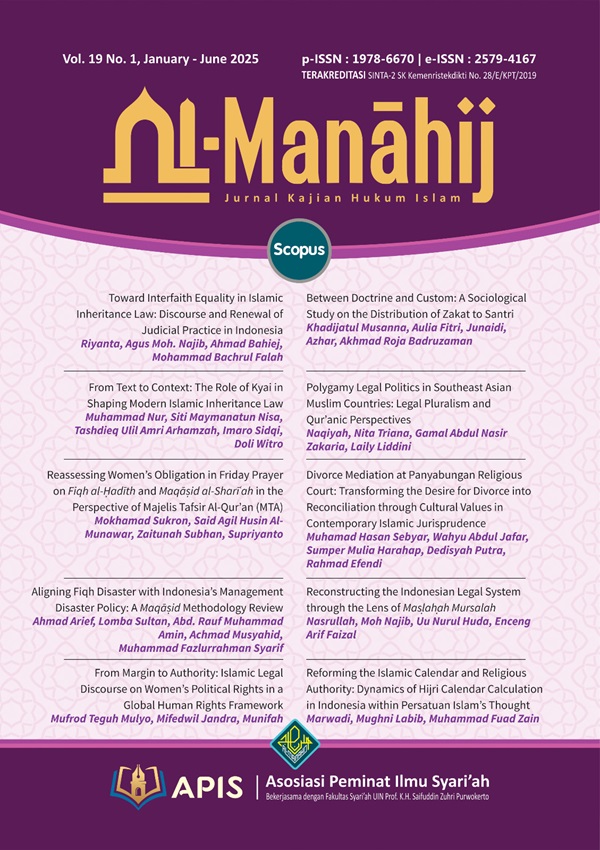
Toward Interfaith Equality in Islamic Inheritance Law: Discourse and Renewal of Judicial Practice in Indonesia
DOI:
https://doi.org/10.24090/mnh.v19i1.10762Keywords:
Wasiat Wājibah, Maslahah, Legal Reform, Islamic Inheritance Law, Non-MuslimsAbstract
The Supreme Court of Indonesia has granted portions of inheritance to non-Muslim relatives through the legal mechanism of wasiat wājibah (obligatory will), based on considerations of propriety and limited to no more than one-third of the estate. This article examines how the Supreme Court establishes the legal basis, rationale, and relevance of applying wasiat wājibah to non-Muslim relatives, and how this practice contributes to the reform of Islamic inheritance law in Indonesia. The study employs a normative legal research method with a case based approach. The findings reveal that the Supreme Court’s decisions to award wasiat wājibah to non-Muslim relatives represent a form of judicial innovation aimed at achieving maslahah (public benefit) among heirs. However, the application of wasiat wājibah remains case-specific, determined by the perceived benefit within the personal relationship between a Muslim testator and their non-Muslim relatives. These rulings hold significant relevance for the reform of Islamic inheritance law in Indonesia. First, conceptually, Islamic inheritance law falls under the domain of mu‘āmalah (civil transactions), which allows for reinterpretation and contextualization based on local realities. Second, the implementation of wasiat wājibah reflects a constructive response to the evolving social and legal dynamics of Indonesia’s pluralistic society.Downloads
References
Ahmad, Rumadi. “Speaking the Unspeakable: The Status of ‘Non-Muslims’ in Indonesia.” Samarah: Jurnal Hukum Keluarga Dan Hukum Islam 6, no. 2 (December 31, 2022): 734–56. https://doi.org/10.22373/SJHK.V6I2.13576.
Alma’amun, Suhaili, Mohd Khairy Kamarudin, Wan Nadiah Wan Mohd Nasir, Nasrul Hisyam Nor Muhamad, and Riayati Ahmad. “Legislative Provisions for Waṣiyyah Wājibah in Malaysia and Indonesia: To What Extent Do They Differ in Practice?” ISRA International Journal of Islamic Finance 14, no. 2 (September 5, 2022): 157–74. https://doi.org/10.1108/IJIF-01-2021-0013/FULL/PDF.
Aniroh, Khoiruddin Nasution and Ali Sodiqin. “The Bilateral Inheritance System in Islamic Family Law: Fairness, Equality, and Mutual Exchange Perspectives.” Samarah: Jurnal Hukum Keluarga Dan Hukum Islam 8, no. 2 (May 22, 2024): 891–911. https://doi.org/10.22373/SJHK.V8I2.17630.
An-Na’im, Abdullahi, and Mashood A. Baderin. “Islam and Human Rights: Selected Essays of Abdullahi An-Na’im.” Islam and Human Rights: Selected Essays of Abdullahi An-Na’im, January 1, 2017, 1–372. https://doi.org/10.4324/9781315251790/Islam-Human-Rights-Abdullahi-Na-Im-Edited-Mashood-Baderin.
Anderson, James Norman Dalrymple. Hukum Islam Di Dunia Modern. Translated by Machnun Husein. Yogyakarta: Tiara Wacana, 1994.
Aniroh, Reni Nur, Khoiruddin Nasution, Ali Sodiqin, Hasbuddin Khalid, and Rizki Ramadan. “Compulsory Testament: Efforts to Protect and Fulfil the Welfare Rights of Adopted Children in Indonesia’s Islamic Inheritance System.” Journal of Legal Dynamics 8, no. 2 (2024): 891–911.
As-Suyūţī. Al-Asybāh Wa an-Naẓāir. Dār al-Fikr, n.d.
Ash-Shan’ani. Subulussalam. Translated by Abu Bakar Muhammad. Surabaya: al-Ikhlas, 1995.
Bakar, Al Yasa Abu. Ahli Waris Sepertalian Darah Kajian Perbandingan Terhadap Penalaran Hazairin Dan Penalaran Fikih Mazhab. Jakarta: INIS, 1998.
Bukhārī. Ṣaḥīḥ Al-Bukhārī. Beirut: Dār al-Fikr, n.d.
Dāwud, Abū. Sunan Abī Dāwud. Beirut: Dār al-Fikr, n.d.
Farkhani, Elviandri, Khudzaifah Dimyati, Absori, and Muh Zuhri. “Converging Islamic and Religious Norms in Indonesia’s State Life Plurality.” Indonesian Journal of Islam and Muslim Societies 12, no. 2 (December 17, 2022): 421–46. https://doi.org/10.18326/IJIMS.V12I2.421-446.
Ḥajar, ‘Ali ibn. Fatḥ Al-Bārī. VI. Kairo: Dār at-Turāś, n.d.
Hakim, Muhammad Lutfi, and Khoiruddin Nasution. “Accommodating Non-Muslim Rights: Legal Arguments and Legal Principles in the Islamic Jurisprudence of the Indonesian Supreme Court in the Post-New Order Era.” Oxford Journal of Law and Religion 11, no. 2–3 (July 25, 2023): 288–313. https://doi.org/10.1093/OJLR/RWAD004.
Halim, Abdul. “Disparities of the Supreme Court Judge’s Decisions on the Non-Muslim Inheritance: Indonesian Case.” J. Legal Ethical & Regul. Isses 24 (2021): 1.
Hamdani, Muhammad Faisal. “Islamic Family Law in the Perspective of Universal Declaration Human Rights (UDHR) and the Universal Islamic Declaration Human Rights (UIDHR).” Ahkam: Jurnal Ilmu Syariah 16, no. 1 (2016): 21–30. https://doi.org/10.15408/AJIS.V16I1.2892.
Ḥazm, Ibn. Al-Iḥkām fī Uṣūl Al-Aḥkām. III. Kairo: Matba’ah al-Asimah, n.d.
———. Al-Muḥallā. IX. Beirut: Dār al-Fikr, n.d.
Hidayati, Sri. “Various Provisions of the Wâjibah Testament in Contemporary Muslim Countries.” Ahkam: Jurnal Ilmu Syariah 12, no. 1 (2012): 81–90. https://doi.org/10.15408/AJIS.V12I1.982.
Ilyas, Ilyas, Faisal A.Rani, Syamsul Bahri, and Sufyan Sufyan. “The Accommodation of Customary Law to Islamic Law: Distribution of Inheritance in Aceh from a Pluralism Perspectives.” Samarah: Jurnal Hukum Keluarga Dan Hukum Islam 7, no. 2 (May 28, 2023): 897–919. https://doi.org/10.22373/sjhk.v7i2.15650.
Kusumaatmadja, Mochtar. Pembinaan Masyarakat Dan Pembinaan Hukum Nasional. Bandung: Binacipta, 1976.
Lutfi, Mustafa. “Critical Analysis of the Progressive Law Theory on the Constitutional Court Judges’ Decisions in Indonesia Regarding Marriageable Age Limit.” Pertanika Journal of Social Sciences & Humanities 28, no. 1 (2020).
Mahmood, Tahir. Personal Law in Islamic Countries. New Delhi: Academy of Law and Religion, 1987.
Manẓūr, Ibn. Lisān Al-‘Arab. IV. Mesir: Dār al-Ma’rifah, n.d.
Mertokusumo, Sudikno. Bab-Bab Tentang Penemuan Hukum. Jakarta: PT Citra Aditya Bakti, 1993.
———. Penemuan Hukum Sebuah Pengantar. Yogyakarta: Liberty, 1998.
Mughniyah, Muhammad Jawad. Fikih Lima Madzhab. Jakarta: Lentera Basritama, 1999.
Muhammad Daud, Zakiul Fuady, and Raihanah Azahari. “The Wajibah Will: Alternative Wealth Transition for Individuals Who Are Prevented from Attaining Their Inheritance.” International Journal of Ethics and Systems 38, no. 1 (January 12, 2022): 1–19. https://doi.org/10.1108/IJOES-09-2018-0133/FULL/PDF.
Muslim. Ṣaḥīḥ Al-Muslim. al-Qanā’ah, n.d.
Permana, Sugiri. “Implications of Hazairin and Munawir Sjadzali Thoughts In Establishment of Islamic Inheritance In Indonesia.” Ahkam: Jurnal Ilmu Syariah 18, no. 2 (2018): 375–94. https://doi.org/10.15408/AJIS.V18I2.9866.
Rahman, Fatchur. Ilmu Waris. Bandung: Al-Maarif, 1981.
Reskiani, Anugrah, Dian Furqani Tenrilawa, Aminuddin Aminuddin, and Rahman Subha. “Reform Methods of Islamic Inheritance Law in Indonesia in Jurisprudence.” JURIS (Jurnal Ilmiah Syariah) 21, no. 1 (June 9, 2022): 39–51. http://ejournal.uinmybatusangkar.ac.id/ojs/index.php/Juris/article/view/5564.
Rosadi, Aden, and Siti Ropiah. “Reconstruction of Different Religion Inheritance through Wajibah Testament.” Jurnal Ilmiah Peuradeun 8, no. 2 (May 30, 2020): 327–50. https://doi.org/10.26811/PEURADEUN.V8I2.466.
Salim, Arskal. “Contemporary Islamic Law in Indonesia : Sharia and Legal Pluralism,” n.d., 214.
Shihab, M. Quraish. Tafsir Al-Misbah. Vol. XIV. Jakarta: Lentera Hati, 2002.
Suwarti, Decha Khunmay, and Stepan Abannokovya. “Conflicts Occurring Due to the Application of Different Legal Inheritance Systems in Indonesia.” Legality : Jurnal Ilmiah Hukum 30, no. 2 (September 18, 2022): 214–27. https://doi.org/10.22219/LJIH.V30I2.21020.
Tarmizi. “Inheritance System of Bugis Community in District Tellu Siattinge Bone, South Sulawesi (Perspective of Islamic Law).” Samarah: Jurnal Hukum Keluarga Dan Hukum Islam 4, no. 1 (June 30, 2020): 179–208. https://doi.org/10.22373/SJHK.V4I1.6784.
Woodward, Mark R. “Islam, Law and Equality in Indonesia: An Anthropology of Public Reasoning. By John R. Bowen. Cambridge University Press, 2003. 289 Pages. $25.00.” Journal of the American Academy of Religion 73, no. 4 (December 1, 2005): 1192–94. https://doi.org/10.1093/JAAREL/LFI122.
Yassari, Nadjma. “Compulsory Heirship and Freedom of Testation in Islamic Law.” Comparative Succession Law: Volume III: Mandatory Family Protection 3 (January 1, 2020): 629–47. https://doi.org/10.1093/OSO/9780198850397.003.0021.
Zayd, Nasr Abu. “The ‘Others’ in the Qur’an: A Hermeneutical Approach.” Philosophy and Politics - Critical Explorations 2 (2016): 97–109. https://doi.org/10.1007/978-3-319-41821-6_10.
Zubair, Asni, Hamzah Latif, Al Furqon, and Dono Hariyanto. “The Construction of Inheritance Law Reform in Indonesia: Questioning the Transfer of Properties through Wasiat Wājibah to Non-Muslim Heirs.” Samarah: Jurnal Hukum Keluarga Dan Hukum Islam 6, no. 1 (June 27, 2022): 176–97. https://doi.org/10.22373/SJHK.V6I1.12628.
Downloads
Published
How to Cite
Issue
Section
License
Copyright (c) 2025 Riyanta, Agus Moh. Najib, Ahmad Bahiej, Mohammad Bachrul Falah

This work is licensed under a Creative Commons Attribution-ShareAlike 4.0 International License.
Authors who publish with this journal agree to the following terms:
- Authors retain copyright and grant the journal right of first publication with the work simultaneously licensed under a Creative Commons Attribution License that allows others to share the work with an acknowledgement of the work's authorship and initial publication in this journal.
- Authors are able to enter into separate, additional contractual arrangements for the non-exclusive distribution of the journal's published version of the work (e.g., post it to an institutional repository or publish it in a book), with an acknowledgement of its initial publication in this journal.
- Authors are permitted and encouraged to post their work online (e.g., in institutional repositories or on their website) prior to and during the submission process, as it can lead to productive exchanges, as well as earlier and greater citation of published work (See The Effect of Open Access).