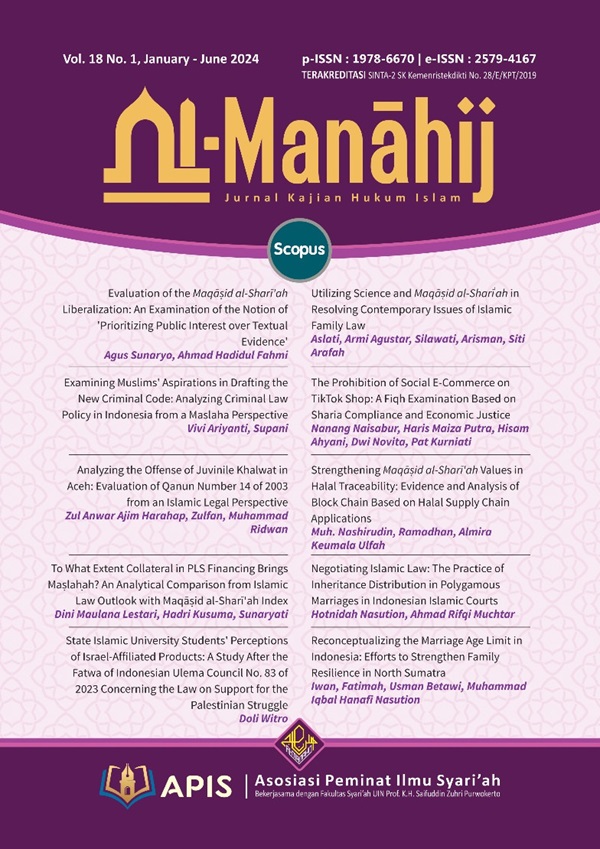
State Islamic University Students’ Perceptions of Israel Affiliated Products: A Study After the Fatwa of Indonesian Ulema Council No. 83 of 2023 Concerning the Law on Support for the Palestinian Struggle
DOI:
https://doi.org/10.24090/mnh.v18i1.10554Keywords:
Student Perceptions, MUI Fatwa, Israeli Products, State Islamic UniversityAbstract
This study aims to describe the perceptions of State Islamic University (UIN) students in Indonesia regarding products affiliated with Israel after the issuance of the Indonesian Ulema Council (MUI) fatwa Number 83 of 2023 regarding support for the Palestinian struggle. This research employed qualitative research methods. The primary data of this study were collected through interviews while the secondary data were obtained from scientific articles, books, and so on. The data collection techniques used in this study were observations, interviews, and documentation. The data analysis techniques included data condensation, data presentation, and conclusion drawing. This study found that the overall perception of UIN students towards Israel-affiliated products was the result of a complex interaction between religious values, humanitarian values, solidarity with Palestine, media information, economic considerations, and political awareness. These factors become reinforcements to their agreement and support for MUI’s steps in supporting Palestine. MUI stipulated Fatwa Number 83 of 2023 concerning the Law of Support for the Palestinian Struggle. One of the substances was a call to boycott products that are clearly affiliated with Israel. This boycott has implications for the company’s reduced financial income due to a decrease in product sales turnover. This can paralyze the performance and operations of the company and as a consequence, their assistance to Israel in carrying out attacks on Palestine will be stopped.Downloads
References
AD. Student of Da’wah Management Department, IAIN Kerinci. Kerinci: Interview, November 24, 2023.
Adamsah, Bahtiar, and Ganjar Eka Subakti. “Development of the Halal Industry on Indonesian Economic Growth.” Indonesian Journal of Halal 5, no. 1 (2022): 71–75. https://doi.org/10.14710/halal.v5i1.14416.
AHS. Postgraduate Student of Law Student, UIN Sunan Gunung Djati Bandung. Bandung: Interview, November 24, 2023.
AM. Postgraduate Student of Sharia Economic Law, UIN Sunan Gunung Djati Bandung. Bandung: Interview, November 24, 2023.
Amini, Anisa, Muhammad Iqbal Fasa, and Suharto Suharto. “The Urgency of Halal Food in Reviewing Islamic Consumption.” Likuid: Jurnal Ekonomi Industri Halal 2, no. 2 (2022): 1–14. https://doi.org/10.15575/likuid.v2i2.16031.
Apriyana, Apriyana, Evi Susanti, and Zurlina Lubis. “Purchasing Behavior of Muslim Students in Consuming Halal Food in Indonesia.” Perbanas Journal of Islamic Economics & Business 3, no. 1 (2023): 1–10. https://doi.org/10.56174/pjieb.v3i1.60.
Araújo, Shadia Husseini de. “Desired Muslims: Neoliberalism, Halal Food Production and the Assemblage of Muslim Expertise, Service Providers and Labour in New Zealand and Brazil.” Ethnicities 21, no. 3 (2021): 411–32. https://doi.org/10.1177/1468796821998369.
Asa’ari, Asa’ari, Jafar Ahmad, Zufriani Zufriani, Doli Witro, and Muhamad Taufik Kustiawan. “Considering Death Penalty for Corruptors in Law on Corruption Eradication from the Perspective of Maqāsid Al-Syarī‘Ah.” Samarah 7, no. 2 (2023): 920–36. https://doi.org/10.22373/sjhk.v7i2.14944.
Ayu, Dena, Mursal Mursal, Putri Jianti, Doli Witro, and Rifqi Nurdiansyah. “A Sociological Approach to Consumer Protection in E-Commerce Transactions During the Covid-19 Pandemic.” Khazanah Hukum 4, no. 3 (2022): 181–91. https://doi.org/10.15575/kh.v4i3.18690.
AZD. Student of Islamic Economics Department, UIN Alauddin Makassar. Makassar: Interview, November 24, 2023.
Bashir, Abdalla Mohamed. “Effect of Halal Awareness, Halal Logo and Attitude on Foreign Consumers’ Purchase Intention.” British Food Journal 121, no. 9 (2019): 1998–2015. https://doi.org/10.1108/BFJ-01-2019-0011.
Busni, Darti, Doli Witro, Raid Alghani, Iwan Setiawan, and Nana Herdiana Abdurrahman. “Hybrid Contracts in Leasing and Ijarah Muntahiya Bit Tamlik in Indonesia Sharia Financial Institutions.” EkBis: Jurnal Ekonomi Dan Bisnis 6, no. 1 (2022): 59–73. https://doi.org/10.14421/ekbis.2022.6.1.1505.
Calder, Ryan. “Halalization: Religious Product Certification in Secular Markets.” Sociological Theory 38, no. 4 (2020): 334–61. https://doi.org/10.1177/0735275120973248.
Creswell, John Ward. A Concise Introduction to Mixed Methods Research. Thousand Oaks, CA: Sage Publication, 2014.
Dewan Syariah Nasional Majelis Ulama Indonesia (DSN-MUI). Fatwa Majelis Ulama Indonesia Nomor 83 Tahun 2023 Tentang Hukum Dukungan Terhadap Perjuangan Palestina. Jakarta: Majelis Ulama Indonesia (MUI), 2023.
Elvira, Rini. “The Influence of Muslim Consumers’ Perceptions About Maslahah on Consumption Decisions Limited to Halal Commodities Only (Study of Students from the Faculty of Sharia and Islamic Economics in 2015).” Manhaj 4, no. 2 (2016): 178–88. https://doi.org/10.1161/mhj.v4i2.161.
F. Student of Aqidah and Islamic Philosophy Department, UIN Datokarama Palu. Palu: Interview, November 24, 2023.
FDA. Postgraduate Student of Sharia Economic Law, UIN Sunan Gunung Djati Bandung. Bandung: Interview, November 24, 2023.
FF. Postgraduate Student of Islamic Counseling Guidance, UIN Sunan Gunung Djati Bandung. Bandung: Interview, November 24, 2023.
Firdaus, Farah Syahida, Ridho Bramulya Ikhsan, and Yudi Fernando. “Predicting Purchase Behaviour of Indonesian and French Muslim Consumers: Insights from a Multi-Group Analysis.” Journal of Islamic Marketing 14, no. 5 (2023): 1229–59. https://doi.org/10.1108/JIMA-05-2021-0169.
Hanifasari, Dina, Ilyas Masudin, Fien Zulfikarijah, Aniek Rumijati, and Dian Palupi Restuputri. “Millennial Generation Awareness of Halal Supply Chain Knowledge toward Purchase Intention for Halal Meat Products: Empirical Evidence in Indonesia.” Journal of Islamic Marketing, 2024. https://doi.org/10.1108/jima-01-2023-0012.
Hassan, Siti Hasnah, Norizan Mat Saad, Tajul Ariffin Masron, and Siti Insyirah Ali. “Buy Muslim-Made First – Does Halal Consciousness Affect Muslims’ Intention to Purchase?” Journal of Islamic Marketing 13, no. 2 (2022): 466–80. https://doi.org/10.1108/JIMA-05-2019-0102.
Hatoli, Hatoli. “Halal Certification of the Indonesian Ulema Council on Electronic and Non-Consumer Products from the Maslahah Perspective.” Journal of Islamic Law 1, no. 2 (2020): 237–55. https://doi.org/10.24260/jil.v1i2.45.
Hidayati, Tri, Muhammad Syarif Hidayatullah, Parman Komarudin, and Atika Atika. “Digitalization of Islamic Finance: Epistemological Study of the National Sharia Board-Indonesian Council of Ulama’s Fatwa.” Al-Ahkam 33, no. 2 (October 31, 2023): 255–78. https://doi.org/10.21580/ahkam.2023.33.2.17324.
Hisam Ahyani, Memet Slamet, and Tobroni. “Building the Values of Rahmatan Lil ’Alamin for Indonesian Economic Development at 4.0 Era from the Perspective of Philosophy and Islamic Economic Law.” AL-IHKAM: Jurnal Hukum & Pranata Sosial 16, no. 1 (June 27, 2021): 121–51. https://doi.org/10.19105/al-lhkam.v16i1.4550.
HR. Student of Sharia Economics (ES) Department, UIN Sunan Kalijaga Yogyakarta. Yogyakarta: Interview, November 24, 2023.
I. Postgraduate Student of Interdisciplinary Islamic Studies, UIN Sunan Kalijaga Yogyakarta. Yogyakarta: Interview, November 24, 2023.
IA. Postgraduate Student of Al-Qur’an Science and Tafsir, UIN Sunan Gunung Djati Bandung. Bandung: Interview, November 24, 2023.
Indrayadi, Toni, Daflizar Daflizar, Yoki Irawan, and Helty Helty. “Indonesian EFL Students’ Difficulties in Recognizing English Letters.” The Qualitative Report 26, no. 11 (2021): 3476–91. https://doi.org/10.46743/2160-3715/2021.4846.
Iswanto, Bambang, and Miftah Faried Hadinatha. “Sharia Constitutionalism: Negotiating State Interests and Islamic Aspirations in Legislating Sharia Economic Law.” AHKAM: Jurnal Ilmu Syariah 23 (2023): 235–58.
Johan, Eva, and Hanna Schebesta. “Religious Regulation Meets International Trade Law: Halal Measures, a Trade Obstacle? Evidence from the SPS and TBT Committees.” Journal of International Economic Law 25, no. 1 (2022): 61–73. https://doi.org/10.1093/jiel/jgac003.
Kamarulzaman, Yusniza, Ann Veeck, Alhassan G. Mumuni, Mushtaq Luqmani, and Zahir A. Quraeshi. “Religion, Markets, and Digital Media: Seeking Halal Food in the U.S.” Journal of Macromarketing 36, no. 4 (2016): 400–411. https://doi.org/10.1177/0276146715622243.
LAP. Postgraduate Student of Islamic Religious Education, UIN Sunan Kalijaga Yogyakarta. Yogyakarta: Interview, November 24, 2023.
Limenta, Michelle, Bayan M. Edis, and Oscar Fernando. “Disabling Labelling in Indonesia: Invoking WTO Laws in the Wake of Halal Policy Objectives.” World Trade Review 17, no. 3 (2018): 451–76. https://doi.org/10.1017/S1474745617000167.
Manan, Abdul, Dicky Wirianto, Kamarullah Kamarullah, and Muhammad Arif Fadhilah. “Halal Tourism: A Proposed Sharia Model for Implementation.” Jurnal Ilmiah Peuradeun 11, no. 1 (January 30, 2023): 81. https://doi.org/10.26811/peuradeun.v11i1.784.
Maulana, Diky Faqih, Makhrus Makhrus, and Hamidatul Hasanah. “The Urgency of MUI Halal Fatwa about Food, Beverage, Medicine and Cosmetic Products for the Consumer Protection.” Volksgeist: Jurnal Ilmu Hukum Dan Konstitusi 5, no. 2 (2022): 199–214. https://doi.org/10.24090/volksgeist.v5i2.6421.
Miles, Matthew B., A. Michael Huberman, and Johnny Saldaña. Qualitative Data Analysis: A Methods Sourcebook. California: SAGE Publications, Inc., 2014.
Mohamed, Zainalabidin, Mad Nasir Shamsudin, and Golnaz Rezai. “The Effect of Possessing Information About Halal Logo on Consumer Confidence in Malaysia.” Journal of International Food and Agribusiness Marketing 25, no. SUPPL1 (2013): 73–86. https://doi.org/10.1080/08974438.2013.800008.
Mohayidin, Mohd Ghazali, and Nitty Hirawaty Kamarulzaman. “Consumers’ Preferences Toward Attributes of Manufactured Halal Food Products.” Journal of International Food and Agribusiness Marketing 26, no. 2 (2014): 125–39. https://doi.org/10.1080/08974438.2012.755720.
MRRP. Student of Al-Quran Science and Tafsir Department, IAIN Kerinci. Kerinci: Interview, November 24, 2023.
MSA. Student of Arabic Language Education Department, UIN Maulana Malik Ibrahim Malang. Malang: Interview, November 24, 2023.
Muin, Fatkhul, and Palmawati Tahir. “Legal Policy of Halal Products for the Development of Small and Micro Enterprises after the Enactment of Government Regulation in Lieu of Law No. 2 of 2022 on the Job Creation.” Al-Risalah: Forum Kajian Hukum Dan Sosial Kemasyarakatan 23, no. 1 (June 24, 2023): 1–12. https://doi.org/10.30631/alrisalah.v23i1.1323.
Mukminin, Amirul, Dairabi Kamil, Muazza Muazza, and Eddy Haryanto. “Why Teacher Education? Documenting Undocumented Female Student Teachers’ Motives in Indonesia: A Case Study.” The Qualitative Report 22, no. 1 (January 2017): 309–26. https://doi.org/10.46743/2160-3715/2017.2640.
Munir, Khadijah binti Abd. “The Response of the Organization of Islamic Cooperation (OIC) to Israel’s Human Rights Violations against Palestine.” UIN Syarif Hidayatullah Jakarta, 2016.
Musataklima, Musataklima. “Self-Declare Halal Products for Small and Micro Enterprises: Between Ease of Doing Business and Assurance of Consumer Spiritual Rights/Self Declare Produk Halal Usaha Kecil Mikro: Antara Kemudahan Berusaha Dan Jaminan Hak Spiritual Konsumen.” De Jure: Jurnal Hukum Dan Syar'Iah; Vol 13, No 1 (2021)DO - 10.18860/j-Fsh.V13i1.11308 , July 28, 2021.
Muslimah, Anissa Nur, H. Ikhwan Hamdani, and Fahmi Irfani. “The Influence of Brand Image and Halal Certification on Customer Purchase Interest (Case Study of Superkue Bogor).” Al Amwal 1, no. 1 (2018): 41–57.
NFN. Student of Islamic Family Law Department, UIN Sunan Kalijaga Yogyakarta. Yogyakarta: Interview, November 24, 2023.
NRW. Student of Arabic Language and Literature Department, UIN Sunan Kalijaga Yogyakarta. Yogyakarta: Interview, November 24, 2023.
NTB. Student of Halal Industry and Business Department, UIN Sunan Kalijaga Yogyakarta. Yogyakarta: Interview, November 24, 2023.
Nugraha, Widya Satya, Dennis Chen, and Shang Ho Yang. “The Effect of a Halal Label and Label Size on Purchasing Intent for Non-Muslim Consumers.” Journal of Retailing and Consumer Services 65, no. October 2021 (2022): 102873. https://doi.org/10.1016/j.jretconser.2021.102873.
Nurjaman, Muhamad Izazi, and Doli Witro. “The Relevance of the Theory of Legal Change According to Ibnu Qayyim Al-Jauziyyah in Legal Products by Fatwa DSN-MUI Indonesia.” El-Mashlahah 11, no. 2 (2021): 164–86. https://doi.org/10.23971/elma.v11i2.3181.
Omar, Nor Asiah, Muhamad Azrin Nazri, Suhaily Mohd-Ramly, and Zuraidah Zainol. “Does Psychological Contract Violation Moderate the Impact of Severity and Recovery Satisfaction on Boycott? An Analysis of Halal Violation.” Journal of Food Products Marketing 24, no. 3 (2018): 311–27. https://doi.org/10.1080/10454446.2017.1266560.
Pratama, Abdul Aziz Nugraha, M. Luthfi Hamidi, and Edi Cahyono. “The Effect of Halal Brand Awareness on Purchase Intention in Indonesia: The Mediating Role of Attitude.” Cogent Business and Management 10, no. 1 (2023). https://doi.org/10.1080/23311975.2023.2168510.
Presiden Republik Indonesia. Undang-Undang Nomor 8 Tahun 1999 Tentang Perlindungan Konsumen. Jakarta: Pemerintah Republik Indonesia, 1999.
———. Undang-Undang Republik Indonesia Nomor 33 Tahun 2014 Tentang Jaminan Produk Halal. Jakarta: Pemerintah Republik Indonesia, 2014.
R. Student of Al-Qur’an Science and Tafsir Department, Universitas PTIQ Jakarta. Jakarta: Interview, November 24, 2023.
Rafiki, Ahmad, Sutan Emir Hidayat, and Muhammad Dharma Tuah Putra Nasution. “An Extensive Effect of Religiosity on the Purchasing Decisions of Halal Products.” PSU Research Review, 2023. https://doi.org/10.1108/PRR-07-2022-0093.
Rasidin, Mhd., Natardi Natardi, and Doli Witro. “The Impact of Unequal Marriage on Household Harmony (Case Study in Sungai Penuh City, Jambi).” Samarah: Jurnal Hukum Keluarga Dan Hukum Islam 4, no. 2 (2020): 313–36. https://doi.org/10.22373/sjhk.v4i2.8083.
Rasyid, Muhammad, Muhsin Aseri, Akh Fauzi Aseri, and Muhammad Syazwan Faid. “Science And Its Role In Changes In Islamic Legal Thought (An Analysis Of Changes In The Fatwa Of The Indonesian Ulema Council Due To Recent Scientific Findings).” Syariah: Jurnal Hukum Dan Pemikiran 23, no. 2 (2023).
Rofiah, Khusniati, Martha Eri Safira, Abid Rohmanu, and Bin Haji Matali. “Legal Awareness of Halal Products Certification among East Java Business Operators and Society.” Juris: Jurnal Ilmiah Syariah 23, no. 1 (2024): 55–65. https://doi.org/10.31958/juris.v23i1.10467.
Rosani, Rosani. “The Influence of Halal Legalization, Prices, and Community Perceptions on Consumer Decisions in Choosing Ottogi Yeul Ramen Food Products (Case Study in Ngulak III Village, Sanga Desa District, Muba Regency, South Sumatra).” JIMESA: Jurnal Ilmiah Mahasiswa Ekonomi Syariah 2, no. 1 (2022): 15–22.
SAN. Student of Islamic Family Law Department, IAIN Madura. Madura: Interview, November 24, 2023.
Santoso, Lukman, Agus Triyanta, and Jawahir Thontowi. “Halal Tourism Regulations in Indonesia: Trends and Dynamics in the Digital Era.” Ijtihad : Jurnal Wacana Hukum Islam Dan Kemanusiaan 22, no. 1 (August 1, 2022): 73–94. https://doi.org/10.18326/ijtihad.v22i1.73-94.
Septiarini, Dina Fitrisia, Ririn Tri Ratnasari, Marhanum Che Mohd Salleh, Sri Herianingrum, and Sedianingsih. “Drivers of Behavioral Intention among Non-Muslims toward Halal Cosmetics: Evidence from Indonesia, Malaysia, and Singapore.” Journal of Islamic Accounting and Business Research 14, no. 2 (2023): 230–48. https://doi.org/10.1108/JIABR-02-2021-0064.
Shahabuddin, Abu Saim Md, Mohd Edil Abd Sukor, and Noor Hazarina Hashim. “Product-Centric Halal Business: A Critique from an Islamic Perspective.” Journal of Islamic Marketing 11, no. 6 (2020): 1707–24. https://doi.org/10.1108/JIMA-06-2019-0129.
Sudrajat, Shinta Azzahra, Arzam Arzam, and Doli Witro. “Legal Protection in Labor Dispute Settlement Through Industrial Relations Mechanism.” Khazanah Hukum 4, no. 1 (2022): 1–9. https://doi.org/10.15575/kh.v4i1.17027.
Supriyadi, Supriyadi, Rahma Aulia, Labib Nubahai, Rozanah Ab Rahman, and Rosmah Mohamed. “Legal Effectiveness of Halal Product Certification in Improving Business Economics in Indonesia and Malaysia.” Al-Ahkam 34, no. 1 (April 30, 2024): 193–220. https://doi.org/10.21580/ahkam.2024.34.1.20546.
Syafitri, Dita Permata, and Atina Shofawati. “The Influence of Product Knowledge on the Decision to Become a Donor of Baitul Maal Hidayatullah Kediri Branch.” Jurnal Ekonomi Syariah Teori Dan Terapan 1, no. 2 (2015): 128–143. https://doi.org/10.20473/vol1iss20142pp128-143.
Syatar, Abdul, Muhammad Imran, M. Ilham, Kurniati, Marilang, and Kamaluddin Nurdin Marjuni. “Examining Call for the Dissolution of Indonesian Ulema Council: Siyāsah Syar’íyyah Perspective.” Juris: Jurnal Ilmiah Syariah 22, no. 2 (2023): 199–211. https://doi.org/10.31958/juris.v22i2.6678.
WG. Postgraduate Student of Arabic Language Education, UIN Sunan Gunund Djati Bandung. Bandung: Interview, November 24, 2023.
Witro, Doli. “Ulama and Umara in Government of Indonesia: A Review Ff Religion and State.” Madania 24, no. 2 (2020): 135–44. https://doi.org/10.29300/madania.v24i2.3778.
YS. Postgraduate Student of Islamic Religious Education, UIN Sunan Gunung Djati Bandung. Bandung: Interview, November 24, 2023.
Zulfa, Eva Achjani, Taliya Qory Ismail, Imam Khomaeni Hayatullah, and Ali Fitriana. “Regulation and Law Enforcement on the Protection of Halal Products in Indonesia.” Cogent Social Sciences 9, no. 2 (2023). https://doi.org/10.1080/23311886.2023.2273344.
Downloads
Published
How to Cite
Issue
Section
License
Copyright (c) 2024 Doli Witro

This work is licensed under a Creative Commons Attribution-ShareAlike 4.0 International License.
Authors who publish with this journal agree to the following terms:
- Authors retain copyright and grant the journal right of first publication with the work simultaneously licensed under a Creative Commons Attribution License that allows others to share the work with an acknowledgement of the work's authorship and initial publication in this journal.
- Authors are able to enter into separate, additional contractual arrangements for the non-exclusive distribution of the journal's published version of the work (e.g., post it to an institutional repository or publish it in a book), with an acknowledgement of its initial publication in this journal.
- Authors are permitted and encouraged to post their work online (e.g., in institutional repositories or on their website) prior to and during the submission process, as it can lead to productive exchanges, as well as earlier and greater citation of published work (See The Effect of Open Access).